

Home
Class 11
CHEMISTRY
Discuss the chemistry of Lassaigne’s tes...

Discuss the chemistry of Lassaigne’s test.

Text Solution

Verified by Experts

Lassaigne’s test
This test is employed to detect the presence of nitrogen, sulphur, halogens, and phosphorous in an organic compound. These elements are present in the covalent form in an organic compound. These are converted into the ionic form by fusing the compound with sodium metal.
`Na+C+Noverset(Delta)toNaCN`
`2Na+Soverset(Delta)toNa_(2)S`
`Na+Xoverset(Delta)toNaX`
(X=Cl,Br,I)
The cyanide, sulphide, and halide of sodium formed are extracted from the fused mass by boiling it in distilled water. The extract so obtained is called Lassaigne’s extract. This Lassaigne’s extract is then tested for the presence of nitrogen, sulphur, halogens, and phosphorous.
(a) Test for nitrogen

Chemistry of the test
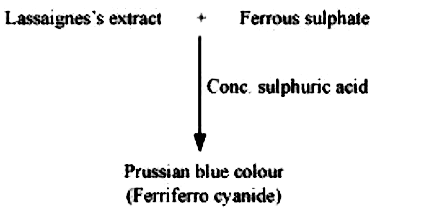
In the Lassaigne’s test for nitrogen in an organic compound, the sodium fusion extract is boiled with iron (II) sulphate and then acidified with sulphuric acid. In the process, sodium cyanide first reacts with iron (II) sulphate and forms sodium hexacyanoferrate (II). Then, on heating with sulphuric acid, some iron (II) gets oxidised to form iron (III) hexacyanoferrate (II), which is Prussian blue in colour. The chemical equations involved in the reaction can be represented as
`6CN^(-)+Fe^(2+)to[Fe(CN)_(6)]^(4-)`
`3[Fe(CN)_(6)]^(4-)+4Fe^(3+)overset(xH_(2)O)tounderset("Prussian blue")(Fe_(4)[Fe(CN)_(6)]_(3).xH_(2)O)`
(b) Test for sulphur
(i) Lassaigne's extract + Lead acetate`overset("acetic acid")to`Black precipitate
Chemistry of the test
In the Lassaigne’s test for sulphur in an organic compound, the sodium fusion extract is acidified with acetic acid and then lead acetate is added to it. The precipitation of lead sulphide, which is black in colour, indicates the presence of sulphur in the compound.
`S^(2-)+Pb^(2+)tounderset(("Black"))(PbS)`
(ii) Lassaigne's extract+ Sodium nitroprusside`to`Violet colour
Chemistry of the test
The sodium fusion extract is treated with sodium nitroprusside. Appearance of violet colour also indicates the presence of sulphur in the compound.
`S^(2-)+[Fe(CN)_(5)NO]^(2-)tounderset("Violet")([Fe(CN)_(5)NOS]^(-4))`
If in an organic compound, both nitrogen and sulphur are present, then instead of NaCN, formation of NaSCN takes place.
Na + C + N + S `to` NaSCN
This NaSCN (sodium thiocyanate) gives a blood red colour. Prussian colour is not formed due to the absence of free cyanide ions.
`Fe^(3+)+SCN^(-)tounderset(("Blood red"))([Fe(SCN)]^(2+))`
(c) Test for halogens

Chemistry of the test
In the Lassaigne’s test for halogens in an organic compound, the sodium fusion extract is acidified with nitric acid and then treated with silver nitrate
`X^(-)+Ag^(+)toAgX`
(X=Cl,Br,I)
If nitrogen and sulphur both are present in the organic compound, then the Lassaigne’s extract is boiled to expel nitrogen and sulphur, which would otherwise interfere in the test for halogens.
Promotional Banner

Topper's Solved these Questions

  • ORGANIC CHEMISTRY- SOME BASIC PRINCIPLES AND TECHNIQUES

    NCERT|Exercise EXERCISE|40 Videos
  • HYDROGEN

    NCERT|Exercise EXERCISE|36 Videos
  • REDOX REACTIONS

    NCERT|Exercise EXERCISE|30 Videos

Similar Questions

Explore conceptually related problems

Which of the following compound will give blood red colour while doing the Lassaigne’s test of sulphur is due to

Nitrogen detection in an organic compound is carried out by Lassaigne’s test. The blue colour formed corresponds to which of the following formulae?

A compound which does not give positive test in the Lassaignes' test for nitrogen is

NCERT-ORGANIC CHEMISTRY- SOME BASIC PRINCIPLES AND TECHNIQUES-EXERCISE
  1. Describe the method, which can be used to separate two compounds with ...

    Text Solution

    |

  2. What is the difference between distillation, distillation under reduce...

    Text Solution

    |

  3. Discuss the chemistry of Lassaigne’s test.

    Text Solution

    |

  4. Differentiate between the principle of estimation of nitrogen in an or...

    Text Solution

    |

  5. Discuss the principle of estimation of halogens, sulphur and phosphoru...

    Text Solution

    |

  6. Explain the principle of paper chromatography.

    Text Solution

    |

  7. Why is nitric acid added to sodium extract before adding silver nitrat...

    Text Solution

    |

  8. Explain the reason for the fusion of an organic compound with metallic...

    Text Solution

    |

  9. Name a suitable technique of the components from a mixture of calcium ...

    Text Solution

    |

  10. Explain why an organic liquid vaporises at a temperature below its boi...

    Text Solution

    |

  11. Will C Cl4 give white precipitate of AgCl on heating with nitrate? Giv...

    Text Solution

    |

  12. Why is solution of potassium hydroxide used to absorb carbon dioxide e...

    Text Solution

    |

  13. Why is it necessary to use acetic acid and not suplhuric acid for the ...

    Text Solution

    |

  14. An organic compound contains 69% carbon and 4.8% hydrogen, the remaind...

    Text Solution

    |

  15. 0.50 gm of an organic compound was treated according to Kjeldahl's meg...

    Text Solution

    |

  16. 0.3080 gm of and organic chloro compound gave 0.5740 gm of siver chlor...

    Text Solution

    |

  17. In the estimation of sulphur by carius method, 0.468 gm of an organic ...

    Text Solution

    |

  18. In the organic compound CH(2) = CH – CH(2) – CH(2) – C equivCH, the pa...

    Text Solution

    |

  19. In the Lassaigne’s test for nitrogen in an organic compound, the Pruss...

    Text Solution

    |

  20. Which of the following carbocation is most stable ? (a) (CH(3))(3)C....

    Text Solution

    |