Home
Class 12
PHYSICS
Two identical blocks each of mass 1kg ar...

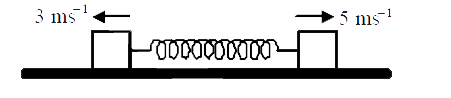
Two identical blocks each of mass 1kg are joined together with a compressed spring. When the system is released the two blocks appear to be moving with unequal speeds in the opposite directions as shown in fig.

Choose the correct statement -

A

It is not possible

B

Whatever may be the speed of the blocks the centre of mass will remain stationary

C

The centre of mass of the system is moving with a velocity of `2ms^(–1)`

D

The centre of mass of the system is moving with a velocity of `1ms^(–1)`

Text Solution

Verified by Experts

The correct Answer is:

D
Promotional Banner

Topper's Solved these Questions

  • CENTRE OF MASS

    MOTION|Exercise Exercise - 2 (Level-II)|28 Videos
  • CENTRE OF MASS

    MOTION|Exercise Exercise - 3 Level-I|34 Videos
  • CENTRE OF MASS

    MOTION|Exercise Exercise - 1|71 Videos
  • Capacitance

    MOTION|Exercise EXERCISE -4 LEVEL II|19 Videos
  • CIRCULAR MOTION

    MOTION|Exercise EXERCISE - 4|16 Videos

Similar Questions

Explore conceptually related problems

Two blocks A and B are joined together with a compressed spring. When the system is released, the two bloks appear to be moving with unequal speeds in the opposite directions as shown in figure. Select incorrect statements(s) :

Two unequal masses are ties together with a cord with a compressed spring in between. Which one is correct?

When two identical balls are moving with equal speed in opposite direction, which of the following is true ? For the system of two bodies.

Two identical blocks A and B of mass m joined together with a massless spring as shown in figure are placed on a smooth surface. If the block A moves with an acceleration a_0 , then the acceleration of the block B is

Two unequal masses are ties together with a cord with a compressed spring in between. When the cord is burnt with a match releasing the spring, the two masses fly apart with equal

Two identical blocks A and B of mass m each are connected to each other by spring of spring constant k. Block B is initially shifted to a small distance x_(0) to the left and then released. Choose the correct statements for this problem, after the spring attains it's natural length.

A system consists of two identical blocks, each of mass m, linked together by the compressed weightless spring of stiffness k, as shown in figure -3.57. The blocks are connected by a thread which is burned through at a certain moment. Find (a) At what values of initial compression, the inital compression of the spring, the lower block will bounce up after the thread has been burned through To what height will the centre of gravity of this system will rise if the initial compression of the spring is 7 mg//k

Two unequal masses are ties together with a cord with a compressed spring in between. Which of the following energies is conserved for the system?

Two blocks each of mass m are joined together using an ideal spring of force constant K and natural length l_(0) . The blocks are touching each other when the system is released from rest on a rough horizontal surface. Both the blocks come to rest simultaneously when the extension in the spring is (l_(0))/4 . The coefficient of friction between each block and the surface (assuming it to be same between any of the blocks and the surface) is :

Two identical blocks each of mass M=9kg are placed on a rough horizontal surface of frictional coefficient mu=0.1 . The two blocks are joined by a light spring and block B is in contact with a vertical fixed wall as shown in figure. A bullet of mass m=1kg and v_0=10m//s hits block A and gets embedded in it. Find the maximum compression of spring. (Spring constant =240N//m, g=10m//s^2 )

MOTION-CENTRE OF MASS-Exercise - 2 (Level-I)
  1. A uniform chain of length 2L is hanging in equilibrium position, if en...

    Text Solution

    |

  2. A straw of length L, mass M lies over a smooth horizontal table with i...

    Text Solution

    |

  3. Two identical blocks each of mass 1kg are joined together with a compr...

    Text Solution

    |

  4. The two blocks A and B of same mass connected to a spring and placed o...

    Text Solution

    |

  5. Two carts (A & B) having spring bumpers collides as shown in figure. I...

    Text Solution

    |

  6. A system consists of two cubes of mass m(1), and m(2) respectively con...

    Text Solution

    |

  7. The diagram shows the velocity - time graph for two masses R and S tha...

    Text Solution

    |

  8. In the figure (i), (ii) & (iii) shown the objects A, B & C are of same...

    Text Solution

    |

  9. Figure shows the velocity-time graph for two masses R and S that colli...

    Text Solution

    |

  10. In a smooth stationary cart of length d, a small block is projected al...

    Text Solution

    |

  11. A ball is projected from ground with a velocity V at an angle theta to...

    Text Solution

    |

  12. In the figure shown, the two identical balls of mass M and radius R ea...

    Text Solution

    |

  13. In the above, suppose that the smaller ball does not stop after collis...

    Text Solution

    |

  14. Which of the following does not hold when two particles of masses m(1)...

    Text Solution

    |

  15. A metal ball hits a wall and does not rebound whereas a rubber ball of...

    Text Solution

    |

  16. Before a rubber ball bounces off from the floor the ball is in contact...

    Text Solution

    |

  17. A ball of 0.1kg strikes a wall at right angle with a speed of 6 m/s an...

    Text Solution

    |

  18. A block of mass m starts from rest and slides down a frictionless semi...

    Text Solution

    |

  19. Two billiard balls undergo a head-on collision. Ball 1 is twice as hea...

    Text Solution

    |

  20. An empty wagon of mass m0 is stationary & is filled with sand at rate ...

    Text Solution

    |
