Home
Class 12
PHYSICS
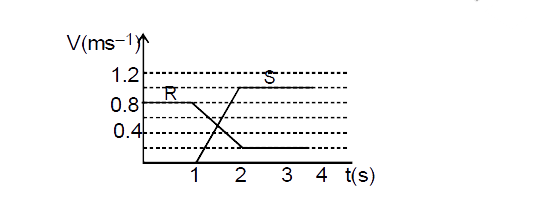
The diagram shows the velocity - time gr...

The diagram shows the velocity - time graph for two masses R and S that collided elastically. Which of the following statements is true ?

I. R and S moved in the same direction after the collision.
II. The velocities of R and S were equal at the mid time of the collision.
III. The mass of R was greater than mass of S.

A

I only

B

II only

C

I and II only

D

I, II and III

Text Solution

Verified by Experts

The correct Answer is:

D
Promotional Banner

Topper's Solved these Questions

  • CENTRE OF MASS

    MOTION|Exercise Exercise - 2 (Level-II)|28 Videos
  • CENTRE OF MASS

    MOTION|Exercise Exercise - 3 Level-I|34 Videos
  • CENTRE OF MASS

    MOTION|Exercise Exercise - 1|71 Videos
  • Capacitance

    MOTION|Exercise EXERCISE -4 LEVEL II|19 Videos
  • CIRCULAR MOTION

    MOTION|Exercise EXERCISE - 4|16 Videos

Similar Questions

Explore conceptually related problems

Figure shows the velocity-time graph for two masses R and S that collided elastically. Which of the following statements is true? i. R and S moved in the same direction after the collision. ii. The velocities of R and S were equal at the mid time of the collision. iii. The mass of R was greater than mass of S . Which of the following is true?

The diagram to the right shows the velocity-time graph for two masses R and S that collided elastically. Which of the following statements is true? [I] R and S moved in the same direction after the collision. [II] Kinetic energy of the system (R & S) is minimum at t=2 milli sec. [III] The mass of R was greater than mass of S .

Two balls of masses m and 2m moving in opposite directions collide head on elastically with velocities v and 2v . Find their velocities after collision.

The car A of mass 1500 kg, travelling at 25 m/s collides with another car B of mass 1000 kg travelling at 15 m/s in the same direction. After collision the velocity of car A becomes 20 m/s. Calculate the velocity of car B after the collision.

A ball of mass M moving with a velocity v collides perfectly inelastically with another ball of same mass but moving with a velocity v in the opposite direction. After collision

Two particles of mass m and 2 m moving in opposite directions collide elastically with velocities v and 2v. Find their velocities after collision.

Two particles of masses m and 2m moving in opposite directions collide elastically with velocity 2v and v , respectiely. Find their velocities after collision.

A body of mass 5 kg makes an elastic collision with another body at rest and continues to move in the original direction after the collision with a velocity equal to 1//10^(th) of its original velocity. The mass of the second body is

The car A of mass 1500kg , travelling at 25m//s collides with another car B of mass 1000kg travelling at 15m//s in the same direction. After collision, the velocity of car A becomes 20m//s . Calcualte the velocity of car B afrer collison.

A ball of mass m moving with velocity v collides elastically with another ball of identical mass coming from the opposite direction with velocity 2v. Their velocities after collisions are-

MOTION-CENTRE OF MASS-Exercise - 2 (Level-I)
  1. Two carts (A & B) having spring bumpers collides as shown in figure. I...

    Text Solution

    |

  2. A system consists of two cubes of mass m(1), and m(2) respectively con...

    Text Solution

    |

  3. The diagram shows the velocity - time graph for two masses R and S tha...

    Text Solution

    |

  4. In the figure (i), (ii) & (iii) shown the objects A, B & C are of same...

    Text Solution

    |

  5. Figure shows the velocity-time graph for two masses R and S that colli...

    Text Solution

    |

  6. In a smooth stationary cart of length d, a small block is projected al...

    Text Solution

    |

  7. A ball is projected from ground with a velocity V at an angle theta to...

    Text Solution

    |

  8. In the figure shown, the two identical balls of mass M and radius R ea...

    Text Solution

    |

  9. In the above, suppose that the smaller ball does not stop after collis...

    Text Solution

    |

  10. Which of the following does not hold when two particles of masses m(1)...

    Text Solution

    |

  11. A metal ball hits a wall and does not rebound whereas a rubber ball of...

    Text Solution

    |

  12. Before a rubber ball bounces off from the floor the ball is in contact...

    Text Solution

    |

  13. A ball of 0.1kg strikes a wall at right angle with a speed of 6 m/s an...

    Text Solution

    |

  14. A block of mass m starts from rest and slides down a frictionless semi...

    Text Solution

    |

  15. Two billiard balls undergo a head-on collision. Ball 1 is twice as hea...

    Text Solution

    |

  16. An empty wagon of mass m0 is stationary & is filled with sand at rate ...

    Text Solution

    |

  17. An empty wagon of mass m0 is stationary & is filled with sand at rate ...

    Text Solution

    |

  18. Find N of ground on chain when chain has fallen through distance x. Li...

    Text Solution

    |

  19. If rocket engine ejects fuel at the rate mu kg/s with relative velocit...

    Text Solution

    |

  20. If rocket engine ejects fuel at the rate mu kg/s with relative velocit...

    Text Solution

    |
