Home
Class 12
CHEMISTRY
The conductivity of sodium Chloride at ...

The conductivity of sodium Chloride at `298K` has been determine at different concentrations and the results are given below `:`
`{:(Concentration(M):,0.001,0.010,0.020,0.050,0.100),(10^(2)xxk(Sm^(-1)):,1.237,11.85,23.15,55.53,1.06.74):}`
Calculate `wedge_(m)` for all concentrations and draw a plot between `wedge_(m)` and `c^(1//2)`. Find the value of `wedge_(m)^(@)`.

Text Solution

Verified by Experts

`(1" S "cm^(-1))/(100" S "m^(-1))=1` (unit convsertion factor)
`^^(@)=` intercept on `^^_(m)"axis"=124.0" S "mol^(-1)`, which is obtained by extrapolation to zero concentration.
Promotional Banner

Topper's Solved these Questions

  • ELECTROCHEMISTRY

    NCERT|Exercise Exercise|33 Videos
  • COORDINATION COMPOUNDS

    NCERT|Exercise Exercise|41 Videos
  • GENERAL PRINCIPLES AND PROCESSESS OF ISOLATION OF ELEMENTS

    NCERT|Exercise Exercise|31 Videos

Similar Questions

Explore conceptually related problems

The molar conductivity of KCl solution at different concentrations at 298 K is given below : {:(c or M (mol L^(-1)),wedge_(m)(Scm^(2)mol^(-1))),(0.000198,148.61),(0.000309,148.29),(0.000521,147.81),(0.000989,147.09):} Show that a plot between wedge_(m) and sqrt(c) is a straight line. Determine the value of wedge_(m)^(@) and A for KCl .

The ratio of degree of dissociation of HCN when concentrations are 0.1 M and 0.001 M respectively will be

The initial rates of reaction 3 A+ 2B +C rarr products at different initial concentration are given below {:("Initial rate, MS"^(-1),|A_(0)|M,|B_(0)|M,|C_(0)|M),(5.0xx10^(-3),0.010,0.005,0.010),(5.0xx10^(-3),0.010,0.005,0.015),(10xx10^(-2),0.010,0.010,0.010),(1.25xx10^(-2),0.005,0.005,0.010):} The order of reaction with respect to the reacts A, B and C are respectively.

NCERT-ELECTROCHEMISTRY-Exercise
  1. Suggest two materials other than hydrogen that can be used as fuels in...

    Text Solution

    |

  2. Explain how rusting of iron is envisaged as setting up of an electroch...

    Text Solution

    |

  3. Arrange the following metals in the order in which they displace each ...

    Text Solution

    |

  4. Given standard electrode potentials K^(o+)|K=-2.93V, Ag^(o+)|Ag=0.80...

    Text Solution

    |

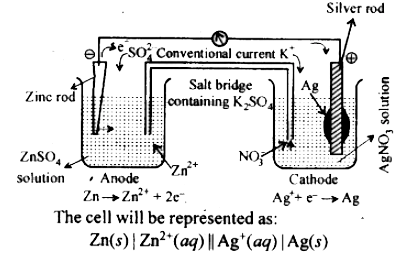
  5. Depict the galvanic cell in which the reaction : Zn(s)+2Ag^(o+)(aq) ...

    Text Solution

    |

  6. Calculate the standard cell potentials of galvanic cell in which the ...

    Text Solution

    |

  7. Write the Nernst equation and EMF of the following cells at 298K : a...

    Text Solution

    |

  8. In the button cells widely used in watches and other devices the follo...

    Text Solution

    |

  9. Define conductivity and molar conductivity for the solution of an ele...

    Text Solution

    |

  10. The conductivity of 0.20M solution of KCl at 298K is 0.0248 S cm^(-1) ...

    Text Solution

    |

  11. The resistance of a conductivity cell contaning 0.001M KCl solution at...

    Text Solution

    |

  12. The conductivity of sodium Chloride at 298K has been determine at di...

    Text Solution

    |

  13. The conductivity of 0.00241 M acetic acid is 7.896xx10^(-5)Scm^(-1). C...

    Text Solution

    |

  14. How much Charge is required for the following reductions : a. 1 "mo...

    Text Solution

    |

  15. How much electricity in terms of Faraday is required to produce. a. ...

    Text Solution

    |

  16. How much electricity is required in coulomb for the oxidation of : (...

    Text Solution

    |

  17. A solution of Ni(NO(3))(2) is electrolyzed between platium electrodes...

    Text Solution

    |

  18. Three electrolytic cell A,B, and C contaning solutions of ZnSO(4), AgN...

    Text Solution

    |

  19. Using the standard electrode potentials given in the electrode potent...

    Text Solution

    |

  20. Predict the products of electrolysis in each of the following : a. A...

    Text Solution

    |

