

Home
Class 12
CHEMISTRY
WERNER’S THEORY OF COORDINATION COMPOUND...

WERNER’S THEORY OF COORDINATION COMPOUNDS

Text Solution

Verified by Experts

The main postulates of Werner's theory of coordination compounds are as follows
(a) Metals possess two type of valencies called
(i) primary valency which are ionisable (ii) secondary valency which are non ionisable
(b) Primary valency is satisfied by the negative ions and it that which a metal exhibits in the formatio of its simple salts
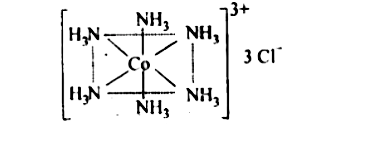
(c) Secondary valence are satisfied by neutral ligand or negative ligand and are those which metal exerciese in the formation of its complex ions. Every cation has a fixed number of secondary valencies which are directed in space about central metal ion in certain fixed directions e.g., in `CoCl_(3)-6NH_(3)` valencies between Co and Cl are primary valencies and valencies between Co and `NH_(3)` are secondary in `COCl_(3)-6NH_(3)` six ammonia molecules linked and thus account for structure of `COCl_(3)-6NH_(3)` as follows in modern theory it is now referred as coordination number of central metal atom or ion.
Promotional Banner

Topper's Solved these Questions

  • COORDINATION COMPOUNDS

    NCERT|Exercise Exercise|41 Videos
  • CHEMISTRY IN EVERYDAY LIFE

    NCERT|Exercise Exercise|32 Videos
  • ELECTROCHEMISTRY

    NCERT|Exercise Exercise|33 Videos

Similar Questions

Explore conceptually related problems

According to werner, the arrangement of 6 groups around the metal centre within the co-ordination sphere can lead to three possible geometries (For Q. 1 and Q. 2) : planar hexagon, trigonal prism and octahedral. For a particular geometry, if the groups (i.e. ligands) are arranged in different ways then the possibility of geometrical isomerism will arise. A complex [PtCl_(2)(NH_(3))_(4)]^(2+) in WERNER 'S universe has a total 3 stereo-isomers possible. If Werner was present, then, according to him, what can be the probable shape of the complex ?

Characteristics OF Catalyst, Theory OF Catalysis || Intermediate Compound Formation Theory || Absorption Theory || Shape Selective Catalysis ||Zeolites|| Enzyme Catalysis

Properties OF Coordination Compounds|| Magnetic moment OF Coordination Compounds|| Stability OF Coordination Compounds

Werner’s Coordination Theory||Crystal Field Theory||Splitting in Octahedral Field and Strength OF Ligands||Filling OF Electrons in Octahedral Field

Bonding in Co-ordination Compounds || Werner’s Co-ordination Theory Concept OF Primary Valency/Secondary Valency || Different test to Distinguish Compounds Formed by Werner

Werner Theory 2

Which of the following are not postulates of Werner? (P) In co-ordination compounds, metals show two types of linkage (valencies) primary and secondary (Q) The primary valencies are normally ionisable. These are satisfied by negative ions. (R) The secondary valency is equal to the co-ordination number and is fixed for a metal (S) The ions/groups bound by the primary and secondary linkages to the metal have characteristic spatial arrangements corresponding to different coordination numbers (T) Octahedral, Tetrahedral and Square planar geometrical shapes are more common in co-ordination compounds of transition metals

Naming OF Bridging Complexes || Werner's Coordination Theory

NCERT-COORDINATION COMPOUNDS-Exercise
  1. Predict the number of unpaired electrons in the square planar [Pt(CN)4...

    Text Solution

    |

  2. The hexaquo manganese(II) ion contains five unpaired electrons, while ...

    Text Solution

    |

  3. WERNER’S THEORY OF COORDINATION COMPOUNDS

    Text Solution

    |

  4. FeSO4 solution mixed with (NH4)2SO4 solution is 1:1 molar ratio gives ...

    Text Solution

    |

  5. Explain with two examples each of the following: coordination entity, ...

    Text Solution

    |

  6. What is meant by unidentate and ambidentate ligands? Give two examples...

    Text Solution

    |

  7. Specify the oxidation numbers of the metals in the following coordinat...

    Text Solution

    |

  8. Using IUPAC norms write the fomulas for the following (i). Tetrahydr...

    Text Solution

    |

  9. Using IUPAC norms write the systematic names of the following: (i). ...

    Text Solution

    |

  10. List various types of isomerism possible for coordination compounds, g...

    Text Solution

    |

  11. How many geometrical isomers are possible in the following corrdinatio...

    Text Solution

    |

  12. Draw the structures of optical isomers of: (i). [Cr(C2O4)3]^(3-) (...

    Text Solution

    |

  13. Draw all the isomers (geometrical and optical) of: (i) [CoCl(2)(en)(...

    Text Solution

    |

  14. Write all the geometrical isomers of [Pt(NH3)(Br)(Cl)(py)] and how man...

    Text Solution

    |

  15. Aqueous copper sulphate solution (blue in colour) gives: (i). A gree...

    Text Solution

    |

  16. What is the coordination entity formed when excess of aqueous KCN is a...

    Text Solution

    |

  17. Discuss the nature of bonding in the following coordination entities o...

    Text Solution

    |

  18. Draw figure to show the splitting of d orbitals in an octahedral cryst...

    Text Solution

    |

  19. What is spectrochemical series? Explain the difference between a weak ...

    Text Solution

    |

  20. What is crystal field splitting energy? How does the magnitude of tria...

    Text Solution

    |