


NCERT-COORDINATION COMPOUNDS-Exercise
- Write all the geometrical isomers of [Pt(NH3)(Br)(Cl)(py)] and how man...
Text Solution
|
- Aqueous copper sulphate solution (blue in colour) gives: (i). A gree...
Text Solution
|
- What is the coordination entity formed when excess of aqueous KCN is a...
Text Solution
|
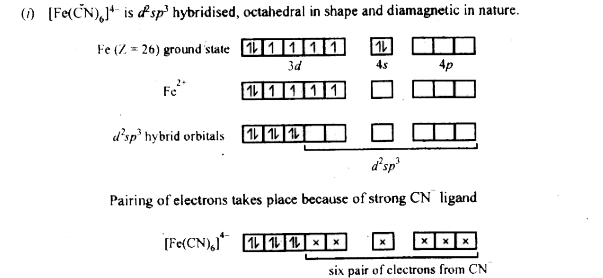
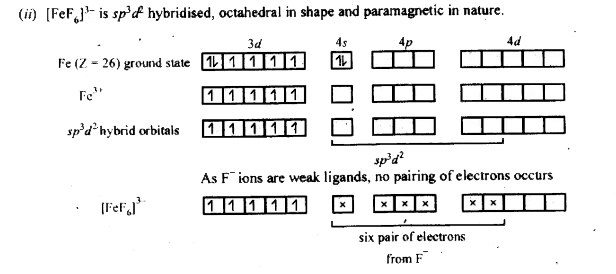
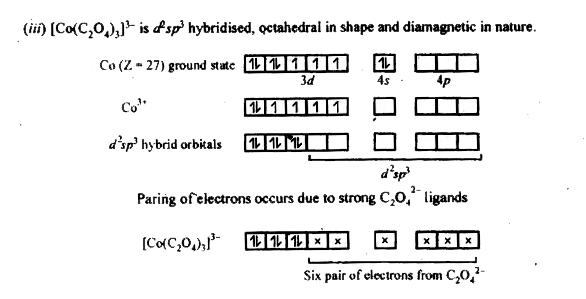
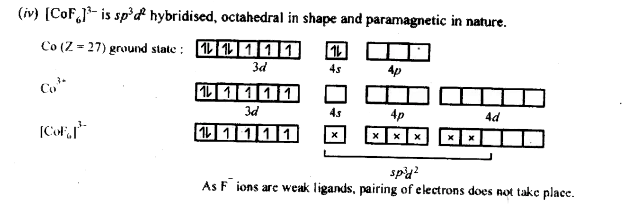
- Discuss the nature of bonding in the following coordination entities o...
Text Solution
|
- Draw figure to show the splitting of d orbitals in an octahedral cryst...
Text Solution
|
- What is spectrochemical series? Explain the difference between a weak ...
Text Solution
|
- What is crystal field splitting energy? How does the magnitude of tria...
Text Solution
|
- [Cr(NH3)6]^(3+) is paramagnetic while [Ni(CN)4]^(2-) is diamagnetic. E...
Text Solution
|
- A solution of [Ni(H(2)O)(6)]^(2+) is green but a solution of [Ni(CN)(4...
Text Solution
|
- [Fe(CN)(6)]^(4-) and [Fe(H(2)O)(6)]^(2+) are of different colours in d...
Text Solution
|
- BONDING IN METAL CARBONYLS
Text Solution
|
- Give the oxidation state, d-orbitals occupation and coordination numbe...
Text Solution
|
- Wrtie down the IUPAC name for each of the following complexes and indi...
Text Solution
|
- Explain the violet colour of the complex [Ti(H(2)O)(6)]^(3+) on the ba...
Text Solution
|
- What is meant by the chelate effect? Give and example.
Text Solution
|
- Discuss briefly giving an example in each case the role of coordinatio...
Text Solution
|
- How many ions are produced from the complex Co(NH3)6Cl2 in solution? ...
Text Solution
|
- Amongst the following ions which one has the highest magnetic moment v...
Text Solution
|
- Among the following, the most stable complex is (i). [Fe(H2O)6]^(3+)...
Text Solution
|
- What will be the correct order for the wavelengths of absorption in th...
Text Solution
|