

Home
Class 12
CHEMISTRY
[Cr(NH3)6]^(3+) is paramagnetic while [N...

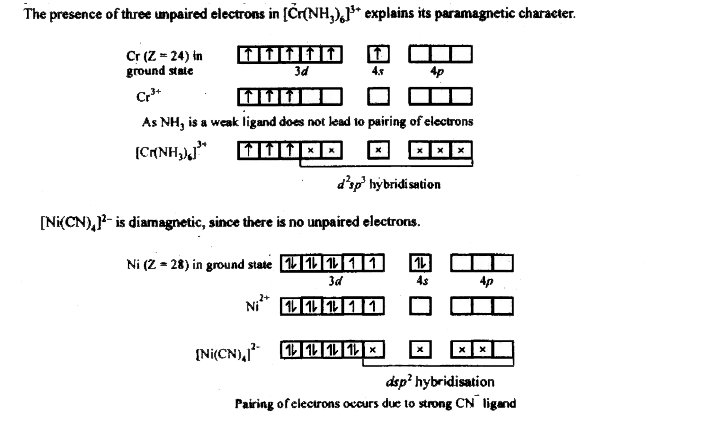
`[Cr(NH_3)_6]^(3+)` is paramagnetic while `[Ni(CN)_4]^(2-)` is diamagnetic. Explain why?

Text Solution

Verified by Experts

The presence of three electron in `[Cr(NH_(3))_(6)]^(3+)` explains its paramagnetic character

`[Ni(CN)_(4)]^(2-)` is diamagnetic since there is no unpaired electrons.
Promotional Banner

Topper's Solved these Questions

  • COORDINATION COMPOUNDS

    NCERT|Exercise Exercise|41 Videos
  • CHEMISTRY IN EVERYDAY LIFE

    NCERT|Exercise Exercise|32 Videos
  • ELECTROCHEMISTRY

    NCERT|Exercise Exercise|33 Videos

Similar Questions

Explore conceptually related problems

Account for the fact that [Fe(CN)_6]^(3-) is weakly paramagnetic while [Fe(CN)_6]^(2+) is diamagnetic.

(i) Write the geometrical isomer of the complex [Co(en)_(2)Cl_(2)]^(+) . (ii) [NiCl_(4)]^(2-) is paramagnetic while [Ni(CN)_(4)]^(2-) is diamagnetic through both are tetrahedral . Why ?

How will you account for the following : (i) [Fe(CN)_6]^(-) is weakly paramagnetic while [Ni(CN)_4]^(2+) diamagnetic. (ii) [Ni(CO)_4] possess tetrahedral geometry while [Ni(CN)_4]^(2-) is square planar.

[Ni(CN)_(4)]^(2-) is diamagnetic while [Cr(NH_(3))_(6)]^(3+) is paramagnetic. Explain.

(a) What type of isomerism is shown by the complex [Co(NH_(3))_(5)(SCN)]^(2+) ? (b) why is [NiCl_(4)]^(2-) paramagnetic while [Ni(CN)_(4)]^(2-) is diamagnetic ? (Atomic number of Ni=28) (c) Why are low spin tetrahedral complexes rarely observed?

Give reason for the statement [Ni(CN)_(4)]^(2-) is diamagnetic while [NiCl_(4)]^(2-) is paramagnetic in nature .

[Fe(H_2O)_6]^(3+) is strongly paramagnetic whereas [Fe(CN)_6]^(3-) is weakly paramagnetic. Explain.

NCERT-COORDINATION COMPOUNDS-Exercise
  1. Write all the geometrical isomers of [Pt(NH3)(Br)(Cl)(py)] and how man...

    Text Solution

    |

  2. Aqueous copper sulphate solution (blue in colour) gives: (i). A gree...

    Text Solution

    |

  3. What is the coordination entity formed when excess of aqueous KCN is a...

    Text Solution

    |

  4. Discuss the nature of bonding in the following coordination entities o...

    Text Solution

    |

  5. Draw figure to show the splitting of d orbitals in an octahedral cryst...

    Text Solution

    |

  6. What is spectrochemical series? Explain the difference between a weak ...

    Text Solution

    |

  7. What is crystal field splitting energy? How does the magnitude of tria...

    Text Solution

    |

  8. [Cr(NH3)6]^(3+) is paramagnetic while [Ni(CN)4]^(2-) is diamagnetic. E...

    Text Solution

    |

  9. A solution of [Ni(H(2)O)(6)]^(2+) is green but a solution of [Ni(CN)(4...

    Text Solution

    |

  10. [Fe(CN)(6)]^(4-) and [Fe(H(2)O)(6)]^(2+) are of different colours in d...

    Text Solution

    |

  11. BONDING IN METAL CARBONYLS

    Text Solution

    |

  12. Give the oxidation state, d-orbitals occupation and coordination numbe...

    Text Solution

    |

  13. Wrtie down the IUPAC name for each of the following complexes and indi...

    Text Solution

    |

  14. Explain the violet colour of the complex [Ti(H(2)O)(6)]^(3+) on the ba...

    Text Solution

    |

  15. What is meant by the chelate effect? Give and example.

    Text Solution

    |

  16. Discuss briefly giving an example in each case the role of coordinatio...

    Text Solution

    |

  17. How many ions are produced from the complex Co(NH3)6Cl2 in solution? ...

    Text Solution

    |

  18. Amongst the following ions which one has the highest magnetic moment v...

    Text Solution

    |

  19. Among the following, the most stable complex is (i). [Fe(H2O)6]^(3+)...

    Text Solution

    |

  20. What will be the correct order for the wavelengths of absorption in th...

    Text Solution

    |