Home
Class 12
CHEMISTRY
Phosgene is a poisonous gas that dissoci...

Phosgene is a poisonous gas that dissociates at high temperature into two other poisonous gases, carbon monoxide and chlorine. The equilibrium constant `K_(p)`= 0.0041 atm at 600K. Find the equilibrium composition of the system after 0.124 atm of `COCl_(2)` initially is allowed to reach equilibrium at this temperature.

Text Solution

Verified by Experts
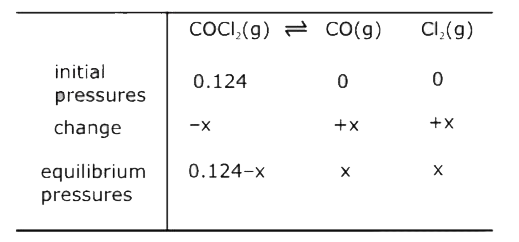

Substitution of the equilibrium pressures into the equilibrium expression gives
`(x^(2))/(0.124-x)=0.0041`
This expression can be rearranged into standard polynomial form `x^(2)+0041x–0.00054=0` and solved by the quadratic formula, but we will simply obtain an approximate solution by iteration.
Because the equilibrium constant is small, we know that x will be rather small compared to 0.124, so the above relation can be approximated by
`(x^(2))/(0.124)=0.0041`
which gives x=0.025. To see how good this is, substitute this value of x into the denominator of the original equation and solve again:
`(x^(2))/(0.124-0.0225)=(x^(2))/(0.102)=0.0041`
This time, solving for x gives 0.0204. Iterating once more, we get
`(x^(2))/(0.124-0.0204)=(x^(2))/(0.104)=0.0041`
and x = 0.0206 which is sufficiently close to the previous to be considered the final result. The final partial pressures are then 0.104 atm for `COCl_(2)`, and 0.0206 atm each for CO and `Cl_(2)`.
Note:
Using the quadratic formula to find the exact solution yields the two roots –0.0247 (which we ignore) and 0.0206, which show that our approximation is quite good. Note: using the quadraticformula to find the exact solution yields the two roots –0.0247 (which we ignore) and 0.0206, which show that our approximation is quite good.
Promotional Banner

Topper's Solved these Questions

  • CHEMICAL EQUILIBRIUM

    MOTION|Exercise SOLVED EXAMPLES|10 Videos
  • CHEMICAL EQUILIBRIUM

    MOTION|Exercise Exercise - 1|45 Videos
  • CHEMICAL BONDING

    MOTION|Exercise EXERCISE -4 LEVEL-II|40 Videos
  • Chemical Kinetics

    MOTION|Exercise Exercise - 4 (Level - II) (SUBJECTIVE PROBLEM)|1 Videos

Similar Questions

Explore conceptually related problems

Consider the following heterogeneous equilibrium, CaCO_(3)(s)CaO(s)+CO_(2)(g) . At 800^(@)C , the pressure of CO_(2) is 0.236 atm. The value of K_(c) for the abvoe given equilibrium reaction at this temperature is

At a certain temperture in a 5L vessel 2 moles of carbon monoxide and 3 moles of chlorine were allowed to reach equilibrium according to the reaction CO+CI_(2) rarr COCI_(2) at equlibrium if one mole of CO is present then equilibrium constant (k_(c )) for the reaction is :

For the dissociation reaction N_(2)OhArr2NO_(2)(g), the equilibrium constant K_(P) is 0.120 atm at 298 K and total pressure of system is 2 atm. Calculate the degree of dissociation of N_(2)O_(4) .

If for the heterogeneous equilibrium CaCO_3(s) hArr CaO(s) +CO_2(g) , the equilibrium constant K_c=1 , at 1 atm what would be the temperature of the reaction?

A vessel at 1000 K contains carbon dioxide with a pressure of 0.5 atm . Some of the carbon dioxide is converted to carbon monoxide on addition of graphite. Calculate the value of K_(p) if total pressure at equilibrium is 0.8 atm .

For the reaction N_(2)O_(4)(g)hArr2NO_(2)(g) , the degree of dissociation at equilibrium is 0.2 at 1 atm pressure. The equilibrium constant K_(p) will be

MOTION-CHEMICAL EQUILIBRIUM-Exercise - 4
  1. Phosgene is a poisonous gas that dissociates at high temperature into ...

    Text Solution

    |

  2. For the reaction, 2NO(2(g))hArr2NO((g)) + O(2(g)) K(c) = 1.0xx10^(-6) ...

    Text Solution

    |

  3. The exothermic formation of ClF(3) is represented by thr equation: C...

    Text Solution

    |

  4. A schematic plot of ln K(eq) versus inverse of temperature for a react...

    Text Solution

    |

  5. An amount of solid NH4HS is placed in a flask already containing ammon...

    Text Solution

    |

  6. Phosphorus pentachloride dissociates as follows, ina closed reaction v...

    Text Solution

    |

  7. The equilibrium constant for the given reaction: SO(3(g))hArrSO(2(g)...

    Text Solution

    |

  8. For the following three reaction 1, 2 and 3, equilibrium constants are...

    Text Solution

    |

  9. The equilibrium constant K(p(1)) and K(p(2)) for the reactions XhArr2Y...

    Text Solution

    |

  10. A vessel at 1000 K contains carbon dioxide with a pressure of 0.5 atm....

    Text Solution

    |

  11. The equilibrium constant for the reaction N(2)(g)+O(2)(g) hArr 2NO(g...

    Text Solution

    |

  12. For the reaction, SO(2)(g)+1/2O(2)(g)hArrSO(3)(g) if K(p)=K(C)(RT)^(x)...

    Text Solution

    |

  13. The standard Gibbs energy change at 300K for the reaction 2AhArrB+C is...

    Text Solution

    |

  14. The equilibrium constant at 298K for a reaction, A+BhArrC+D is 100. If...

    Text Solution

    |

  15. Which of the following lines correctly show the temperature dependence...

    Text Solution

    |

  16. If Ag^(+)+NH(3)hArr[Ag(NH(3))]^(+), K(1)=3.5xx10^(-3) and [Ag(NH(3))]^...

    Text Solution

    |

  17. The thermal dissociation of equilibrium of CaCo(3)(s) is studied under...

    Text Solution

    |

  18. For the reaction, SO(2)(g)+1/2O(2)(g)hArrSO(3)(g) if K(p)=K(C)(RT)^(x)...

    Text Solution

    |

  19. The % yield of ammonia as a function of time in the reaction N(2)(g) +...

    Text Solution

    |

  20. Thermal decomposition of gaseous X(2) to gaseous X at 298 K takes plac...

    Text Solution

    |

  21. Thermal decomposition of gaseous X(2) to gaseous X at 298 K takes plac...

    Text Solution

    |

