Home
Class 12
CHEMISTRY
The progress of the reaction AhArrnB wit...

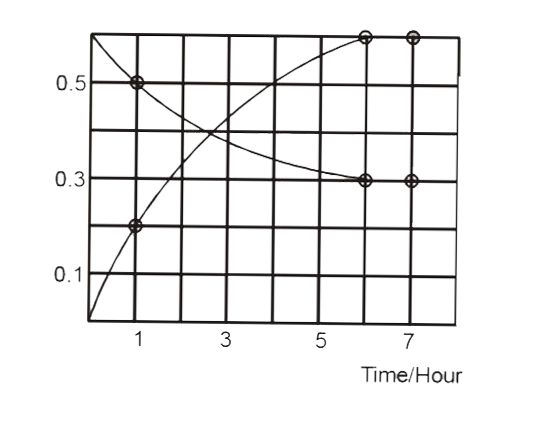
The progress of the reaction `AhArrnB` with time, is presented in figure. Determine

the equilibrium constant K.

Text Solution

Verified by Experts

The correct Answer is:

1.2 mol/L
Promotional Banner

Topper's Solved these Questions

  • CHEMICAL EQUILIBRIUM

    MOTION|Exercise Exercise - 4|20 Videos
  • CHEMICAL EQUILIBRIUM

    MOTION|Exercise Exercise - 2|99 Videos
  • CHEMICAL BONDING

    MOTION|Exercise EXERCISE -4 LEVEL-II|40 Videos
  • Chemical Kinetics

    MOTION|Exercise Exercise - 4 (Level - II) (SUBJECTIVE PROBLEM)|1 Videos

Similar Questions

Explore conceptually related problems

The progress of the reaction AhArrnB with time, is presented in figure. Determine the value of n.

The progress of the reaction AhArrnB with time, is presented in figure. Determine the initial rate of conversion of A.

The progress of the reaction A hArr nB , with times is presented in the figure below. Determine: (a) The value of n , (b) K_(eq) ( c) Initial rate of converison of A

The progress of the reaction, A ⇌ nB with time, is presented in figure given below. Determine. (i) The value of n, (ii) The equilibrium constant K, and (iii) the initial rate of conversion of A.

The progress of the reaction A hArr nB with time is persented in the figure given below: Determine a. The value of n. b. The equilibrium constant K. c. The initial rate of concentration of A.

For a system in equilibrium, the rate constant for the forward reaction is represented by K_f and the rate constant for the reverse reaction is represented by K_r .Which equation represents the equilibrium constant for this reaction in the forward direction ?

For a reversible exothermic reaction , which is the effect of increasing temperature on the equilibrium constant (k_("eq")) and on the forward rate constant (k_(f)) ?

In an equilibrium reaction for which Delta G^(@) = 0 , the equilibrium constant K =

The unit for the equilibrium constant of the reaction

MOTION-CHEMICAL EQUILIBRIUM-Exercise - 3
  1. Consider the reaction of chloromethane with OH^(-) in aqueous solution...

    Text Solution

    |

  2. The progress of the reaction AhArrnB with time, is presented in figure...

    Text Solution

    |

  3. The progress of the reaction AhArrnB with time, is presented in figure...

    Text Solution

    |

  4. The progress of the reaction AhArrnB with time, is presented in figure...

    Text Solution

    |

  5. If K(c) = 7.5 ×x 10^(-9) at 1000 k for the reaction N(2)(g) + O(2)(g)h...

    Text Solution

    |

  6. The degree of dissociation of N(2)O(4) into NO(2) at 1 atm 40^(@)C is ...

    Text Solution

    |

  7. At 46° C Kp for the reaction N(2)O(4) (g)hArr 2NO(2)(g) is 0.667 atm. ...

    Text Solution

    |

  8. At some temperature and under a pressure of 4 atm, PCl(5) is 10% disso...

    Text Solution

    |

  9. In a mixture of N(2) and H(2) in the ratio 1:3 at 30 atm and 300^(@)C,...

    Text Solution

    |

  10. The system N(2)O(4)hArr 2 NO(2) maintained in a closed vessel at 60° C...

    Text Solution

    |

  11. The vapour density of N(2)O(4) at a certain temperature is 30. Calcula...

    Text Solution

    |

  12. In the esterfication C(2)H(5)OH(1) + CH(3)COOH(1)hArrCH(3)COOC(2)H(5)(...

    Text Solution

    |

  13. 20.0 grams of CaCO(3)(s) were placed in a closed vessel, heated & main...

    Text Solution

    |

  14. An equilibrium mixture of PCl(5), PCl(3) and Cl(2) at a certain temper...

    Text Solution

    |

  15. A sample of HI (9.30 x× 10^(-3) mol) was placed in an empty 2.00 L con...

    Text Solution

    |

  16. The equilibrium constant for the reaction A((g))+2B((g)) rarr C((g)) i...

    Text Solution

    |

  17. The initial concentrations or pressure of reactants and products are g...

    Text Solution

    |

  18. The initial concentrations or pressure of reactants and products are g...

    Text Solution

    |

  19. The initial concentrations or pressure of reactants and products are g...

    Text Solution

    |

  20. The initial concentrations or pressure of reactants and products are g...

    Text Solution

    |
