Home
Class 12
PHYSICS
A uniform rod of mass m and length l c...

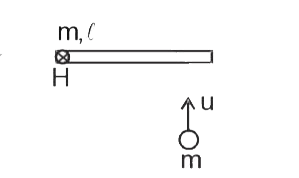
A uniform rod of mass m and length l can rotate freely on a smooth horizontal plane about a vertical axis hinged at point H. A point mass having same mass m coming with an initial speed u perpendicular to the rod, strikes the rod in-elastically at its free end. Find out the angular velocity of the rod just after collision?

Text Solution

Verified by Experts

Angular momentum is conserved about H because no external force is present in horizontal plane which is producing torque about H.
`mul =((ml^(2))/(3)+ml^(2))omega rArr w=(3u)/(4l)`
Promotional Banner

Topper's Solved these Questions

  • ROTATIONAL MOTION

    MOTION|Exercise Exercise - 1|90 Videos
  • ROTATIONAL MOTION

    MOTION|Exercise Exercise - 2|40 Videos
  • RAY OPTICS

    MOTION|Exercise Exercise-4|38 Videos
  • SEMI CONDUCTOR AND LOGIC GATES

    MOTION|Exercise EXERCISE 3|34 Videos

Similar Questions

Explore conceptually related problems

A uniform rod of mass m and length l can rotate freely on a smooth horizontal plane about a vertical axis hinged at point H. A point mass having same mass m coming with an initial speed u perpendicular to the rod, strikes the rod and sticks to it at a distance of (3l)/4 from hinge point. Theangular velocity of the rod just after collision is (36u)/(nl) . Find the value of n.

A uniform rod of mass M and length l is placed on a smooth- horizontal surface with its one end pivoted to the surface. A small ball of mass m moving along the surface with a velocity v_(0) , perpendicular to the rod, collides elastically with the free end of the rod. Find: a. the angular velocity of the rod after collision. b. the impulse applied by the pivot on the rod during collision. (Take M//m = 2 )

A rod of mass 12 m and length l lying on a smooth horizontal plane can rotate freely about a stationary, vertical axis passing through the rod's end. A particle of mass m moving along the plane with speed v_(0) hits the rod's end perpendicularly and gets stuck there. Find the angular velocity of the system.

A uniform rod of mass M and length a lies on a smooth horizontal plane. A particle of mass m moving at a speed v perpendicular to the length of the rod strikes it at a distance a/4 from the centre and stops after the collision. Find a. the velocity of the cente of the rod and b. the angular velocity of the rod abut its centre just after the collision.

A uniform rod of mass m and length l can rotate in a vertical plane abota smooth horizontal axis hinged at point H . Find the force exerted by the hinge just after rod is released from rest, from initial horizontal position?

A uniform rod of mass m and length l rotates in a horizontal plane with an angular velocity omega about a vertical axis passing through one end. The tension in the rod at a distance x from the axis is

A uniform rod of mass M and length L lies on a frictionless horizontal plane. A particle of same mass M moving with speed v_(0) perpendicular to the length of the rod strikes the end of the rod and sticks to it. Find the velocity of the center of mass and the angular velocity about the center of mass of (rod + particle) system.

A uniform rod of mass M and length L lies on a smooth horizontal plane. A particle of mass m moving at a speed v perpendicular to the length of the rod strikes it at a distance L//6 from the center and stops after the collision. Find (a) the velocity of center of mass of rod and (b) the angular velocity of the rod about its center just after collision.

A uniform rod AB of mass 3m and length 2l is lying at rest on a smooth horizontal table with a smooth vertical axis through the end A. A particle of mass 2m moves with speed 2u across the table and strikes the rod at its mid-point C if the impact is perfectly elastic. Find the speed of the particle after impact if (a). It strikes rod normally, (b). Its path before impact was inclinded at 60^(@) to AC.

MOTION-ROTATIONAL MOTION -Exercise - 3 ( Section-B )
  1. A uniform rod of mass m and length l can rotate freely on a smooth h...

    Text Solution

    |

  2. A 'T' shaped object with dimensions shown in the figure, is lying on a...

    Text Solution

    |

  3. The moment of inertia of a uniform semicircular disc of mass M and rad...

    Text Solution

    |

  4. A thin circular ring of mass m and radius R is rotating about its axis...

    Text Solution

    |

  5. Four point masses, each of value m, are placed at the corners of a squ...

    Text Solution

    |

  6. A coin is placed on a horizontal platform which undergoes vertical sim...

    Text Solution

    |

  7. A force of - F hat k on O, the origin of the coordinate system. The to...

    Text Solution

    |

  8. Angular momentum of the particle rotating with a central force is con...

    Text Solution

    |

  9. A round uniform body of radius R, mass M and moment of inertia 'I' rol...

    Text Solution

    |

  10. For the given uniform square lamina ABCD, whose centre is O

    Text Solution

    |

  11. A circular disc of radius R is removed from a bigger circular disc of ...

    Text Solution

    |

  12. Consider a uniform square plate of side 'a' and mass 'm'. The moment o...

    Text Solution

    |

  13. A thin uniform rod of length l and mass m is swinging freely about a h...

    Text Solution

    |

  14. A pulley os radius 2m is rotated about its axis by a force F= (20 t- ...

    Text Solution

    |

  15. A thin horizontal circular disc is roating about a vertical axis passi...

    Text Solution

    |

  16. A hoop of radius r and mass m rotating with an angular velocity omega0...

    Text Solution

    |

  17. A bob of mass m attached to an inextensible string of length I is susp...

    Text Solution

    |

  18. A mass 'm' is supported by a massless string wound around a uniform ho...

    Text Solution

    |

  19. A block of mass is placed on a surface with a vertical cross section g...

    Text Solution

    |

  20. From a solid sphere of M and radius R a cube of maximum possible volu...

    Text Solution

    |

  21. A roller is made by joining together two cones at their vertices O, ti...

    Text Solution

    |
