Home
Class 12
PHYSICS
Two wheels A and B are placed coaxially....

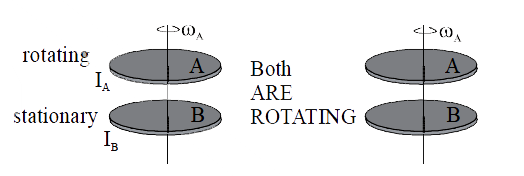
Two wheels A and B are placed coaxially. A has moment of inertia `I_(A)` and angular velocity `omega_(A)` while B is stationary. On clubbing them a clutch they move jointly by an angular velcoity `'omega'` then find the M.I of 'B'

Text Solution

Verified by Experts

The phenomenon occurs in the absense of enternal torque, so applying law of COAM, we have
`because I_(A)omega_(A)=(I_(A)+_(B))omega rArr I_(B)=(I_(A)omega_(A)-I_(A)omega)/(omega)`
`=I_(A)((omega_(A))/(omega)-1)`
Promotional Banner

Topper's Solved these Questions

  • ROTATIONAL MOTION

    MOTION|Exercise Exercise - 1|90 Videos
  • ROTATIONAL MOTION

    MOTION|Exercise Exercise - 2|40 Videos
  • RAY OPTICS

    MOTION|Exercise Exercise-4|38 Videos
  • SEMI CONDUCTOR AND LOGIC GATES

    MOTION|Exercise EXERCISE 3|34 Videos

Similar Questions

Explore conceptually related problems

The angular momentum of a body with mass (m) moment of inertia (I) and angular velocity (omega)" rad"//s is equal to

The moment of inertia of a body moving with angular velocity omega decreases from l to (l)/(3) without any external torque. Calculate the new angular velocity of the body.

The relation between the torque tau and angular momentum L of a body of moment of inertia I rotating with angular velocity omega is

A uniform circular disc of radius R is rotating about its own axis with moment of inertia I at an angular velocity omega if a denser particle of mass m is gently attached to the rim of disc than its angular velocity is

Two discs A and B are mounted coaxiallay on a vertical axle. The discs have moments of inertia I and 2 I respectively about the common axis. Disc A is imparted an initial angular velocity 2 omega using the entire potential energy of a spring compressed by a distance x_1 Disc B is imparted an angular velocity omega by a spring having the same spring constant and compressed by a distance x_2 Both the discs rotate in the clockwise direction. The loss of kinetic energy in the above process is

Two discs A and B are mounted coaxiallay on a vertical axle. The discs have moments of inertia I and 2 I respectively about the common axis. Disc A is imparted an initial angular velocity 2 omega using the entire potential energy of a spring compressed by a distance x_1 Disc B is imparted an angular velocity omega by a spring having the same spring constant and compressed by a distance x_2 Both the discs rotate in the clockwise direction. The ratio x_1//x_2 is

Two discs A and B are mounted coaxially ona vertical axle. The discs have moments of inertia l and 2l respectively about the common axis. Disc A is imparted an initial angular velocity 2 omega using the centre potential energy of a spring compressed by a distance x_(1) . Disc B is imparted angular velocity omega by a spring having the same spring constant and compressed by a distance x_(2) . Both the disc rotate in the clockwise direction. The loss of kinetic energy the above process is -

Two discs A and B are mounted coaxially ona vertical axle. The discs have moments of inertia l and 2l respectively about the common axis. Disc A is imparted an initial angular velocity 2 omega using the centre potential energy of a spring compressed by a distance x_(1) . Disc B is imparted angular velocity omega by a spring having the same spring constant and compressed by a distance x_(2) . Both the disc rotate in the clockwise direction. The rotation x_(1)//(x_(2) is.

Two discs A and B are mounted coaxiallay on a vertical axle. The discs have moments of inertia I and 2 I respectively about the common axis. Disc A is imparted an initial angular velocity 2 omega using the entire potential energy of a spring compressed by a distance x_1 Disc B is imparted an angular velocity omega by a spring having the same spring constant and compressed by a distance x_2 Both the discs rotate in the clockwise direction. When disc B is brought in contact with disc A, they acquire a common angular velocity in time t. The average frictional torque on one disc by the other during this period is

MOTION-ROTATIONAL MOTION -Exercise - 3 ( Section-B )
  1. Two wheels A and B are placed coaxially. A has moment of inertia I(A) ...

    Text Solution

    |

  2. A 'T' shaped object with dimensions shown in the figure, is lying on a...

    Text Solution

    |

  3. The moment of inertia of a uniform semicircular disc of mass M and rad...

    Text Solution

    |

  4. A thin circular ring of mass m and radius R is rotating about its axis...

    Text Solution

    |

  5. Four point masses, each of value m, are placed at the corners of a squ...

    Text Solution

    |

  6. A coin is placed on a horizontal platform which undergoes vertical sim...

    Text Solution

    |

  7. A force of - F hat k on O, the origin of the coordinate system. The to...

    Text Solution

    |

  8. Angular momentum of the particle rotating with a central force is con...

    Text Solution

    |

  9. A round uniform body of radius R, mass M and moment of inertia 'I' rol...

    Text Solution

    |

  10. For the given uniform square lamina ABCD, whose centre is O

    Text Solution

    |

  11. A circular disc of radius R is removed from a bigger circular disc of ...

    Text Solution

    |

  12. Consider a uniform square plate of side 'a' and mass 'm'. The moment o...

    Text Solution

    |

  13. A thin uniform rod of length l and mass m is swinging freely about a h...

    Text Solution

    |

  14. A pulley os radius 2m is rotated about its axis by a force F= (20 t- ...

    Text Solution

    |

  15. A thin horizontal circular disc is roating about a vertical axis passi...

    Text Solution

    |

  16. A hoop of radius r and mass m rotating with an angular velocity omega0...

    Text Solution

    |

  17. A bob of mass m attached to an inextensible string of length I is susp...

    Text Solution

    |

  18. A mass 'm' is supported by a massless string wound around a uniform ho...

    Text Solution

    |

  19. A block of mass is placed on a surface with a vertical cross section g...

    Text Solution

    |

  20. From a solid sphere of M and radius R a cube of maximum possible volu...

    Text Solution

    |

  21. A roller is made by joining together two cones at their vertices O, ti...

    Text Solution

    |
