Home
Class 11
PHYSICS
Consider a point object of mass 'm' movi...

Consider a point object of mass 'm' moving in a circle of radius a=1m. For any instantaneous position of the object, `theta` is the angle that the radial line joining the object and the centre makes with the position X-axis of a cartesian coordinate system with the centre of circle O as the origin. `hati` and `hatj` are unit vectors along X- axis and Y-axis, respectively . Suppose that the motion is a 'Unifrom Circular Motion ' with a constant angular speed `(pi)/(36) rad//sec` and that the sense of rotation is counterclockwise with ` theta = 0 at t = 0` . For an object which moves in a circle , it is usually convenient to introduce two mutually perpendicular unit vectors `hatr_(r)` and `hatr_(t)`, as shown in the fig 3.57. Here `hatr_(r)` is the radial unit vector and `hatr_(t)` , the tangential unit vector.
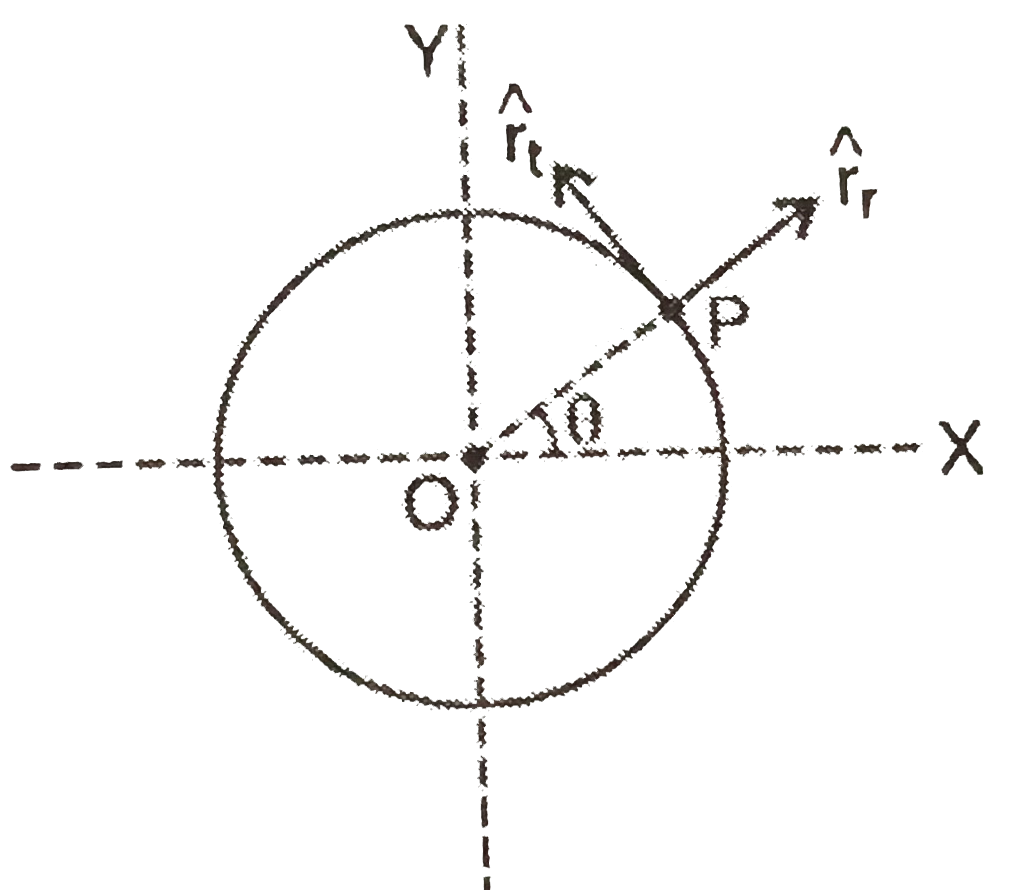
Answer the following questions :
In trems of `hatr_(r), hatr_(t)` and `theta, hati` can be expressed as :
Text Solution

Verified by Experts

The correct Answer is:
A


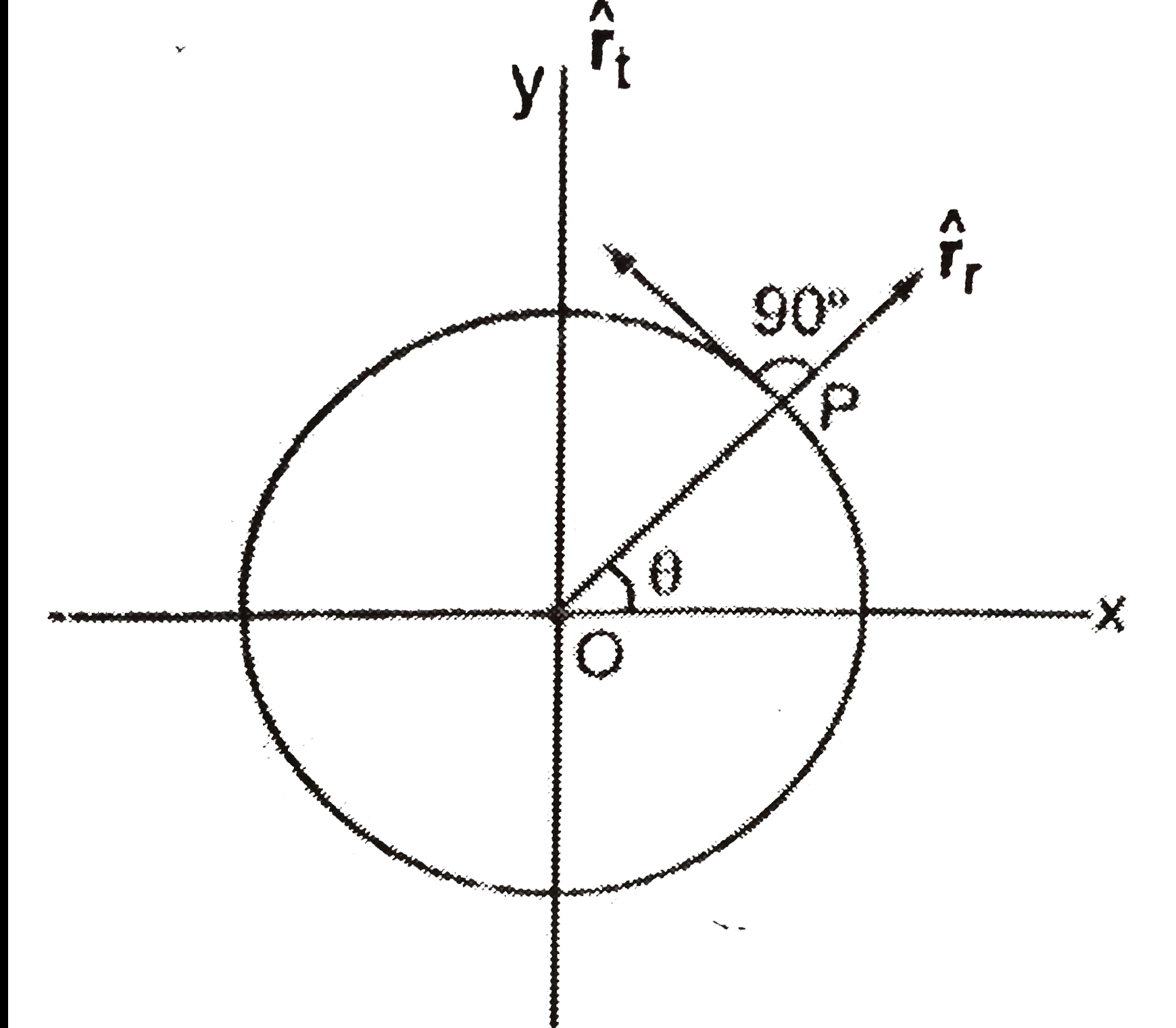
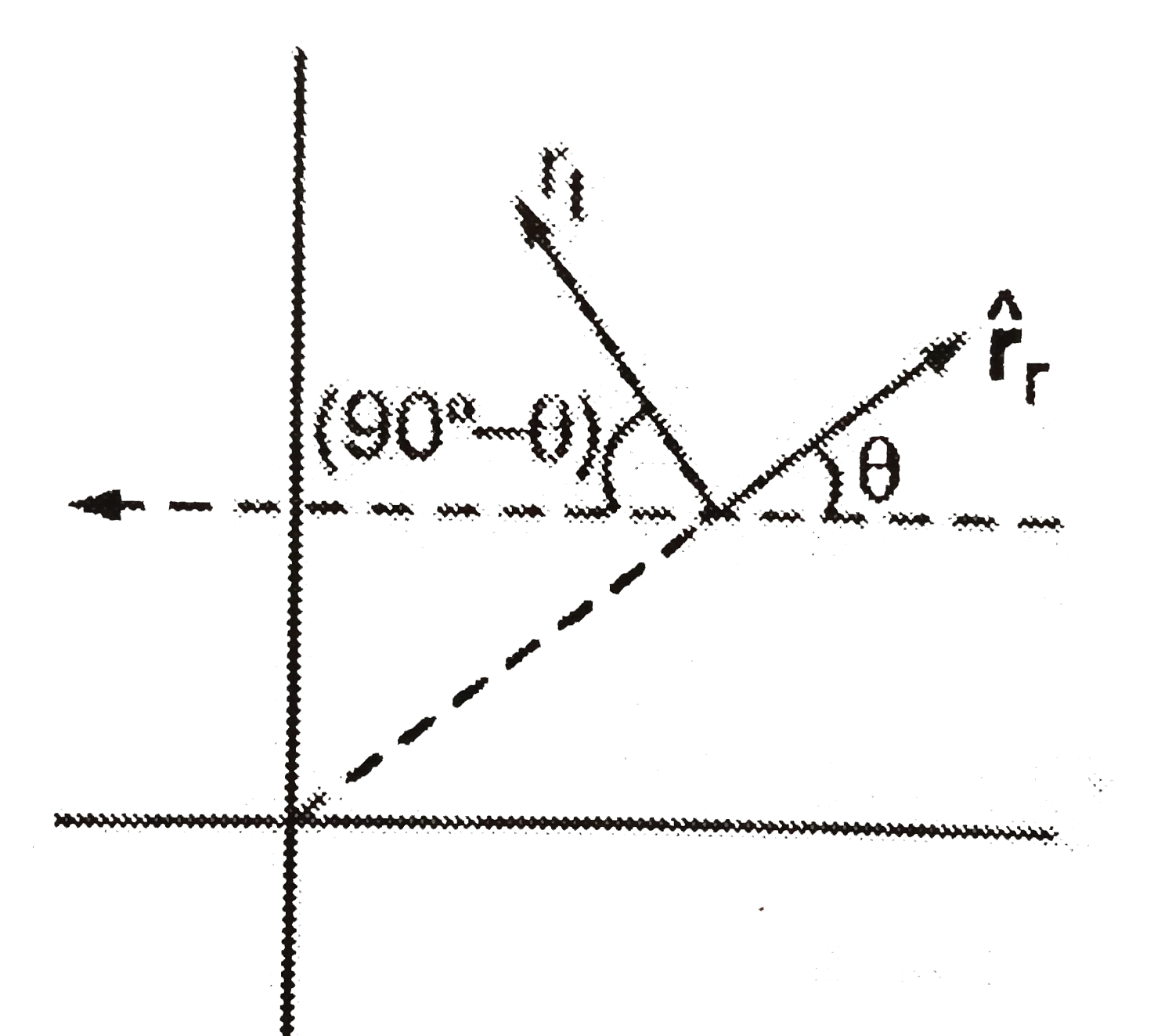
`hati = vecr_(r) cos theta +[-vecr_(t) cos(90^(@) -theta)]`
( direction of `vecr_(t)` component is opposite to `vecr_(r)` )
`hati = vecr_(r) cos theta -vecr_(t) sin-theta`
Promotional Banner

Topper's Solved these Questions

  • VECTORS

    GRB PUBLICATION|Exercise PASSAGE -3|3 Videos
  • VECTORS

    GRB PUBLICATION|Exercise PASSAGE -1|3 Videos
  • UNITS AND DIMENSIONS

    GRB PUBLICATION|Exercise Link Compression|6 Videos

Similar Questions

Explore conceptually related problems

Consider a point object of mass 'm' moving in a circle of radius a=1m. For any instantaneous position of the object, theta is the angle that the radial line joining the object and the centre makes with the position X-axis of a cartesian coordinate system with the centre of circle O as the origin. hati and hatj are unit vectors along X- axis and Y-axis, respectively . Suppose that the motion is a 'Unifrom Circular Motion ' with a constant angular speed (pi)/(36) rad//sec and that the sense of rotation is counterclockwise with theta = 0 at t = 0 . For an object which moves in a circle , it is usually convenient to introduce two mutually perpendicular unit vectors hatr_(r) and hatr_(t) , as shown in the fig 3.57. Here hatr_(r) is the radial unit vector and hatr_(t) , the tangential unit vector. Answer the following questions : For any position of the objected P, the tangential unit vector can be expressed as :

Will the displacement of an object change on shifting the position of origin of the coordinate system ?

An object of mass 50 kg is moving in a horizontal circle of radius 8 m . If the centripetal force is 40 N, then the kinetic energy of an object will be

An object of mass 5 kg is acted upon by a force that varies with position of the object as shown. If the object starts out from rest at a point x=0. What is its speed at x=50 m.

An object of mass 15kg is moving with a uniform velocity of 4m/s. what is the kinetic energy possessed by the object ?

An object of mass m is moving with a constant velocity upsilon How much work should be done on the object in order to bring the object to rest ?

The position-time graph of an object moving in a straight line is shown below. The object has zero velocity at

An object of mass 1 kg is moving with a velocity 10 m/s. Find the kinetic energy of the object

