Home
Class 11
CHEMISTRY
Interpret the non-linear shape of H(2)S ...

Interpret the non-linear shape of `H_(2)S` molecule and non-planar shape of `PCl_(3)` using valence shell electron pair repulsion (VSEPR) theory.
(Atomic number `:H=1, P=15, S=16, Cl=17`)

Text Solution

Verified by Experts
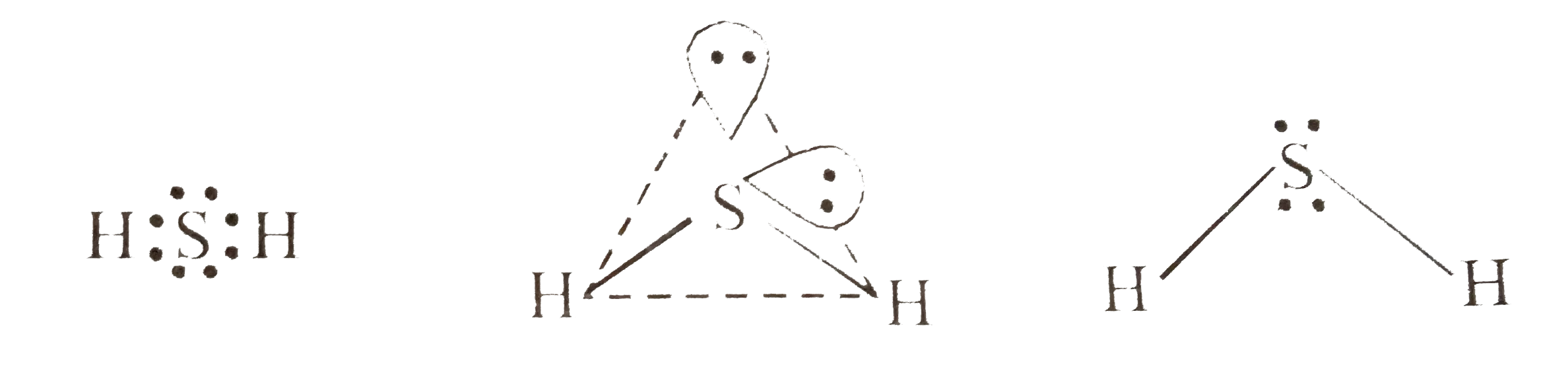
Shape of `H_(2)S` The eolectronic configuration of sulphur (Z=16) is 2,8,6. Out of the six valencr electrons, two constitute bond pairs with the electrons of hydrogen atoms while the remaining fhor electeons are in the form of two lone paires. The central sulphur atom is surrounded by two lone pairs and two shared pairs of electrons and to minimise the repulsives interactions in the electron pairs, the shape of the molecule is non-linear (bond angle =`92^(@)`)
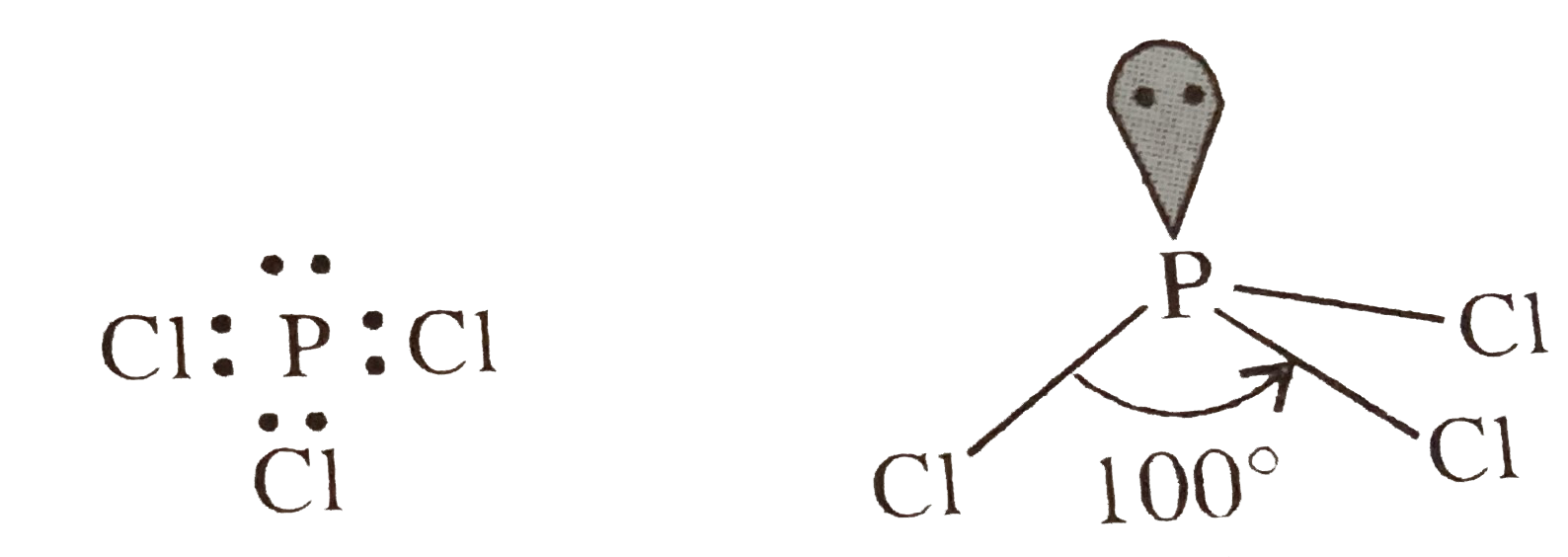
Shape of `PCl_(3).` The electronic configuration of phosphorus (Z=15) is 2,8,5 In `PCl_(3)` molecule, three valence electrons of phosphorus from three shared pairs with the electrons of three chlorine atoms and the remaining two electrons from one lone pair.

In order to minimise rthe repulsive interactions in the electron pairs, the spape of the moleculeis non-planar with bond angle nearly `100^(@).`
Promotional Banner

Topper's Solved these Questions

  • CHEMICAL BONDING AND MOLECULAR STRUCTURE

    DINESH PUBLICATION|Exercise ADDITIONAL IMPORTANT QUASTIONS|41 Videos
  • CHEMICAL BONDING AND MOLECULAR STRUCTURE

    DINESH PUBLICATION|Exercise H.O.T.S. CONCEPTUAL QUESTIONS|11 Videos
  • CHEMICAL BONDING AND MOLECULAR STRUCTURE

    DINESH PUBLICATION|Exercise COMPREHENSION|4 Videos
  • CARBOXYLIC ACIDS AND THEIR DERIVATIVES

    DINESH PUBLICATION|Exercise Unit test|20 Videos
  • CLASSIFICATION OF ELEMENTS AND PERIODICITY IN PROPERTIES

    DINESH PUBLICATION|Exercise All Questions|310 Videos

Similar Questions

Explore conceptually related problems

The shape of ClO_3^- according to valence shell electron pair repulsion theory will be

Interpret non-linear shape of H_(2)S and non-planar shape of PCl_(3) on the basis of VSEPR theory.

The approximate shape of a molecule can often be predicted by using what is called the valence-shell electron-pair repulsion (VSEPR) model. Electrons in bonds and in lone pairs can be thought of a ''charge cloud'' that repel one another nad stay as far apart as possible, thus causing molecules to assume specific shapes. The repulsive interactions of electron pairs decrease in the order: Lone pair - Lone pair gt Lone pair - Bond pair gt Bond pair - Bond pair These repulsive effects result in deviations from idealised shapes and alteration in bond angles in molecules. Which among the following molecules have sp^(3)d hybridization with one lone pair of electron on the central atom? (P) SF_(4) (Q) [PCl_(4)]^(+) (R) XeO_(2)F_(2) (S) ClOF_(3)

The approximate shape of a molecule can often be predicted by using what is called the valence-shell electron-pair repulsion (VSEPR) model. Electrons in bonds and in lone pairs can be thought of a ''charge cloud'' that repel one another nad stay as far apart as possible, thus causing molecules to assume specific shapes. The repulsive interactions of electron pairs decrease in the order: Lone pair - Lone pair gt Lone pair - Bond pair gt Bond pair - Bond pair These repulsive effects result in deviations from idealised shapes and alteration in bond angles in molecules. Molecular shape of XeF_(3)^(+),SF_(3)^(+) and CF_(3)^(+) are :

The approximate shape of a molecule can often be predicted by using what is called the valence-shell electron-pair repulsion (VSEPR) model. Electrons in bonds and in lone pairs can be thought of a ''charge cloud'' that repel one another nad stay as far apart as possible, thus causing molecules to assume specific shapes. The repulsive interactions of electron pairs decrease in the order: Lone pair - Lone pair gt Lone pair - Bond pair gt Bond pair - Bond pair These repulsive effects result in deviations from idealised shapes and alteration in bond angles in molecules. Which of the following statements is incorrect?

The approximate shape of a molecule can often be predicted by using what is called the valence-shell electron-pair repulsion (VSEPR) model. Electrons in bonds and in lone pairs can be thought of a ''charge cloud'' that repel one another nad stay as far apart as possible, thus causing molecules to assume specific shapes. The repulsive interactions of electron pairs decrease in the order: Lone pair - Lone pair gt Lone pair - Bond pair gt Bond pair - Bond pair These repulsive effects result in deviations from idealised shapes and alteration in bond angles in molecules. Which of the following statement is correct with respect ot bond angles?

The approximate shape of a molecule can often be predicted by using what is called the valence-shell electron-pair repulsion (VSEPR) model. Electrons in bonds and in lone pairs can be thought of a ''charge cloud'' that repel one another nad stay as far apart as possible, thus causing molecules to assume specific shapes. The repulsive interactions of electron pairs decrease in the order: Lone pair - Lone pair gt Lone pair - Bond pair gt Bond pair - Bond pair These repulsive effects result in deviations from idealised shapes and alteration in bond angles in molecules. Among the following molecules. (P) XeO_(3)" (Q)"XeOF_(4) (R) XeO_(2)F_(2)" (S)"XeF_(5) Those having different molecular geometry but same number of lone pairs on Xe are :

The space model which is obtained by joining the points representing various bonded atoms gives the shape of the molecule. The geometry of the molecule is definite relative arrangement of the bonded atoms in a molecule. The shape and geometry of a molecule is explained by valence shell electron pair repulsion theory given by Gillespie and Nyholm. Which molecule has both shape and geometry identical ? (I) SnCl_(2) " " (II) NH_(3) " " (III) PCl_(5) " " (IV) SF_(6)

DINESH PUBLICATION-CHEMICAL BONDING AND MOLECULAR STRUCTURE -BORD EXAMINATIONS
  1. Define hydrogen bond. Is it weaker or stronger than the van der Waals ...

    Text Solution

    |

  2. What is meant by the term bond order ? Calculate the bond order ? Calc...

    Text Solution

    |

  3. Interpret the non-linear shape of H(2)S molecule and non-planar shape ...

    Text Solution

    |

  4. Using molecular orbital theory, compare the bond energy and magnetic c...

    Text Solution

    |

  5. Explain the shape of BrF(5^.)

    Text Solution

    |

  6. Structures of molecules of two compounds are given: (a) Which of the...

    Text Solution

    |

  7. Why does type of overlap given in the following figure not result in b...

    Text Solution

    |

  8. Explain why PCl(5) is trigonal bipyramidal whereas IF(5) is square pyr...

    Text Solution

    |

  9. In both water and dimethyl ether (CH(3)-underset(* *)overset(* *)O-CH...

    Text Solution

    |

  10. The energy of sigma2p(z), molecular orbital is greater than pi2p(x) an...

    Text Solution

    |

  11. Give the change in bond order in the following ionisation process? i...

    Text Solution

    |

  12. Give reasons for the following : (i) Covalent bonds are directional...

    Text Solution

    |

  13. What is an ionic bond ? With two suitable examples, explain the difere...

    Text Solution

    |

  14. Explain why CO(3)^(2-) ion cannot be represented by a single Lewis str...

    Text Solution

    |

  15. Predict the hybridisation of each carbon in the molecule of organic co...

    Text Solution

    |

  16. Group the following as linear and non-linear molecules : H(2)O,HOCl,...

    Text Solution

    |

  17. Elements X,Y and Z have 4,5 and 7 valence electrons respectively, (i) ...

    Text Solution

    |

  18. Draw the resonatin structure of (i) Ozone molecule (ii) Nitrate ion

    Text Solution

    |

  19. Presict the shapes of the following molecules on the basis of hybridis...

    Text Solution

    |

  20. All the C-O bonds in carbonate in (CO(3)^(2-)) are equal in length. Ex...

    Text Solution

    |