Home
Class 11
CHEMISTRY
X and Y are two volatile liquids with mo...

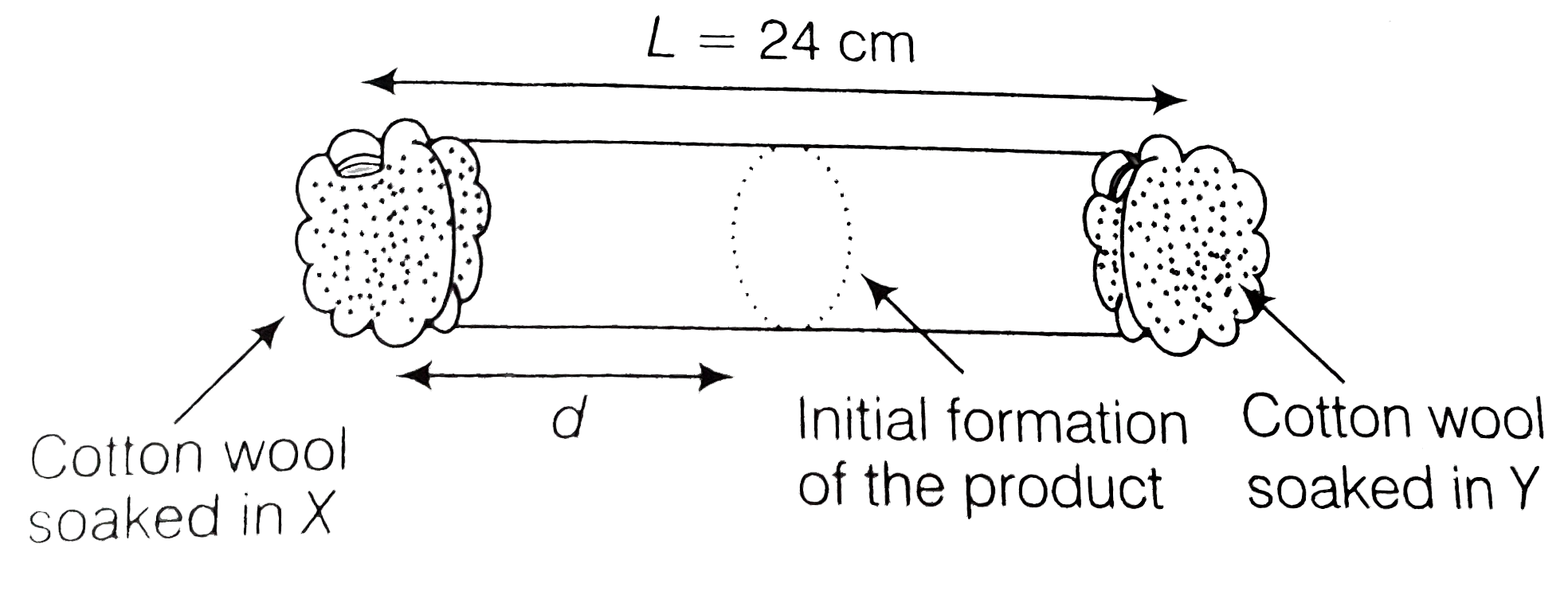
`X` and `Y` are two volatile liquids with molar weights of `10gmol^(-1)` and `40gmol^(-1)` respectively. Two cotton plugs, one soaked in `X` and the other soaked in `Y`, are simultaneously placed at the ends of a tube of length `L=24` cm, as shown in the figure.
The tube is filled with an inert gas at 1 atm pressure and a temperature of `300K`. Vapours of `X` and `Y` react to form a product whichh is first observed at a distance `d`cm from the plug soaked in `X`.
Take `X` and `Y` to have equal molecular diameters and assume ideal behaviour for the inert gas and two vapours.

The experimental value of `d` is found to be smaller than the estimate obtained using Graham's law. This is due to

A

larger mean for path for X as compared of that of Y

B

larger mean free path for Y as compared to that of X

C

increased collision frequency of Y with the inert gas as compared to that of X with the inert gas

D

increased collision frequency of X with the inert as compared to that of Y with the inert gas.

Text Solution

Verified by Experts

The correct Answer is:

D

Collisions frequency is the measure of molecular collisions taking place per second per unit volume of the gas. As the collision frequnecy increases. The distance covered by the molecules becomes less than the expected value. In this case, the molecules of X being lighter result in more collisions with the inert gas molecules as compared to molecules of Y. As a result, the experimental values of d is found to be smaller than what is estimated according to Graham's Law.
Promotional Banner

Topper's Solved these Questions

  • STATES OF MATTER : GASES AND LIQUIDS

    DINESH PUBLICATION|Exercise Straight Objective Type (MCQ)|29 Videos
  • STATES OF MATTER : GASES AND LIQUIDS

    DINESH PUBLICATION|Exercise Assertion and Reason|11 Videos
  • STATES OF MATTER : GASES AND LIQUIDS

    DINESH PUBLICATION|Exercise Comphension 3|5 Videos
  • STATES OF MATTER (SOLID STATE CHEMISTRY)

    DINESH PUBLICATION|Exercise ULTIMATE PREPARATORY PACKAGE|21 Videos
  • STRUCTURE OF ATOM

    DINESH PUBLICATION|Exercise Reason Type Questions|1 Videos

Similar Questions

Explore conceptually related problems

X and Y are two volatile liquids with molar weights of 10gmol^(-1) and 40gmol^(-1) respectively. Two cotton plugs, one soaked in X and the other soaked in Y , are simultaneously placed at the ends of a tube of length L=24 cm, as shown in the figure. The tube is filled with an inert gas at 1 atm pressure and a temperature of 300K . Vapours of X and Y react to form a product whichh is first observed at a distance d cm from the plug soaked in X . Take X and Y to have equal molecular diameters and assume ideal behaviour for the inert gas and two vapours. The value of d in cm (shown in figure), as estimated from Graham's law, is

Two liquids which do not react chemically are placed in a bent tube as shown in figure. The height of the liquids above their surface of separation are

A tube of length 50 cm is containing a gas in two secitons separated by a mercury column of length 10 cm as shown in figure. The tube's open end is just inside the Hg surface in container, find pressure of gas in upper section. [Assume atmospheric pressure = 75 cm of Hg column]

In two containers X and Y same gas is filled. If the pressure, volume and absolute temperature of gas in X are three times as compared to that in Y and if the mass of X is mg , the mass of Y is

Two liquids X and Y boil at 110^(@)C and 130^(@)C , respectively. Which one of them has higher vapour pressure at 50^(@)C ?

A liquid of density rho is filled in a U-tube is accelerated with an acceleration a so that the height of liquid in its two vertical arms are h_1 and h_2 as shown in the figure. If l is the length of horizontal arm of the tube, the acceleration a is
