Home
Class 11
CHEMISTRY
Indicate sigma (sigma) and pi (pi) bonds...

Indicate sigma `(sigma)` and pi `(pi)` bonds in the following molecules :
(i) `C_(6)H_(6)" "`(ii) `C_(6)H_(12)" "`(iii) `CH_(2)Cl_(2)" "`(iv) `CH_(3)NO_(2)" "`(v) `HCONHCH_(3)" "`(vi) `CH_(2)=C=CH_(2)`

Text Solution

Verified by Experts
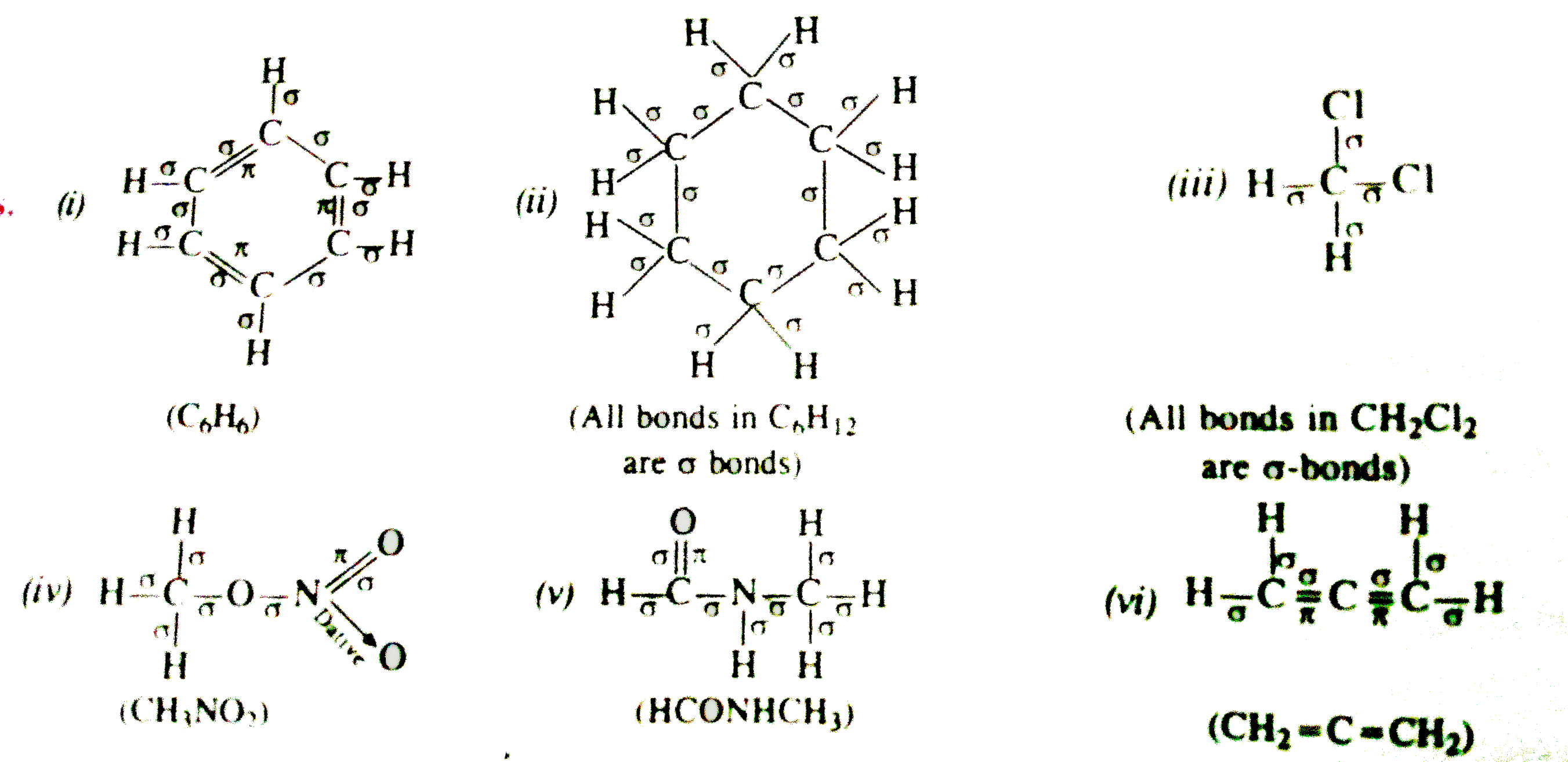
The following Structure are
Promotional Banner

Topper's Solved these Questions

  • ORGANIC CHEMISTRY - SOME BASIC PRINCIPLES & TECHNIOUES

    DINESH PUBLICATION|Exercise SHORT ANSWER TYPE QUESTION|33 Videos
  • ORGANIC CHEMISTRY - SOME BASIC PRINCIPLES & TECHNIOUES

    DINESH PUBLICATION|Exercise CONCEPT BASED QUESTION|45 Videos
  • ORGANIC CHEMISTRY - SOME BASIC PRINCIPLES & TECHNIOUES

    DINESH PUBLICATION|Exercise PURIFICATION & CHARACTERISATION OF ORGANIC COMPOUNDS|38 Videos
  • NUCLEAR AND RADIO CHEMISTRY

    DINESH PUBLICATION|Exercise Evaluate Yourself|45 Videos
  • P BLOCK ELEMENTS (GROUP 13 AND 14 )

    DINESH PUBLICATION|Exercise Straight obj.|17 Videos

Similar Questions

Explore conceptually related problems

Indicate the sigma and pi bonds in the following molecules : (i) C_2 H_6 (ii) C_6 H_12 (iii) CH_2 Cl_2 (iv) CH_2 = C = CH_2 (v) CH_3 NO_2 (vi) HCON HCH_3

Indicate the sigma- and pi - bonds in the following molecules: I. C_(6) H_(6) II. C_(6) H_(12) III. CH_(2) CI_(2) IV. CH_(2) = C = CH_(2) V. CH_(3) NO_(2) VI. HCOMHCH_(3)

Indicate the number of sigma -and pi -bonds in the following molecules: (i) CH_(3)-C-=C-H (ii) CH_(3)-CH=CH_(2) (iii) H_(2)C=C=CH_(2) (iv) CH_(3)-CH_(2)-CH_(3) (v) H_(2)C=C-CH-CH_(3) (vi) HC=C-CH=CHCH_(3) (vii) H_(2)C =CH-C-=N (viii) CH_(3)OH (ix) CH_(3)-C-=N (x) CH_(3)NO_(2) (xi) CH_(2)CI_(2) (xii) C_(6)H_(12) (Hexene)

Indicate the number of sigma and pi bonds in the following molecules: (i) CH_(3)-CH=CH_(2) (ii) CH_(3)-CH_(2)-CH_(2)-CH_(3) (iii) CH_(3)-C-=C-CH_(3) (iv)

How many sigma and pi bonds are present in the following molecules : (i) CH_(3)-CH_(3)" "(ii) CH_(3)-OH" "(iii) CH_(2)=CH-C equiv N" "(iv) CH_(2)=C=CH_(2)CH_(3)" "(v) CH equiv C CH=CHCH_(3)

How many bonds (sigma and pi ) are there in the following molecules? (i) H_(2)C=C=CH_(2) (ii) CH_(3)-C-=CH (iii) H_(2)C=CH-C-=N (iv) CH_(3)NO_(2) (v) CH_(3)OH (iv) C_(2)H_(2)

Find the type of hybridization of each carbon in the following molecules. (i) CH_(3)F , (ii) CH_(3)CHO (iii) CH_(3)CH_(2)CN , (iv) CH_(3)CONH_(2) (v) CH_(3)C-=C CH_(3) , (vi) CH_(3)CH-=CH_(2) Strategy: Carbon atom forming four sigma bonds but no pi bond is always sp^(3) htbridized, carbon atom forming three sigma bonds and one pi bond is always sp^(2) hybridized, and carbon atom forming two sigma bonds and two pi bonds is always sp hybridized.

Write the empirical formulae of the following compounds. (i) C_(6)H_(6) (ii) Na_(2)CO_(3) (iii) C_(6)H_(12)O_(6) (iv) H_(2)O_(2) (v) CH_(3)COOH (vi) CuSO_(4)

Give the IUPAC name of the following compounds: (i) (CH_(3))_(2) , (ii) CH_(3)COCH(CH_(3))_(2) , (iii) Cl_(2)CHCOCH_(3) (iv) CH_(3)CH(OH)CH_(2)CHO , (v) C_(6)H_(5)CH_(2)CHO , (vi) CH_(2)=CHCOCH =CH_(2)

DINESH PUBLICATION-ORGANIC CHEMISTRY - SOME BASIC PRINCIPLES & TECHNIOUES-N.C.E.R.T.
  1. What are the hydridised states of carbon atoms in the following compou...

    Text Solution

    |

  2. Indicate sigma (sigma) and pi (pi) bonds in the following molecules : ...

    Text Solution

    |

  3. Write bond line formulas for : (i) Isopropyl alcohol (ii) 2, 3-Dimet...

    Text Solution

    |

  4. Give the IUPAC name of the following compounds :

    Text Solution

    |

  5. Which of the following represents the correct IUPAC name of the compou...

    Text Solution

    |

  6. Draw the formulae for the first five numbers of each homologous series...

    Text Solution

    |

  7. Give the condensed and bond line formulas for the following compounds ...

    Text Solution

    |

  8. Identify the functional groups in the following compounds.

    Text Solution

    |

  9. Which is expected to be more stable : O(2)NCH(2)CH(2)O^(-) or CH(3)CH(...

    Text Solution

    |

  10. Draw the resonance structures for the following compounds. Show the el...

    Text Solution

    |

  11. Explain why alkyl groups act as electron donors when attracted to a pi...

    Text Solution

    |

  12. What are nucleophiles and electrophiles. Explain with examples.

    Text Solution

    |

  13. Identify the reagents shown in bold in the following equations as nucl...

    Text Solution

    |

  14. Classify the following reactions in one of the reaction type studied i...

    Text Solution

    |

  15. What is the relation between the following pairs ? (a) (c) H-...

    Text Solution

    |

  16. Classify each of the following as homolysis as homolysis or heterolysi...

    Text Solution

    |

  17. Explain the terms inductive and electromeric effects. Which electron d...

    Text Solution

    |

  18. Give a brief description of the principle of the following processes t...

    Text Solution

    |

  19. Describe the method which can be used to separate two compounds with d...

    Text Solution

    |

  20. What is the difference between distillation, distillation under reduce...

    Text Solution

    |

