Home
Class 12
CHEMISTRY
An organic compound (A) with molecular f...

An organic compound (A) with molecular formula `C_(8)H_(8)O` forms an orange-red precipitate with 2,4-DNP reagent and gives yellow precipitate on heating with iodine in the presence of sodium hydroxide. It neither reduces Tollens’ or Fehlings’ reagent, nor does it decolourise bromine water or Baeyer’s reagent. On drastic oxidation with chromic acid, it gives a carboxylic acid (B) having molecular formula `C_(7)H_(6)O_(2)`. Identify the compounds (A) and (B) and explain the reactions involved.

Text Solution

Verified by Experts
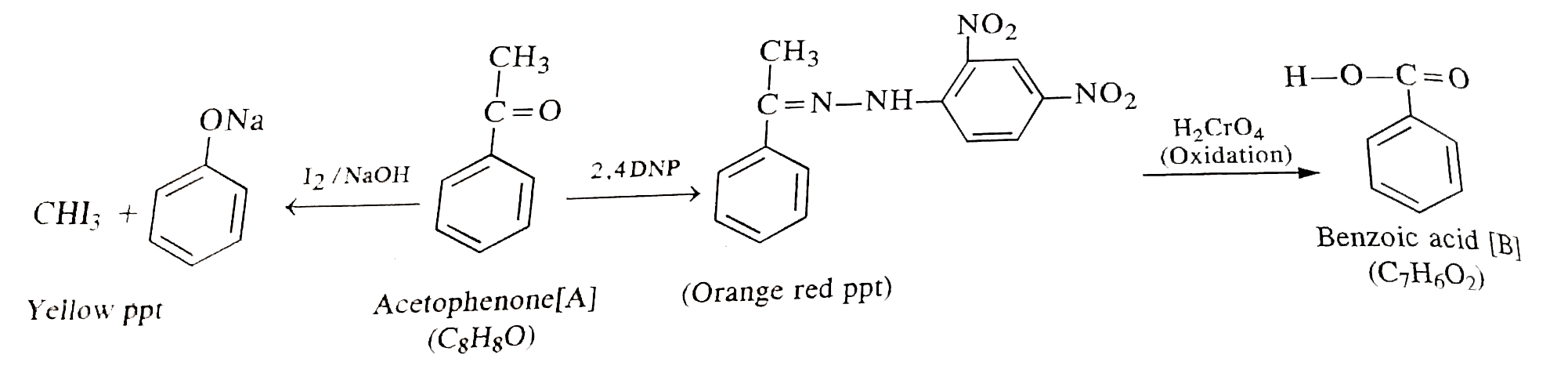
(i) Since the compound [A] gives positive DNP and iodoform tests, it must have a methyl ketonic group `(CH_(3)-CO-)`.
(ii) Since the compound [A] does not reduce Tollen's reagent or Fehling solution, it is not an aldehyde.
(iii) As the compound [A] does not decolourise bromine water, it must be saturated in nature and is expected to be an aromatic compound.
(iv) The avialable infomation shows that the compound [A] upon oxidation with chromic acid `[H_(2)CrO_(4)]` gives carboxylic acid [B] with molecular formula `C_(7)H_(6)O_(2)`. The formula is of benzoic acid which is an aromatic acid.
(v) Since [B] has been formed as a result of oxidation of compound [A], this shows that the compound which is a methyl ketone has the formula `C_(6)H_(5)-overset(O)overset(||)C-CH_(3) (C_(8)H_(8)O)` and is acetophenone.
The reaction involved are as follows:
Promotional Banner

Topper's Solved these Questions

  • ALDEHYDES AND KETONES

    DINESH PUBLICATION|Exercise Problem|15 Videos
  • ALDEHYDES AND KETONES

    DINESH PUBLICATION|Exercise Additional Important Question|35 Videos
  • ALCOHOLS AND PHENOLS

    DINESH PUBLICATION|Exercise Matrix|9 Videos
  • ALKALI EARTH METALS

    DINESH PUBLICATION|Exercise Unit test-12|5 Videos

Similar Questions

Explore conceptually related problems

An organic compound (A) with molecular formula C_8H_8 O forms an orange red precipitate with 2,4 -DNP reagent and gives yellow precipitate on heating with iodine in the presence of sodium hydroxide . It neither reduces Tollen's reagent or Fehling's solution , nor does it decolourise bromine water or Baeyer's reagent. On drastic oxidation with chromic acid, it gives a carboxylic acid (B) having molecular formulae C_7H_6O_2 . Identify the compound (A) and (B) and explain the reactions involved .

An organic compound containing (x) with molecular formula C_(8)H_(8)O forms an oragne-red precipitate with 2,- -DNP reagent and gives yellow precipitate on heating with ioxdine in the presence of sodium hydroxide. It neither reduces Tollen's Fehlling's reagent, nor does it decolouries bromine water or Baeyer's reagent. On drastic oxidation with chromic acid, it gives a carboxylic acid (Y) having molcular formula C_(7)H_(6)O_(2) . Identify the compounds X and Y.

An organic compound 'P' with jmolecular formula C_(8)H_(8)O forms an organic red ppt with 2,4-DNP gives yellow ppt. on heating with I_(2) in presence of NaOH . It neither reduces tollen's or fehling reagent nor does it decolourise Br_(2) water or baeyer's reagent. On drastic oxidation with chromic acid (H_(2)CrO_(4)) it gives an acid (Q) having molecular formula C_(7)H_(6)O_(2) . Q. Identify compound P:

An organic compound 'P' with jmolecular formula C_(8)H_(8)O forms an organic red ppt with 2,4-DNP gives yellow ppt. on heating with I_(2) in presence of NaOH . It neither reduces tollen's or fehling reagent nor does it decolourise Br_(2) water or baeyer's reagent. On drastic oxidation with chromic acid (H_(2)CrO_(4)) it gives an acid (Q) having molecular formula C_(7)H_(6)O_(2) . Q. Qoverset(NaOH//CaO //Delta)toR (Major product). R will be,

An organic compound [A] with molecular formula C_(9)H_(10)O forms an arage-red precipitate [B] with 2,4 DNP reagent. Compound [A] gives yellow precipiatate [C] on heating wihth iodine in the presence of soedium hydroxide along with a colourless compound [D]. The compound [A] does not reduce Tollen's reagent or Fehling's solution nor does it decolourise bromine water or Baeyer's reagent. On drastic oxidation with chromic acid, compound [A] gives a crboxylic acid [E] having molecular formula C_(7)H_(6)O_(2) . Deduce the strcutres of the organic compounds [A] to [E].

An organic compound 'P' with jmolecular formula C_(8)H_(8)O forms an organic red ppt with 2,4-DNP gives yellow ppt. on heating with I_(2) in presence of NaOH . It neither reduces tollen's or fehling reagent nor does it decolourise Br_(2) water or baeyer's reagent. On drastic oxidation with chromic acid (H_(2)CrO_(4)) it gives an acid (Q) having molecular formula C_(7)H_(6)O_(2) . Q. Punderset(Delta)overset(dil.overset(ө)(O)H)toSunderset(H_(3)O^(o+))overset(CH_(3)MgBr(1" mole"))to No. of stereoisomer in the final product T:

An organic compound A with molecular formula C_(9)H_(10)O gives positive DNP and iodoform tests. It does not reduce. Tollen's reagent or Fehling reagent and does not decolourless bromine water or Bayer's reagent. On drastic oxidation with chronic acid, compound A gives a carboxylic acid having molecular formula C_(7)H_(6)O_(2) . Deduce the structur eof organic compound A and write all the chemical reactions involved.

An orgainc compound having the molecular formula C_(8)H_(10)O on being heated with I_(2) and dilute NaOH gives a yellow precipitate. The expected compound is :

