Home
Class 12
PHYSICS
The figure shows the position – time (x ...

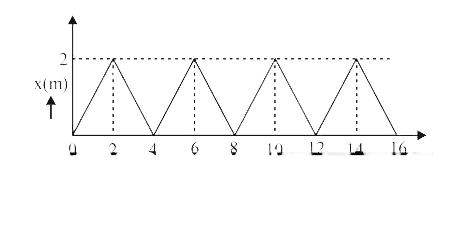
The figure shows the position – time (x – t) graph of one – dimensional motion of a body of mass 0.4 kg. The magnitude of each impulse is:

A

0.4 Ns

B

0.8 Ns

C

1.6 Ns

D

0.2 Ns

Text Solution

Verified by Experts

The correct Answer is:

B

Here, mass of the body, m = 0.4 kg
Since position – time (x – t) graph is a straight line, so motion is uniform. Because of impulse direction of velocity change as it can be seen from the slopes of the graph.
From graph,
Initial velocity , `u = ((2 - 0))/((2 - 0)) = 1 ms^(-1) " Final velocity" , v = ((0 - 2))/((4 - 2)) = -1 m s^(-1)`
Initial momentum, `" " P_(i) = m u = 0.4 xx 1 = 0.4 Ns`
Final momentum, `P_f = mv = 0.4 (-1) = -0.8 Ns`
|Impulse | = 0.8 Ns.
Promotional Banner

Similar Questions

Explore conceptually related problems

The figure shows the position - time (x - t) graph of one-dimensional motion of a body of mass 0.4 kg. The magnetic of each impulse is

The figure shows the position-time (x-t) graph of one-dimensional motion of a body of mass 0.4kg. The magnitude of each impulse is

Figure shows the position-time (x-t) graph of one dimensional motion of a mass 500g. What is the time interval between two consecutive impulses received by the body?

Figure shows the position time graph for a particle in one dimensional motion. What is the displacement of the particle in first 4 seconds ?

In the figure given below, the position time graph of a particle of mass 0.1kg is shown. The impulse at t=2 sec is

Figure below shows the velocity-time graph of a one dimensional motion. Which of the following characteristic of the particle is represented by the shaded area?

In the figure given below, the position–time graph of a particle of mass 0·1 kg is shown. The impulse at t=2 sec is

Figure shows the position the graph for a particle in one dimensional motion. Which of the graphs in fugure represent the variation in the velocity of the particle with time ?

In the figure given below, the position-time graph of a particle of mass 0.1kg is shown. The impuslse at t=2 sec is
