Home
Class 11
PHYSICS
Two discs of moments of inertia I(1) and...

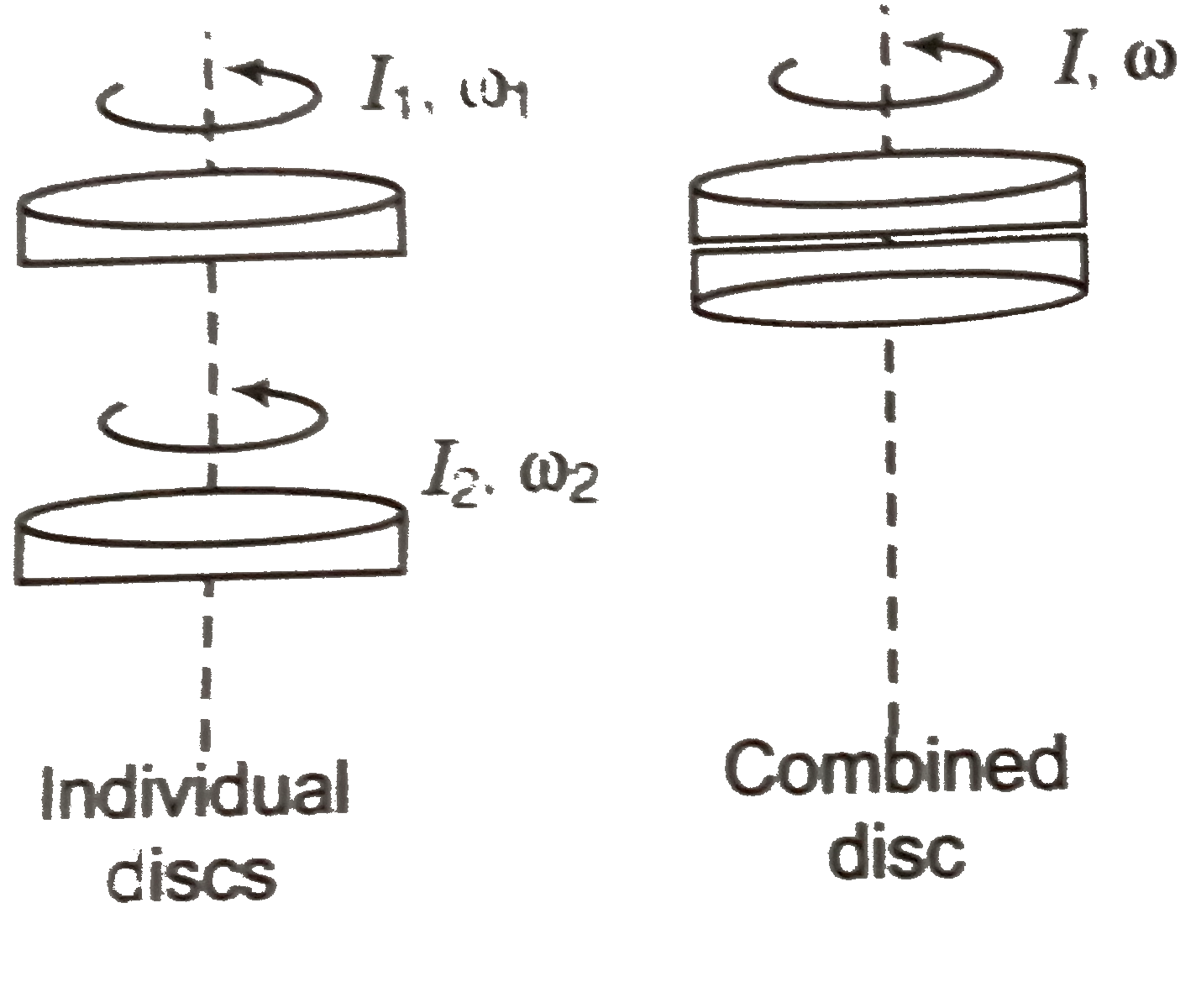
Two discs of moments of inertia `I_(1) and I_(2)` about their respective axes (normal to the disc and passing through the centre), and rotating with angular speed `omega_(1) and omega_(2)` are brought into contact face to face with their axes of rotation coincident . What is the angular speed of the two-disc system ?

A

Does the law of conservation of angular monentum apply to the situation ? Why ?

B

Find the angular speed of the two disc system .

C

Calculate the loss in kinetic energy of the system in the the process.

D

Account for this loss.

Text Solution

Verified by Experts

Consider the diagram below
let the common angular velocity of the system is `omega `
( A) yes , the law of conservation of angular momentum can be applied ,Because , there is no net external torque on the system of the two disc .
External forces , gravition and normal reaction ,act through th axis of rotation , hence produce no torque .

( B) BY conservation of angular momentum
`L_(f)=L_(j)`
`implies Iomega=Iomega_(1)+I_(2)omega_(2)`
` implies omega=(I_(1)+I_(2)omega_(2))/(I)=(I_(1)omega_(1)+I_(2)omega_(2))/(I_(1)+I_(2))" "(:' I=I_(1)+I_(2))`
`(C) K_(f)=(1)/(2)(I_(1)+I_(2))((I_(1)omega_(1)+I_(2)omega_(2)))/((I_(1)+I_(2)))=(1)/(2)((I_(1)omega_(1)+I_(2)omega_(2)))/((I_(1)+I_(2)))`
`k_(f)=(1)/(2)(I_(1)omega_(1)^(2)+I_(2)omega_(2)^(2))`
`DeltaK=K_(f)-K_(i)=-(I_(1)I_(2))/(2(I_(1)+I_(2)))(omega_(1)-omega_(2))^(2)lt0`
(D) Hence there is loss in KE of the loss in kintic energy is mainly due to the work against the frication between the two discs.
Promotional Banner

Topper's Solved these Questions

  • SYSTEM OF PARTICLES AND ROTATIONAL MOTION

    NCERT EXEMPLAR|Exercise very short answer type questions|18 Videos
  • SYSTEM OF PARTICLES AND ROTATIONAL MOTION

    NCERT EXEMPLAR|Exercise very short answer type questions|18 Videos
  • OSCILLATIONS

    NCERT EXEMPLAR|Exercise MULTIPLE CHOICE QUESTIONS (MCQs)|40 Videos
  • THERMAL PROPERTIES OF MATTER

    NCERT EXEMPLAR|Exercise Very short Answer type Questions|15 Videos

Similar Questions

Explore conceptually related problems

Two discs of moments of inertia I_(1) and I_(2) about their respective axes (normal to the disc and passing through the centre), and rotating with angular speed omega_(1) and omega_(2) are brought into contact face to face with their axes of rotation coincident (i) What is the angular speed of the two-disc system ? (ii) Show that the kinetic energy of the combined system is less than the sum of the initial kinetic energies of the two discs. How do you account for this loss in energy ? Take omega_(1) ne omega_(2) .

Two discs of moments of inertia I_1 and I_2 about their respective axes (normal to the disc and passing through the centre), and rotating with angular speed omega_1 and omega_2 are brought into contact face to face with their axes of rotation coincident. What is the loss in kinetic energy of the system in the process?

Two discs of moments of inertia I_(1) and I_(2) about their respective axes (normal to the disc and passing through the centre) and rotating with angular speeds omega_(1) and omega_(2) are brought into contact face to face with their axes of rotation coincident. (a) Does the law of conservation of angular momentum apply to the situation ? Why ? (b) Find the angular speed of the two-disc system. (c ) Calculate the loss in kinetic energy of the system in the process. (d) Account for this loss.

Two discs have moments of intertia I _(1) and I _(2) about their respective axes perpendicular to the plane and passing through the centre. They are rotating with angular speeds, W_(1) and W_(2) respectively and are brought into contact face to face with their axes of rotation coaxial. The loss in kinetic energy of the system in the process is given by :

Two discs of moments of inertia I_1 and I_2 about their respective axes, rotating with angular frequencies, omega_1 and omega_2 respectively, are brought into contact face to face with their axes of rotation coincident. The angular frequency of the composite disc will be A .