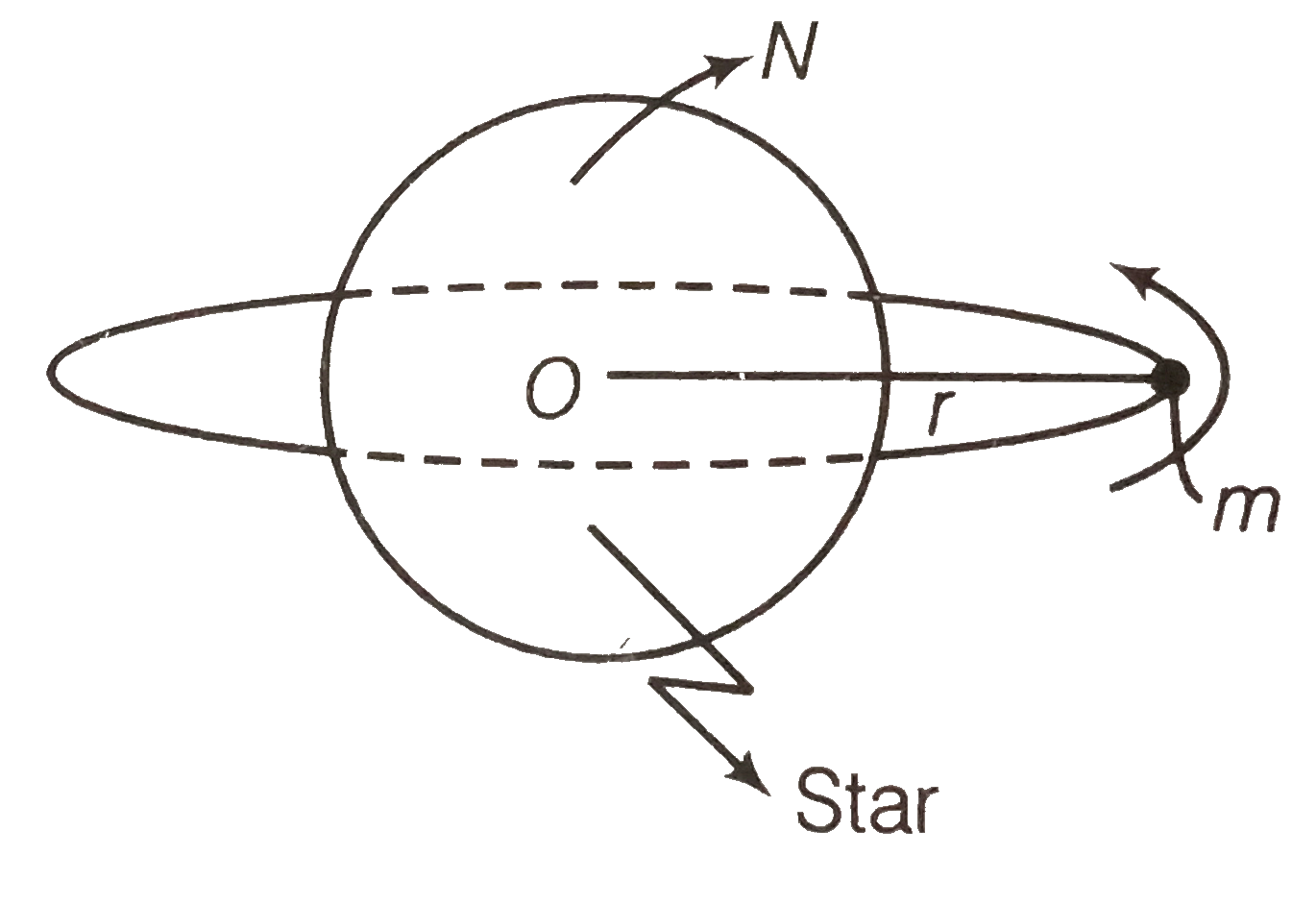
The situation is shown in the diagram, where a body of mass `m` is revolving around a star of mass M.
Linear velocity of the body `v = sqrt((GM)/(r))`
`rArr v prop (1)/(sqrtr)`
Therefore, when r increases, v decreases
Angular velocity of the body `omega = (2pi)/(T)`
According to Kepler's law of period,
`T^(2) prop r^(3) rArr T = kr^(3//2) " " ( :. omega = (2pi)/(T))`
Therefore, when r increases, `omega` decreases.
Kinetic energy of the body `K = (1)/(2) mv^(2) = (1)/(2) m xx (GM)/(r) = (GMm)/(2r)`
`:. K prop (1)/(r)`
Therefore, when r increases, KE decreases
Gravitational potential energy of the body,
`U = -(GMm)/(r) rArr U prop - (1)/(r)`
Therefore, when r increases, PE becomes less negative i.e., increases.
Total energy of the body `E = KE + PE = (GMm)/(2r) + (-(GMm)/(r)) = - (GMm)/(2r)`
Therefore, when r increases, total energy becomes less negative, i.e., increases.
Angular momentum of the body `L = mvr = mr sqrt((GM)/(r)) = m sqrt(GMr)`
`:. L prop sqrtr`
Therefore when r increases, angular momentum L increases.
Note In this case, we have not considered the sun -object system as isolated and the force on the system is not zero. So, angular momentum is not conserved.