Home
Class 11
PHYSICS
Six point masses of mass m each are at t...

Six point masses of mass `m` each are at the vertices of a regular hexagon of side `l`. Calculate the force on any of the masses.

Text Solution

Verified by Experts

Consider the diagram below, in which six point masses are placed at six vertices A, B, C, D, E and F
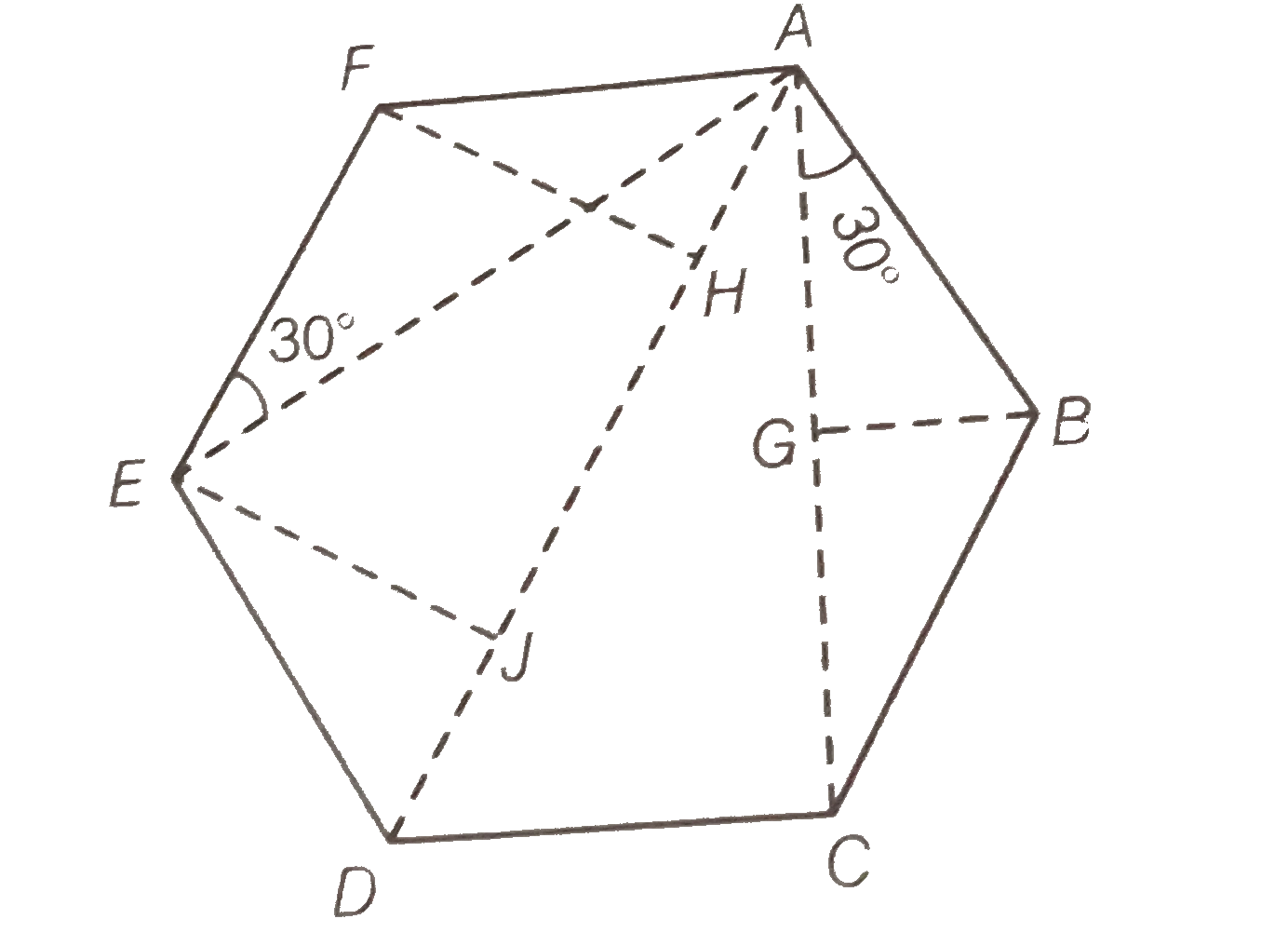
`AC = AG + GC = 2AG`
`= 2 l cos 30^(@) = 2l sqrt3//2`
`= sqrt3l = AE`
`AD = AH + HJ + JD`
`= l sin 30^(@) + l + l sin 30^(2) = 2l`
Force on mass m at A due to mass m at B is, `f_(1) = (Gmm)/(l^(2))` along AB.
Force on mass m at A due to mass m at C is, `f_(2) = (Gm xx m)/((sqrt(3l))^(2)) = (Gm^(2))/(3l^(2))` along AC. [`:. AC = sqrt(3l)`]
Force on mass m at A due to mass m at D is, `f_(3) = (Gm xx m)/((2l)^(2)) = (Gm^(2))/(4l^(2))` along AD `[ :. AD = 2l]`
Force on mass m at A due to mass m at E is `f_(4) = (Gm xx m)/((sqrt(3l))^(2)) = (Gm^(2))/(3l^(2))` along AE.
`f_(5) = (Gm xx m)/(l^(2)) = (Gm^(2))/(l^(2))` along AF.
Resultant force due to `f_(1)` and `f_(5)` is `F_(1) = sqrt(f_(1)^(2) + f_(5)^(2) + 2f_(1) f_(5) cos 120^(@)) = (Gm^(2))/(l^(2))` along AD.
[`:.` Angle between `f_(1)` and `f_(5) = 120^(@)`]
Resultant force due to `f_(2)` and `f_(4)` is, `F_(2) = sqrt(t_(2)^(2) + t_(4)^(2) + 2f_(2)f_(4) cos 60^(@))`
`= (sqrt3 Gm^(2))/(3l^(2)) = (Gm^(2))/(sqrt(3l^(2))` along AD.
So, net force along AD `= F_(1) + F_(2) + F_(3) = (Gm^(2))/(l^(2)) + (Gm^(2))/(sqrt(3l)^(2)) + (Gm^(2))/(4l^(2)) = (Gm^(2))/(l^(2)) (1+ (1)/(sqrt3) + (1)/(4))`

Promotional Banner

Topper's Solved these Questions

  • GRAVITATION

    NCERT EXEMPLAR|Exercise Short Answer type question|6 Videos
  • KINETIC THEORY

    NCERT EXEMPLAR|Exercise Multiple Choice Questions (MCQs)|31 Videos

Similar Questions

Explore conceptually related problems

Six identical particles each of mass m are arranged at the corners of a regular hexagon of side length L . If the mass of one of the particle is doubled, the shift in the centre of mass is

Six point charges are arrange at the vertices of a regular hexagon of side length a (shown in figure). Find the magnitude of electric field at the centre of regular hexagon.

Three masses of 1 kg each are kept at the vertices of an equilateral triangle of side 3 m. What is the force acting on a point mass of 5 kg placed at its centroid ?

Five point charge ( +q each) are placed at the five vertices of a regular hexagon of side 2a .what is the magnitude of the net electric field at the centre of the hexazon?

Five point masses m each are kept at five vertices of a regular pentagon. Distance of centre of pentagon from any one of the verticle is 'a'. Find gravitational potential and filed strength at centre.

Four masses, each equal to M are placed at the four corners of a square of side a. Calculate the force of attraction on another mass m, kept at the centre of the square.

Three equal masses of 1 kg each are placed at the vertices of an equilateral triangle of side 1 m, then the gravitational force on one of the masses due to other masses is (approx.)

Four point masses easch of mass 'm' are placed at four vertieces A, B, C, nd D of a regular hexagon of side 'a' as shown in figure , Find gravitational potential and field strength at the centre O of the hexagon. .

Five point charges, each +q are placed on five vertices of a regular hexagon of side' l '. Find the magnitude of the resultant force on a charge –q placed at the centre of the hexagon.
