Consider the adjacent diagram
Given, mass of the earth `M = 6 xx 10^(24) kg`
Radius of the earth, `R = 6400 km = 6.4 xx 10^(6) m`
Time period `T = 24h`
`= 24 xx 60 xx 7=60 = 86400 s`
`G = 667 xx 10^(-11) N - m^(2)//kg^(2)`
(a) Time period `T = 2 pi sqrt(((R + h)^(3))/(GM)) " " [.: v_(0) = sqrt((GM)/(R + h)) " and " T = (2pi (R + h))/(v_(0))]`
`rArr T^(2) = 4 pi^(2) ((R + h)^(3))/(GM) rArr (R + h)^(3) = (T^(2) GM)/(4 pi^(2))`
`rArr R + h = ((T^(2)GM)/(4 pi^(2)))^(1//3) rArr h = ((T^(2)GM)/(4pi^(2)))^(1//3) - R`
`rArr h = [((24 xx 60 xx 60)^(2) xx 6.67 xx 10^(-11) xx 6 xx 10^(24))/(4 xx (3.14)^(2))]^(1//3) - 64 xx 10^(6)`
`= 4.23 xx 10^(7) - 6.4 xx 10^(6)`
`= (42.3 - 6.4) xx 10^(6)`
`= 35.0 xx 10^(6) m`
`= 3.59 xx 10^(7) m`
(b) If satellite is at height `h` from the earth's surface, then according to the diagram.
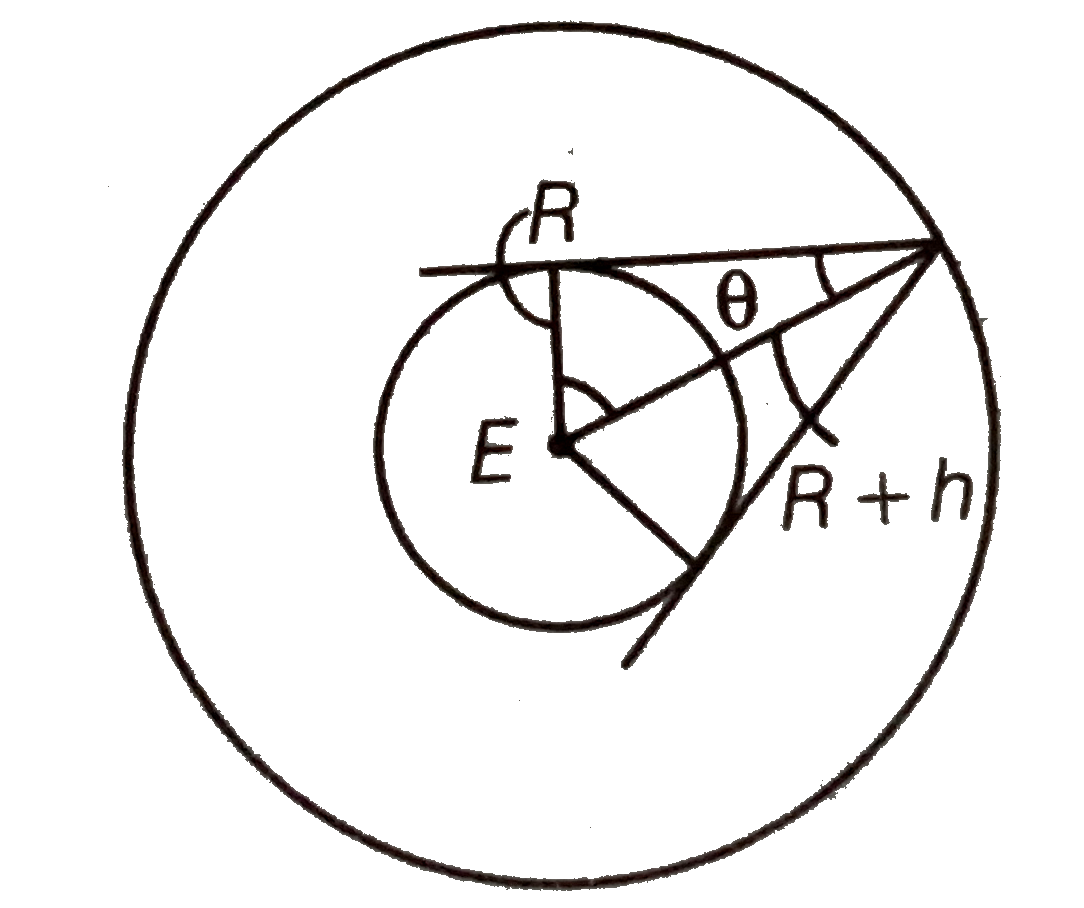
`cos theta = (R)/(R + h) = (1)/((1 + (h)/(R))) = (1)/((1 + (3.59 xx 10^(7))/(6.4 xx 10^(6))))`
`= (1)/(1 + 5.61) = (1)/(6.61) = 0.1513 = cos 81^(@)18'`
`theta = 81^(@)18'`
`:. 2 theta = 2 xx (81^(@)18') = 162^(@) 36'`
If `n` is the number of satellites needed to cover entire the earth, then
`n = (360^(@))/(2 theta) = (360^(@))/(162^(@)36') = 2.31
`:.` Minimum 3 satellites are required to cover entire the earth


