

Home
Class 11
PHYSICS
A particle is projected in aer an angle ...

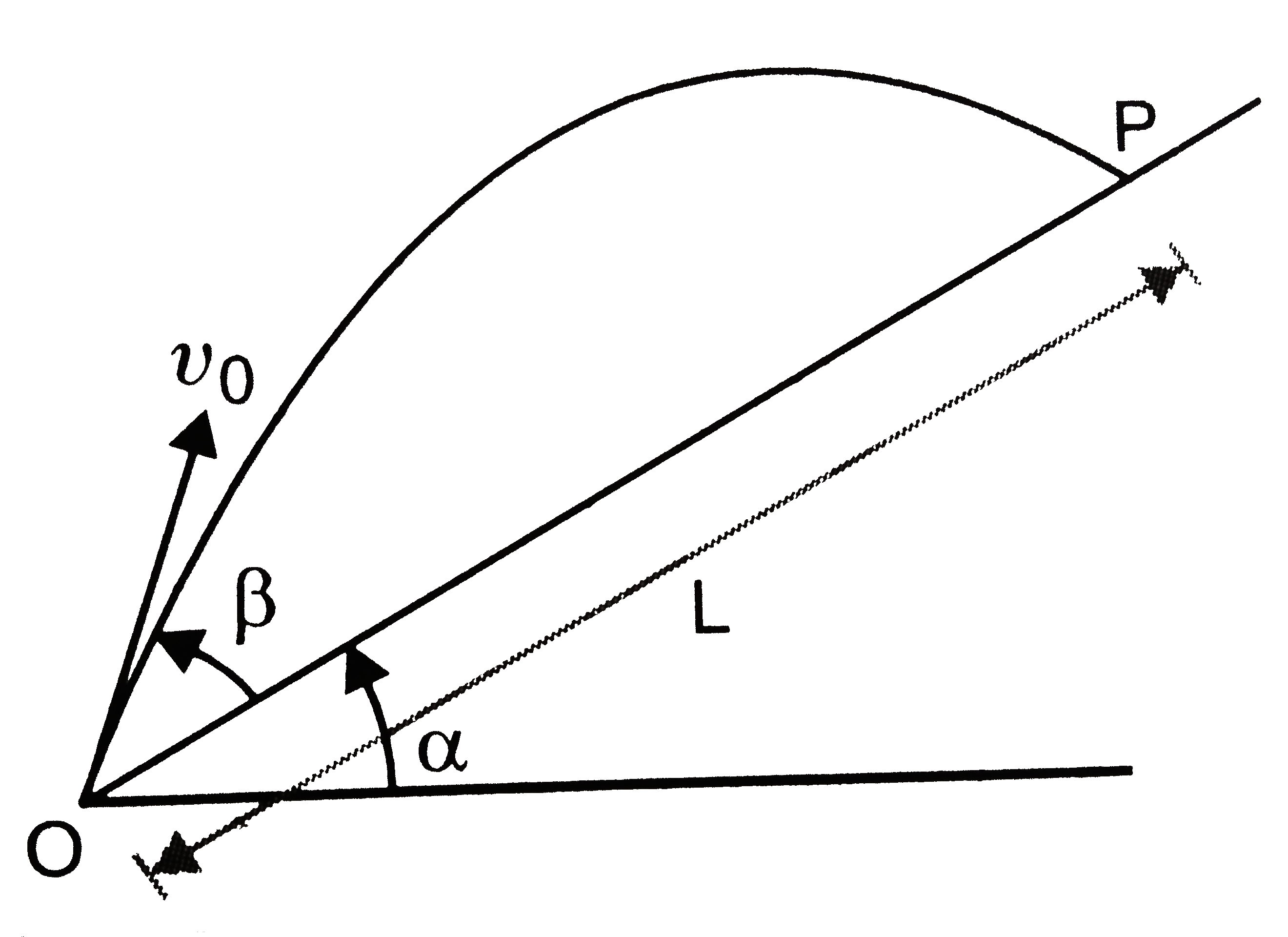
A particle is projected in aer an angle ` beta` to a surface which itself is inclined at an angle ` alpha` to the horixonta (Fig. 2 (EP). 26)
(a) Find an ecxpression for range on the plane surface (distanc eon the plance from the point of projection at which particle will hit the surface). (b) Time of flight. 9c ) ` beta` at which range will be maximum.

Text Solution

Verified by Experts


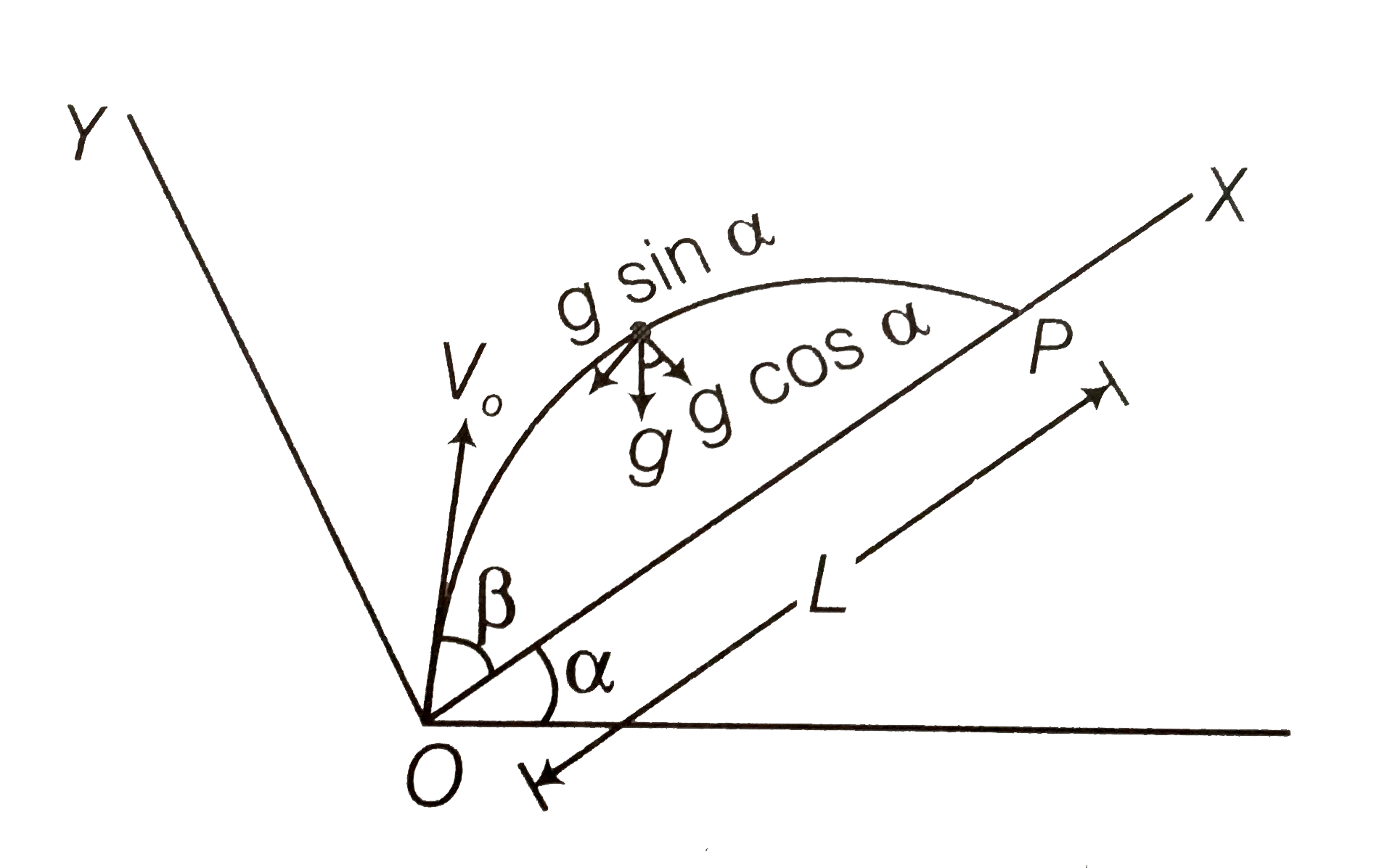
Consider the adjacent diagram.
Mutually perpendicular x and y-axes are shown in the diagram.
Particle is projected from the point O.
Let time taken in reaching from point O to point P is T.
(b) Considering motion along vertical upward direction perpendicular to OX.
For the journey O to P.
`y=0, u_(y)=v_(0) sin beta, a_(y) = - g cos alpha, t = T`
Applying equation,
`y=u_(y)t+(1)/(2)a_(y)t^(2)`
`rArr " " 0=v_(0)sin beta T + (1)/(2) (-g cos alpha)T^(2)`
`rArr T[v_(0)sin beta -(gcos alpha)/(2)T]=0`
`rArr " " T=0,T=(2 v_(0)sin beta)/(g cos alpha)`
As T = 0, corresponding to point O
Hence, `" " T="Time of flight" =(2 v_(0)sin beta)/(g cos alpha)`
(a) Considering motion along OX,
`x=L, u_(x)=v_(0) cos beta, a_(x)=-g sin alpha`
`t=T=(2v_(0)sin beta)/(g cos alpha)`
`x=u_(x)t+(1)/(2)a_(x)t^(2)`
`rArr " " L=v_(0)cos beta T+(1)/(2)(-g sin alpha)T^(2)`
`rArr " " L=v_(0) cos betaT-(1)/(2)g sin alpha T^(2)`
`=T[v_(0)cos beta -(1)/(2) g sin alpha T]`
`=T[v_(0)cos beta-(1)/(2) g sin alpha xx (2v_(0)sin beta)/(g cos alpha)]`
`=(2v_(0)sin beta)/(g cos alpha)[v_(0)cos beta-(v_(0)sin alpha sin beta)/(g cos alpha)]`
`=(2v_(0)^(2)sin beta)/(g cos^(2) alpha)[cos beta.cos alpha-sin alpha . sin beta]`
`rArr " " L=(2v_(0)^(2)sin beta)/(g cos^(2) alpha)cos (alpha+beta)`
(c) For range (L) to be maximum.
Let, `" " Z=sin beta. cos(alpha+beta)`
`=sinbeta[cos alpha.cosbeta-sinalpha.sin beta]`
`=(1)/(2)[cosalpha.sin 2 beta - 2 sin alpha. sin^(2)beta]`
`=(1)/(2)[sin 2 beta. cos alpha - sin alpha (1-cos 2 beta)]`
`rArr " " z=(1)/(2) [sin 2 beta. cos alpha-sin alpha + sin alpha. cos 2 beta]`
`=(1)/(2)[sin 2 beta . cos alpha + cos 2 beta. sin alpha - sin alpha]`
`=(1)/(2) [sin (2beta + alpha)-sin alpha]`
For z to be maximum,
`sin (2=beta+alpha)`=maximum = 1
`rArr " " 2beta + alpha =(pi)/(2) or, beta = (pi)/(4) -(alpha)/(2)`
Promotional Banner

Topper's Solved these Questions

  • MECHANICAL PROPERTIES OF SOLIDS

    NCERT EXEMPLAR|Exercise LONG SHORT ANSWER TYPE QUESTION|16 Videos
  • MOTION IN A STRAIGHT LINE

    NCERT EXEMPLAR|Exercise Very Short Answer Type Qns|14 Videos

Similar Questions

Explore conceptually related problems

A particle is projected horizontally with a speed u from the top of plane inclined at an angle theta with the horizontal. How far from the point of projection will the particle strike the plane ?

A particle is projected horizontal with a speed u from the top of plane inclined at an angle theta with the horizontal. How far from the point of projection will the particle strike the plane?

A particle I projected at an angle of elevation alpha after time t it makes an angle beta with horizontal. The velocity of projection is

A particle is projected at an angle with horizontal. If T is the time of flight and R is a horizontal range, then theta is

A particle is projected horizontally with a speed V=5m/s from the top of a plane inclined at an angle theta=37^(@) to the horizontal (g=10m//s^(2)) Find the time taken by the particle to hit the plane.

A particle is projected from the bottom of an inclined plane of inclination 30^@ . At what angle alpha (from the horizontal) should the particle be projected to get the maximum range on the inclined plane.

A particles is projected horizontally with a speed v from the top of a plane inclined at an angle tehta to the horizontal as shown in the figure. (a) Hwo far from the point of projection will the particle strike the plane ? (b) Find the time taken by the particel to hit the plane. (c) What is the velocity of particle just before it hits the plane ?

A particle is projected up an inclines plane. Plane is inclined at an angle theta with horizontal and particle is projected at an angle alpha with horizontal. If particle strikes the plane horizontally prove that tan alpha=2 tan theta

NCERT EXEMPLAR-MOTION IN A PLANE-Multiple Choice Questions
  1. A ball is thrown from a roof top at angle of 40^(@)above the horizont...

    Text Solution

    |

  2. A football is kicked into the air vertically upwards. What is its (a) ...

    Text Solution

    |

  3. vec A , vec B and vec C are three non-collinear, non co-planar vectors...

    Text Solution

    |

  4. A boy travelling in an open car moving on a levelled road with constan...

    Text Solution

    |

  5. A boy throws a ball in air at 60^@ to the horizontal along a road wit...

    Text Solution

    |

  6. In dealing with motion of projectile in air, we ignore effect of air r...

    Text Solution

    |

  7. A fighter plane is flying horizontally at an altitude of 1.5 km with s...

    Text Solution

    |

  8. (a) Earth can be thought of as a sphere of radius 64 00 km. Any objec...

    Text Solution

    |

  9. Given below in Column I are the relations between vectors a,b and c an...

    Text Solution

    |

  10. If |A|=2 and |B| = 4, then match the relation in Column I with the ang...

    Text Solution

    |

  11. If | vec A | =2 and | vec B| =4, then match the relations in column ...

    Text Solution

    |

  12. A hill is 500 m high. Supplies are to be across the hill using a cano...

    Text Solution

    |

  13. A gun can fire shells with maximum speed v(0) and the maximum horizont...

    Text Solution

    |

  14. A particle is projected in aer an angle beta to a surface which itsel...

    Text Solution

    |

  15. A particle falling vertically from a height hits a plane surface incli...

    Text Solution

    |

  16. A girl riding a bicycle with a speed of 5 m//s to wards Noth directio...

    Text Solution

    |

  17. A river is flowing due east with a speed 3 m//s (Fig. 2 (EP) .31 ). ...

    Text Solution

    |

  18. A cricket fielder can throw the cricket ball with a speed v0. If he t...

    Text Solution

    |

  19. Motion in two dimensions, in a plane can be studied by expressing posi...

    Text Solution

    |

  20. A man wants to reach from A to the opposite corner of the square C. T...

    Text Solution

    |