

Home
Class 12
CHEMISTRY
Alcohols react with active metals e.g., ...

Alcohols react with active metals e.g., Na, K etc., to give corresponding alkoxides. Write down the decreasing order of reactivity of sodium metal towards primary, secondary and tertiary alcohols.

Text Solution

Verified by Experts

An electron releasing group produces +I effect so it increases the electron density on oxygen and decreases the polarity of O-H nond. As the number of alkyl group increases from `1^(@)` to `3^(@)` alcohols, the electron density on the O-H bond increases.
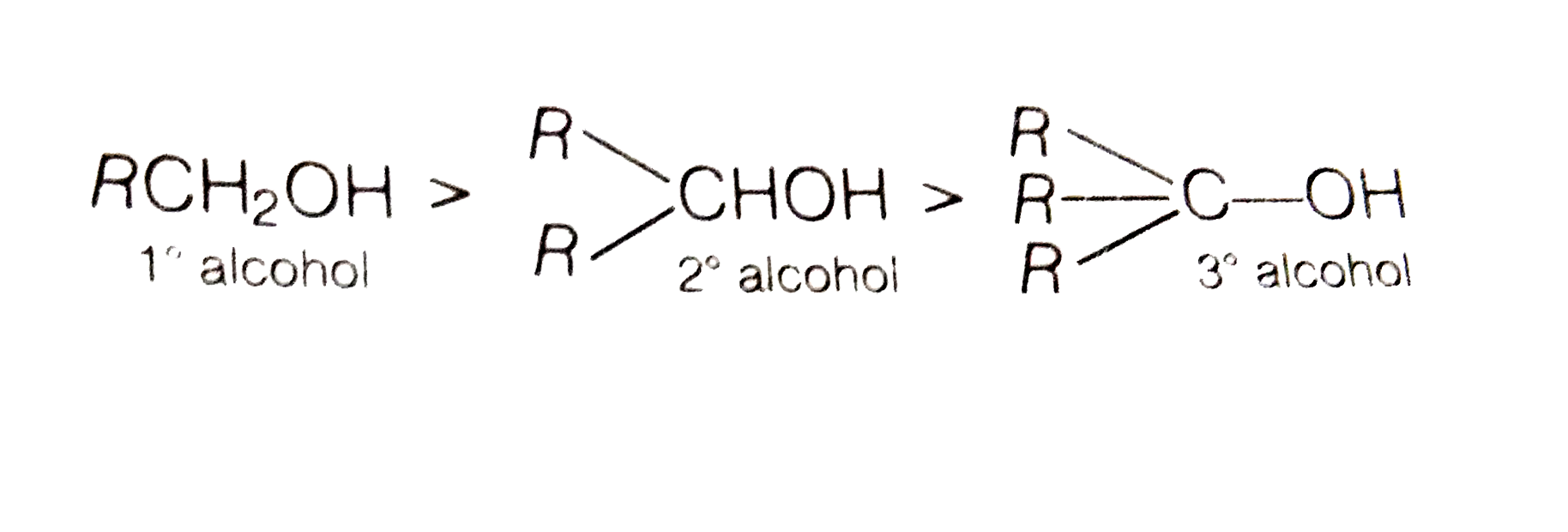
It will finally decrease the polarity and increase the strength of O-H bond in going from `1^(@)` to `3^(@)` alcohols. Thus, acidic strength decreases in the following order

As we know that, sodium metal is basic in nature and alcohols are acidic in nature. Thus, reactivity of alcohol with sodium metal decreases with decrease in acidic strength. Therefore, the correct order is `1^(@) gt 2^(@) gt 3^(@)`.
Promotional Banner

Topper's Solved these Questions

  • ALDEHYDE, KETONES AND CARBOXYLIC ACIDS

    NCERT EXEMPLAR|Exercise Aldehyde, Ketones And Carboxylic Acids|50 Videos

Similar Questions

Explore conceptually related problems

What is the decreasing order of reactivity of sodium metal towards three types of aliphatic alcohols ?

The order of reactivity of alcohols with sodium metal is

Arrange the followign metals in the decreasing order to reactivity Na, K, Cu and Ag.

The order of reactivity of alcohols in the esterification reaction is : Primary gt secondary gt tertiary. Justify.

Reactivity order of primary(p), secondary(s) and tetriary (T) alcohols towards esterification is

Arrange the following alcohols in the decreasing order of reactivity towards (a) Lucas reagent Sodium metal (1) 1-Butano1 (2) sodium metal (3) 2-Methy1-2-propanol.

NCERT EXEMPLAR-ALCOHOLS, PHENOLS AND ETHERS-Alcohols, Phenols And Ethers
  1. When phenol is treated with bromine water, white precipitate is obtain...

    Text Solution

    |

  2. What is the correct increasing order of acidic strength in the followi...

    Text Solution

    |

  3. Alcohols react with active metals e.g., Na, K etc., to give correspond...

    Text Solution

    |

  4. What happens when benzene diazonium chloride is heated with water ?

    Text Solution

    |

  5. Arrange the following compounds in decreasing order of acidity. H(2)...

    Text Solution

    |

  6. Name the enzymes and write the reactions involved in the preparation o...

    Text Solution

    |

  7. How can propan-2-one be converted into tert-butyl alcohol ?

    Text Solution

    |

  8. Write structural formula for all the isomeric alcohols having the mole...

    Text Solution

    |

  9. Explain why is OH group in phenols more strongly held as compared to O...

    Text Solution

    |

  10. Explain why nucleophilic substitution reactions are not very common in...

    Text Solution

    |

  11. Preparation of alcohols from alkenes involves the electrophilic attack...

    Text Solution

    |

  12. Explain why is O=C=O non polar while R-O-R is polar ?

    Text Solution

    |

  13. Why is the reactivity of all the three classes of alcohols with conc. ...

    Text Solution

    |

  14. Write steps to carry out the conversion of phenol to aspirin.

    Text Solution

    |

  15. Nitration is an example of aromatic electrophilic substitution and its...

    Text Solution

    |

  16. In Kolbe's reactio insteaded of phenol, phenoxide ion is treated with ...

    Text Solution

    |

  17. Dipole moment of phenol is smaller than that of methanol. Why ?

    Text Solution

    |

  18. Ethers can be prepared by Williamson synthesis in which an alkyl halid...

    Text Solution

    |

  19. Why is the C-O-H bond angle in alcohols slightly less than the tetrahe...

    Text Solution

    |

  20. Explain why low molecular mass alcohols are soluble in water ?

    Text Solution

    |