Home
Class 11
CHEMISTRY
Structures of molecules of two compounds...

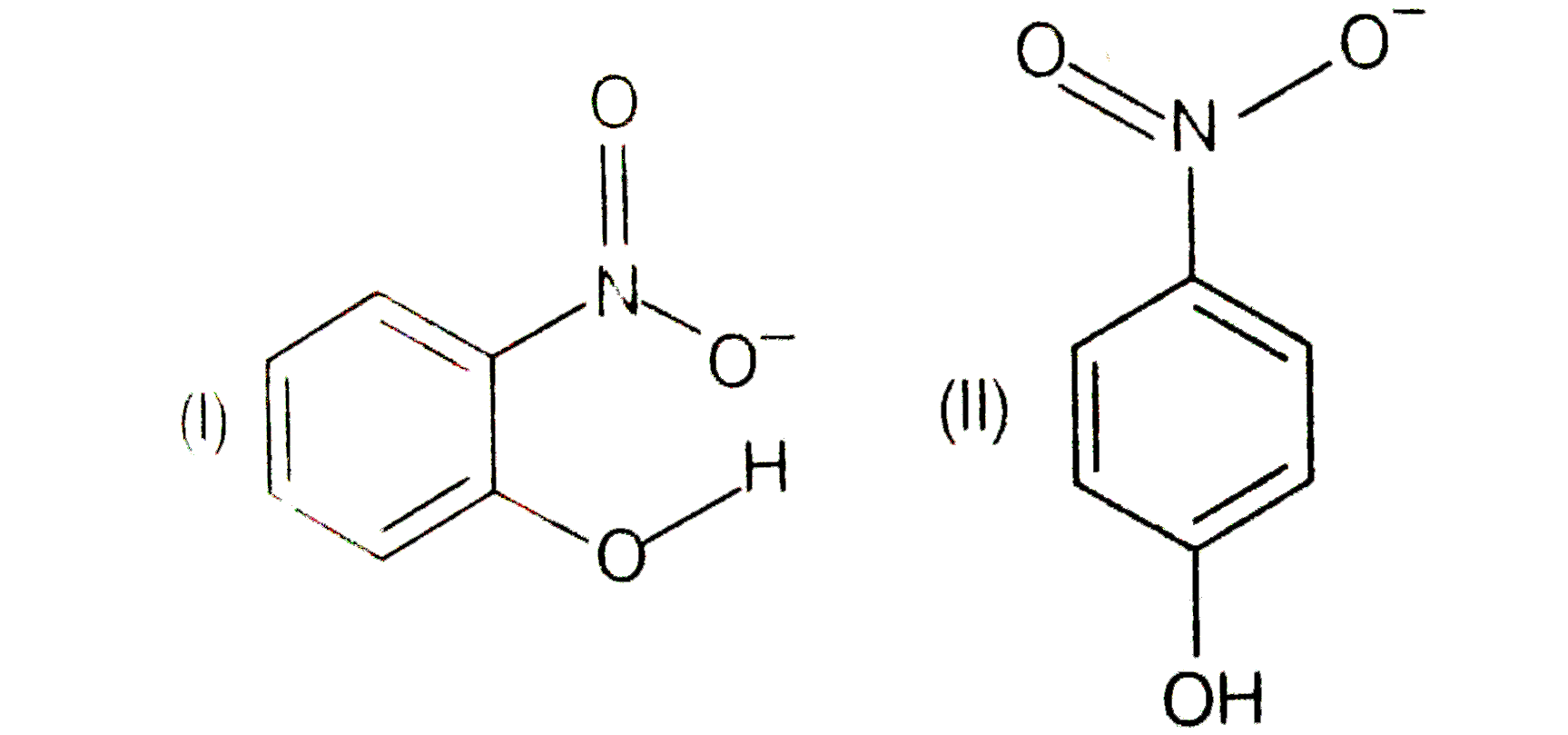
Structures of molecules of two compounds are given below.

a) Which of the two compounds will have intermolecular hydrogen bonding and which compound is expected to show intramolecular hydrogen bonding?
b) The melting point of compound depends on, among other things, the extent of hydrogen bonding. On this basis explain which of the above two compounds will show higher melting point?
c) Solubility of compounds in water depends on powers to form hydrogen bonds with water. Which of the above compounds will form hydrogen bond with easily and be more stable in it?

Text Solution

Verified by Experts

The correct Answer is:

a

a) Compound (i) will form intramolecular H-bonding. Intramolecular H-bonding is formed when H-atom. In between the two highly electronegative atoms is present within the same molecule. In ortho-nitrophenol (compound I). H-atom is in between the two oxygen atoms.

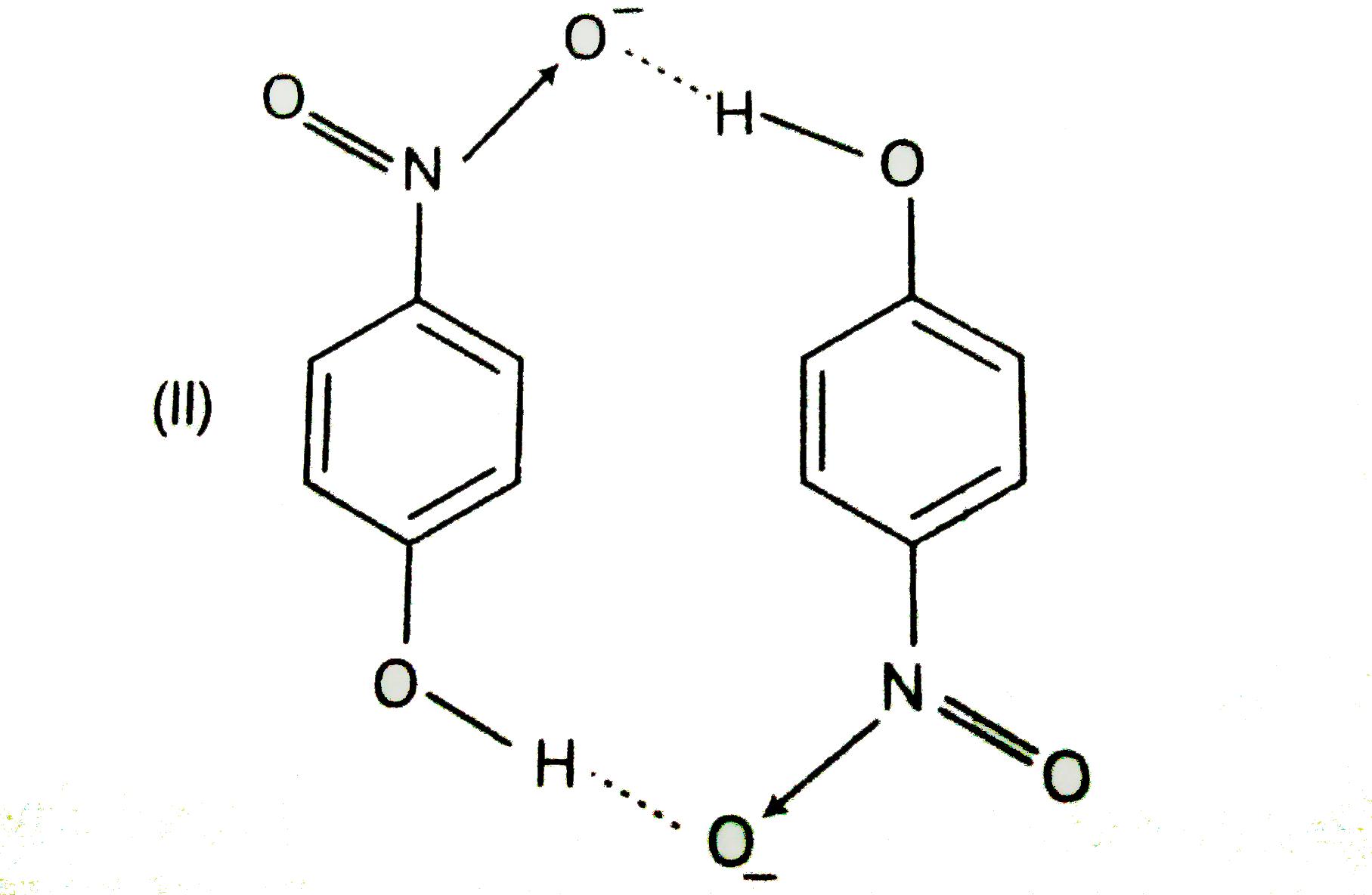
Compound (II) forms intermolecular H-bonding. In para-nitrophenol (II) there is a gap between `NO_(2)` and OH group. So, H-bond exists between H-atoms of one molecule and O-atom of another molecules as depicted below.

b) Compound (II) will have higher melting point because large number of molecules and joined together by H-bonds.
c) Due to intramolecular H-bonding, compound (I) is not able to form H-bond with water, so it is lesss soluble in water. While molecules of compound II form H-bonding with `H_(2)O` easily. so it is soluble in water.
Promotional Banner

Topper's Solved these Questions

  • CHEMICAL BONDING AND MOLECULAR STRUCTURE

    NCERT EXEMPLAR|Exercise Matching the columns|5 Videos
  • CHEMICAL BONDING AND MOLECULAR STRUCTURE

    NCERT EXEMPLAR|Exercise Assertions and Reasons|3 Videos
  • CHEMICAL BONDING AND MOLECULAR STRUCTURE

    NCERT EXEMPLAR|Exercise Long Answer type questions|9 Videos
  • CLASSIFICATION OF ELEMENTS AND PERIODICITY IN PROPERTIES.

    NCERT EXEMPLAR|Exercise Long answer types question|7 Videos

Similar Questions

Explore conceptually related problems

Structures of molecules of two compounds are given: (a) Which of the two compounds will have intermolecular hydrogen bonding and which compound is expected to show intramolecular hydrogen bonding. (b) The melting point of a compound depends on, among other things, the extent of hydrogen bonding. On this basis explain which of these two compounds will show higher melting point. (c ) Solubility of compounds in water depends on power of formed hydrogen bonds with water. Which of these compounds will from hydrogen bond will water easily and be more soluble in it ?

Which of the following molecule have intramolecular hydrogen bonding?

Which of the following compounds will have highest melting point?

Which of the following compounds will have highest melting point ?

Structures of molecules of two compounds are given below : (a) Which of the following compounds will have intermolecular hydrogen bonding and which compound is expected to show intramolecular hydrogen bonding? (b) Which of the above two compounds will show higher melting point? (c ) Which of the above compounds will form hydrogen bond with water easily and be more soluble in it?

NCERT EXEMPLAR-CHEMICAL BONDING AND MOLECULAR STRUCTURE-Short answer types questions
  1. Using molelcular orbital theory, compare the bond energy and magnetic ...

    Text Solution

    |

  2. Explain the shape of BrF(5^.)

    Text Solution

    |

  3. Structures of molecules of two compounds are given below. a) Whic...

    Text Solution

    |

  4. Why does type of overlap given in the following figure not result in b...

    Text Solution

    |

  5. Explain why PCl(5) is trigonal bipyramidal whereas IF(5) is square pyr...

    Text Solution

    |

  6. In both water and dimethyl ether (CH(3)-underset(..)overset(..)O-CH(3)...

    Text Solution

    |

  7. Write Lewis structure of the following compounds and show format charg...

    Text Solution

    |

  8. The energy of sigma2p(z), molecular orbital is greater than pi2p(x) an...

    Text Solution

    |

  9. Give the change in bond order in the following ionisation process? i...

    Text Solution

    |

  10. Give reason for the following. a) Covalent bonds are directional bon...

    Text Solution

    |

  11. What is an ionic bond? With two suitable exmaples the difference betwe...

    Text Solution

    |

  12. Arrange the following bonds in order of increasing ionic character giv...

    Text Solution

    |

  13. Explain why CO(3)^(2-) ion cannot be represented by a single Lewis str...

    Text Solution

    |

  14. Predict the hybridisation of each carbon in the molecule of organic co...

    Text Solution

    |

  15. Group the following as linear and non-linear molecules : H(2)O,HOCl,...

    Text Solution

    |

  16. Elements X,Y and Z have 4,5 and 7 valence electrons respectively, (i) ...

    Text Solution

    |

  17. Draw the resonatin structure of (i) Ozone molecule (ii) Nitrate ion

    Text Solution

    |

  18. Presict the shapes of the following molecules on the basis of hybridis...

    Text Solution

    |

  19. All the C-O bonds in carbonate in (CO(3)^(2-)) are equal in length. Ex...

    Text Solution

    |

  20. what is meant by the term average bond enthalpy? Why is there differen...

    Text Solution

    |