Home
Class 12
PHYSICS
A long charged cylinder of linear char...

A long charged cylinder of linear charge density `lambda` is surrounded by a hollow co-axial conducting cylinder. What is the electric field in the space between the two cylinders ?

Text Solution

Verified by Experts
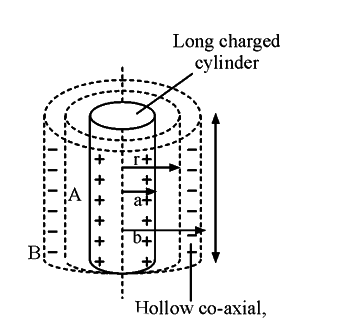
Let there be a long charged cylinder A of linear charge density , length l and radius a. Now, one more hollow co-axial cylinder B of same length l and radius b surrounds the cylinder A(b `gt` a)
The charge on cylinder `A,q=lamda l`
Total charge = Linear charge density × Length
This charge spreads uniformly on A and a charge -q is induced on B. Let E be the electric field produced in the space between the two cylinders. Consider a Gaussian cylindrical surface of radius r between the two given cylinders.
Electric flux linked with the Gaussian surface `int_E=int E. ds =int E.ds cos 0^@=E int ds=E times 2`
[As angle between the direction of electric field and area vector is zero]
According to Gauss’s theorem `phi=E times 2pi rl=q/e_0, E times 2pi rl=(lamda l)/e_0, E=lamda/(2pi e_0r)`
Promotional Banner

Similar Questions

Explore conceptually related problems

A long charged cylinder of linear charge density lambda is surrounded by a hollow co-axial conducting cyclinder. What is the electric field in the space between the two cylinders ?

Two parallel infinite line charges with linear charge densities +lambda C//m and -lambda C/m are placed at a distance of 2R in free space. What is the electric field mid-way between the two line charges?

An infinite line charge of uniform electric charge density lambda lies along the axis of an electrically conducting infinite cylindrical shell of radius R. At time t=0 , the space inside the cylinder is filled with a material of permittivity epsilon and electrical conductivity sigma . The electrical conduction in the material follows Ohm's law. Which one of the following graphs best describes the subsequent variation of the magnitude of current density j(t) at any point in the material ?

A very long charged wire (lying in the xy plane ) which is having a linear charge density lambda is having one of its end at a point P as shown in figure . What is electric field intensity at point Q :

