Home
Class 12
PHYSICS
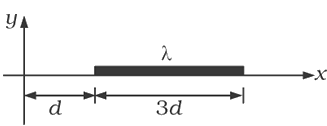
A continuous line of charge of length 3d...

A continuous line of charge of length 3d lies along the x-axis, extending from x + d to x + 4d, The line carries a uniform linear charge density `lambd` . In terms of `d, lambda` and any necessary physical constant find the magnitude of the electric field at the origin.

A

`lambda//5 pi epsi_(0) d`

B

`lambda // 4 pi epsi_(0) d`

C

`3 lambda //16 pi espi_(0)d`

D

`3 lambda // 8 pi epsi_(0)d`

Text Solution

Verified by Experts

The correct Answer is:

C

Electric field at origin can be given by intergrating the electric fkeld due to an element considered on the rod of length dx at a distance x from origin which is given as
`E= int_a ^(4d) (k lamda dx)/x^2 implies E= lamda/(4pi e_0) -1/x |_d^(4d) =lamda/(4 pi e_0) (1/d-1/(4d))=(3 lamda)/(16 pi e_0d)`
Promotional Banner

Similar Questions

Explore conceptually related problems

A continuous line of charge oflength 3d lies along the x-axis, extending from x + d to x + 4d . the line carries a uniform linear charge density lambda . In terms of d, lambda and any necessary physical constants, find the magnitude of the electric field at the origin:

Find the electric field at the origin due to the line charge (ABCD) of linear charge density lambda ,

A rod of length L lies along the x-axis with its left end at the origin. It has a non-uniform charge density lamda=alphax , where a is a positive constant. (a) What are the units of alpha ? (b) Calculate the electric potential at point A where x = - d .

A rod of length L is placed along the x-axis between x = 0 and x = L. The linear density (mass/ length) lambda of the rod varies with the distance x from the origin as lambda = Rx . Here, R is a positive constant. Find the position of centre of mass of this rod.

Two uniformly long charged wires with linear densities lambda and 3lambda are placed along X and Y axis respectively. Determined the slope of electric field at any point on the l ine y=sqrt3x

If three infinite charged sheets of uniform surface charge densities sigma, 2sigma and -4 sigma are placed as shown in figure, then find out electric field intensities at points A, B, C and D.

An infinitely long time charge has linear charge density lamdaC//m the line charge is along the line x=0,z=2m find the electric field at point (1,1,1) m.

A rod of length 'l' is placed along x-axis. One of its ends is at the origin. The rod has a non-uniform charge density lambda= a, a being a positive constant. Electric potential at P as shown in the figure is -
