Home
Class 12
CHEMISTRY
CH3-overset(CH3)overset(|)underset(CH3)u...

`CH_3-overset(CH_3)overset(|)underset(CH_3)underset(|)C-CH_2CH_2CH_2OH overset(H^+)to `
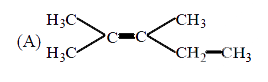
Alkene The alkene formed in the above reaction will be

A

B

`CH_3-overset(CH_3)overset(|)underset(CH_3)underset(|)C-CH=CH-CH_3`

C

`CH_3-overset(CH_3)overset(|)underset(CH_3)underset(|)C-CH=CH_2`

D

none of the above

Text Solution

AI Generated Solution

The correct Answer is:

To solve the question regarding the alkene formed from the given alcohol, we will follow these steps: ### Step 1: Identify the Structure of the Alcohol The given compound is: \[ CH_3 - C(CH_3)_2 - CH_2 - CH_2 - CH_2 - OH \] This structure indicates that we have a tertiary alcohol due to the presence of a hydroxyl (-OH) group attached to a carbon that is connected to three other carbon atoms. ### Step 2: Dehydration Reaction When the alcohol is treated with an acid (H⁺), a dehydration reaction occurs. This involves the loss of a water molecule (H₂O) from the alcohol, leading to the formation of a carbocation. ### Step 3: Formation of Carbocation Upon dehydration, the -OH group is protonated, making it a better leaving group. The water molecule leaves, forming a carbocation. In this case, the carbocation formed is a primary carbocation initially, but it can undergo rearrangement to form a more stable secondary carbocation. ### Step 4: Carbocation Rearrangement The primary carbocation can undergo a hydride shift (a rearrangement) to form a more stable secondary carbocation. This occurs as follows: - The hydride (H⁻) from the adjacent carbon shifts to the positively charged carbon, stabilizing the carbocation. ### Step 5: Formation of Alkene Once the more stable carbocation is formed, the next step is the elimination of a proton (H⁺) to form the alkene. The elimination can occur in two possible ways: 1. Elimination of H from the carbon adjacent to the carbocation. 2. Elimination of H from the carbon that is further away. ### Step 6: Determine the More Stable Alkene The alkene formed from the elimination will depend on which carbon the H⁺ is removed from: - If H⁺ is removed from the adjacent carbon, we will get one alkene. - If H⁺ is removed from the other carbon, we will get another alkene. ### Step 7: Analyze Alkene Stability To determine which alkene is more stable, we consider the number of alkyl groups attached to the double bond: - More alkyl substituents on the double bond lead to greater stability due to hyperconjugation and the inductive effect. ### Conclusion After analyzing the possible alkenes formed and their stability, the alkene with the most alkyl substituents will be the major product. ### Final Answer The alkene formed in the reaction will be the one with the highest stability, which is: \[ CH_3 - C(CH_3)=CH - CH_2 - CH_3 \]
Promotional Banner

Topper's Solved these Questions

  • ALCOHOLS & ETHERS

    MOTION|Exercise EXERCISE -2 (LEVEL -II) MULTIPLE CORRECT JEE ADVANCED|21 Videos
  • ALCOHOLS & ETHERS

    MOTION|Exercise EXERCISE -3 OBJECTIVE PROBLEMS JEE ADVANCED|17 Videos
  • ALCOHOLS & ETHERS

    MOTION|Exercise EXERCISE -1 OBJECTIVE PROBLEMS JEE MAIN|47 Videos
  • ALKYI HALIDE

    MOTION|Exercise Exercise - 4 | Level-II|8 Videos

Similar Questions

Explore conceptually related problems

CH_(3)-underset(CH_(3))underset(|)overset(CH_(3))overset(|)(C)CH_(2)CH_(2)CH_(2)OHoverset(H^(+))(rarr) The alkene formed in the above reaction will be :

CH_(3)-underset(CH_(3))underset(|)(CH)-CH=CH-CH_(2)-overset(O)overset(||)(C)-OH

Write the IUPAC name of the compound given below. CH_3-overset(CH_2-CH_3)overset(|)underset(CH_2-CH_3)underset(|)C-CH_2-overset(CH_2-CH_3)overset(|)underset(CH_2-CH_3)underset(|)C-CH_3

Give the IUPAC name of the compound, CH_3-overset(CH_3)overset(|)underset(OH)underset(|)C-CH_2-CH_3

The IUPAC name of CH_3-underset(CH_3)underset(|)overset(CH_3)overset(|)C-CH=CH_2 is -

CH_(3)-overset(CH_(3))overset("| ")underset(CH_(3))underset("| ")"C "CH=CH_(2) rarr CH_(3)-underset(CH_(3))underset("| ")overset(CH_(3))overset("| ")"C "-underset(OH)underset("| ")"CH"-CH_(3) The abvoe change can be proceed by
