Home
Class 12
PHYSICS
A constant force F = m(2)g//2 is applied...

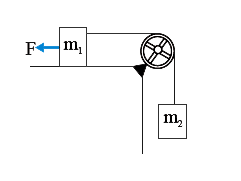
A constant force `F = m_(2)g//2` is applied on the block of mass `m_(1)` as shown in fig. The string and the pulley are light and the surface of the table is smooth. The acceleration of `m_(1)` is `:`

A

`(m_(2)g)/( 2(m_(1)+m_(2)))` towards right

B

`( m_(2)g)/( 2(m_(1)-m_(2)))` towards left

C

`( m_(2)g)/( 2(m_(2)-m_(1)))` towards right

D

`( m_(2)g)/( 2(m_(2)-m_(1)))` towards left

Text Solution

Verified by Experts

The correct Answer is:

1
Promotional Banner

Similar Questions

Explore conceptually related problems

A constant force F=m_2g/s is applied on the block of mass m_1 as shown in figure. The string and the pulley are light and the surface of the table is smooth. Find the acceleration of m_1

Three blocks of masses m_(1), m_(2) and M are arranged as shown in figure. All the surfaces are fricationless and string is inextensible. Pulleys are light. A constant force F is applied on block of mass m_(1) . Pulleys and string are light. Part of the string connecting both pulleys is vertical and part of the strings connecting pulleys with masses m_(1) and m_(2) are horizontal. {:((P),"Accleration of mass " m_(1),(1) F/(m_(1))),((Q),"Acceleration of mass" m_(2),(2) F/(m_(1)+m_(2))),((R),"Acceleration of mass M",(3) "zero"),((S), "Tension in the string",(4) (m_(2)F)/(m_(1)+m_(2))):}

In the Fig force F = alpha t is applied on the block of mass m_(2) . Here alpha is a constant and t is the time .Find the acceleration of the block Also draw the acceleration time graph of both the block

Three blocks of masses m_1, m_2 and m_3 are connected as shown in the figure. All the surfaces are frictionless and the string and the pulleys are light. Find the acceleration of m_1

Find the acceleration of masses m_(1) and m_(2) moving down the smooth incline plane. The string and the pulley are masseless and frictionless.

Two blocks of masses m and M are placed on a horizontal frictionless table connected by light spring as shown in figure. The Mass M is pulled to the right with a force F It the acceleration of mass m is a then the acceleration of M will be .

A block of mass m_(1) on a smooth, horizontal· swface is: connected to a second mass m_(2) by a light cord ovbr a light,: frictionless pulley as shown. (Neglect the mass of the cord and' of the pulley). A force of magnitude F_(0) is applied to mass m_(1) · as shown. Neglect any friction. (a) Find the value of force F_(0) for which the sy!tem will be in equilibrium. (b) Find the acceleration of masses andtensio~ in string if F_(0) has a value which is double of that foun,d in part (a).

find the acceleration of the block of mass M in the situation shown in figure. All the surfaces are frictionless and the pulleys and the string are light.

A block of mass m_(1)=2 kg is kept on a smooth horizontal table. Another block of mass m_(2)=1 kg is connected to m_(1) by a light inextensible string passing over a smooth pulley as shown in the figure. If the blocks are released, what will be the (a) acceleration of each block (b) tension in the string?

A block of mass m = 2kg is accelerating by a force F = 20N applied on a smooth light pulley as shown in the figure. If the coefficient of kinetic friction between the block and the surface is mu=0.3 , find its acceleration.
