Home
Class 12
CHEMISTRY
Explain the estimation of nitrogen of an...

Explain the estimation of nitrogen of an organic compound by
b) Kjeldahl's method

Text Solution

Verified by Experts
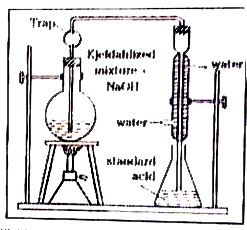
Eslimation of `N_(2)` by Kjeldahl's method : In this method the organic compound is heated with conc, `H_(2)SO_(4)` in presence of a small amount of `CuSO_(4)`. Then `N_(2)` is quantitively converted into ammonium sulphate. The contents of the flask are transferred into another flask and heated with excess of `NaOH` solution to liberated is passed and absorbed in a knwon vol. of known conc. `H_(2)SO_(4)` (excess). Now the excess of acid remained after the neutrallsation by `NH_(3)` is lirated against a slandard solution of akali. From this, the amount of `H_(2)SO_(4)` used to neutralise `NH_(3)` is calculated. From this the mass of ammonia formed is calculated and from the `%` of `N_(2)` gas is calculated.

Organic compound `+H_(2)SO_(4)rarr(CH_(4))_(2)SO_(4)`
`(NH_(4))_(2)SO_(4)+2NaOH rarr Na_(2)SO_(4)+2H_(2)O+2NH_(3)`
`2NH_(3)+_(2)SO_(4)rarr (NH_(4))_(2)SO_(4)`.
Calculations :
Mass of organic compound = a g
Vol. of `H_(2)SO_(4)` Initially taken = V ml.
Molarity of `H_(2)SO_(4)=M`
Vol. of `NaOH` consumed after complete neutrallsation `=V_(1)ml`.
Molarity of `NaOH =M`
`2NaOH +H_(2)SO_(4) rarr Na_(2)SO_(4)+2H_(2)O`
Then from the formula,
`(NaOH)=(MV_(1))/(n_(1))=(MV_(2))/(n_(2))(H_(2)SO_(4))`
We get, `(MV_(1))/(2)=(MV_(2)/(1) or V_(2)=(V_(1))/(2)" ml. "`
`therefore" Vol. of "H_(2)SO_(4)" neutralilsed by "NH_(3)`
`=(V-(V_(1))/(2))ml`
`=(2(V-(V_(1))/(2))ml` of M molar `NH_(3)` solution.
`"1000 ml. of 1 M"NH_(3)` solution.
1000 ml. of `1 M NH_(3)` solution contains 17 g of `NH_(3)` of 14 g of `N_(2)`.
`therefore 2(V-(V_(1))/(2))` ml of M molar `NH_(3)` solution .............?
`=(14xxM xx2(V-(V_(1))/(2)))/(1000)g" of "N_(2)`
`therefore % " of Nitrogen"`
`=(14xxMxx2(V-(V_(1))/(2)))/(1000)xx(100)/(a)`
Promotional Banner

Topper's Solved these Questions

  • ORGANIC CHEMISTRY

    VGS PUBLICATION-BRILLIANT|Exercise Short Answer Questions|17 Videos
  • MOST IMPORTANT QUESTIONS

    VGS PUBLICATION-BRILLIANT|Exercise ORGANIC CHEMISTRY (LONG ANSWER TYPE QUESTIONS)|11 Videos
  • STATES OF MATTER : GASES AND LIQUIDS

    VGS PUBLICATION-BRILLIANT|Exercise ADDITIONAL QUESTION & ANSWERS|10 Videos

Similar Questions

Explore conceptually related problems

Explain the estimation of nitrogen of an organic compound by (a) Dumas method and (b) Kjeldahl's method

During the estimation of nitrogen in an organic compound by Kjeldhal's method, the ammonia evolved from 0.5g of the compound was absorbed in 50 ml of 0.5 M H_(2)SO_(4) . The residual acid required 60 ml of 0.5 M NaOH solution. The percentage of nitrogen in the compound is

During the estimation of nitrogen in an organic compound by Kjeldhal's method, the ammonia evolved from 0.5g of the compound was absorbed in 50 ml of 0.5 M H_(2)SO_(4) . The residual acid required 60 ml of 0.5 M NaOH solution. The number of grams of NH_(3) releaed in the process is

Differentiate between the principal of estimation of nitrogen in an organic compound by (i) Kjeldehl's method and (ii) Dumas method.

During estimation of nitrogen present in an organic compound by Kjeldahl’s method, the ammonia evolved from 0.5 g of the compound in Kjeldahl’s estimation of nitrogen, neutralized 10 mL of 1 M H_(2)SO_(4) . Find out the percentage of nitrogen in the compound.

VGS PUBLICATION-BRILLIANT-ORGANIC CHEMISTRY-Long Answer Questions
  1. Explain the following : c) Partition chromatography

    Text Solution

    |

  2. Explain the estimation of nitrogen of an organic compound by a) Duma...

    Text Solution

    |

  3. Explain the estimation of nitrogen of an organic compound by b) Kjel...

    Text Solution

    |

  4. Explain inductive effect with a suitable example.

    Text Solution

    |

  5. Write a note on mesomeric effect.

    Text Solution

    |

  6. Describe resonance effect with one example.

    Text Solution

    |

  7. Explain how many types of organic reactlons are possible.

    Text Solution

    |

  8. Write the possible conformations of ethane and explain which is more s...

    Text Solution

    |

  9. Explain aromatic electroplhilic substitution reactions of benzene.

    Text Solution

    |

  10. Explain electrophilic addition reactions of ethylene with mechanism.

    Text Solution

    |

  11. With the help of mechamism explain free radical halogenationis of allk...

    Text Solution

    |

  12. Discuss Markovnikov's rule and Kharash effect.

    Text Solution

    |

  13. How would you convert the following compounds into benzene ? Chloro...

    Text Solution

    |

  14. How would you convert the following compounds into benzene ? Toluene

    Text Solution

    |

  15. How would you convert the following compounds into benzene ? p - nit...

    Text Solution

    |

  16. Why is Wurtz reaction not preferred for the preparation of alkanes con...

    Text Solution

    |

  17. Write the equations involved in the detection of Nitrogen, Halogens an...

    Text Solution

    |

  18. How are carbon and hydrogen of an organic compound estimated?

    Text Solution

    |

  19. Describe Dumans and Kjeldhahl's method for the estimation of Nitrogen ...

    Text Solution

    |

  20. How do you determine Sulphur , Phosphorous and Oxygen quantitatively i...

    Text Solution

    |

