Home
Class 12
PHYSICS
Consider a radioactive nucleus A which d...

Consider a radioactive nucleus A which decays to a stable nucleus C through the following sequence
`A to B to C`
Here B is an intermediate nuclei which is also radioactive. Considering that there are `N_(0)` atoms of A initially , plot the praph showing the variation of number of atoms of A and B versus time.

Text Solution

Verified by Experts
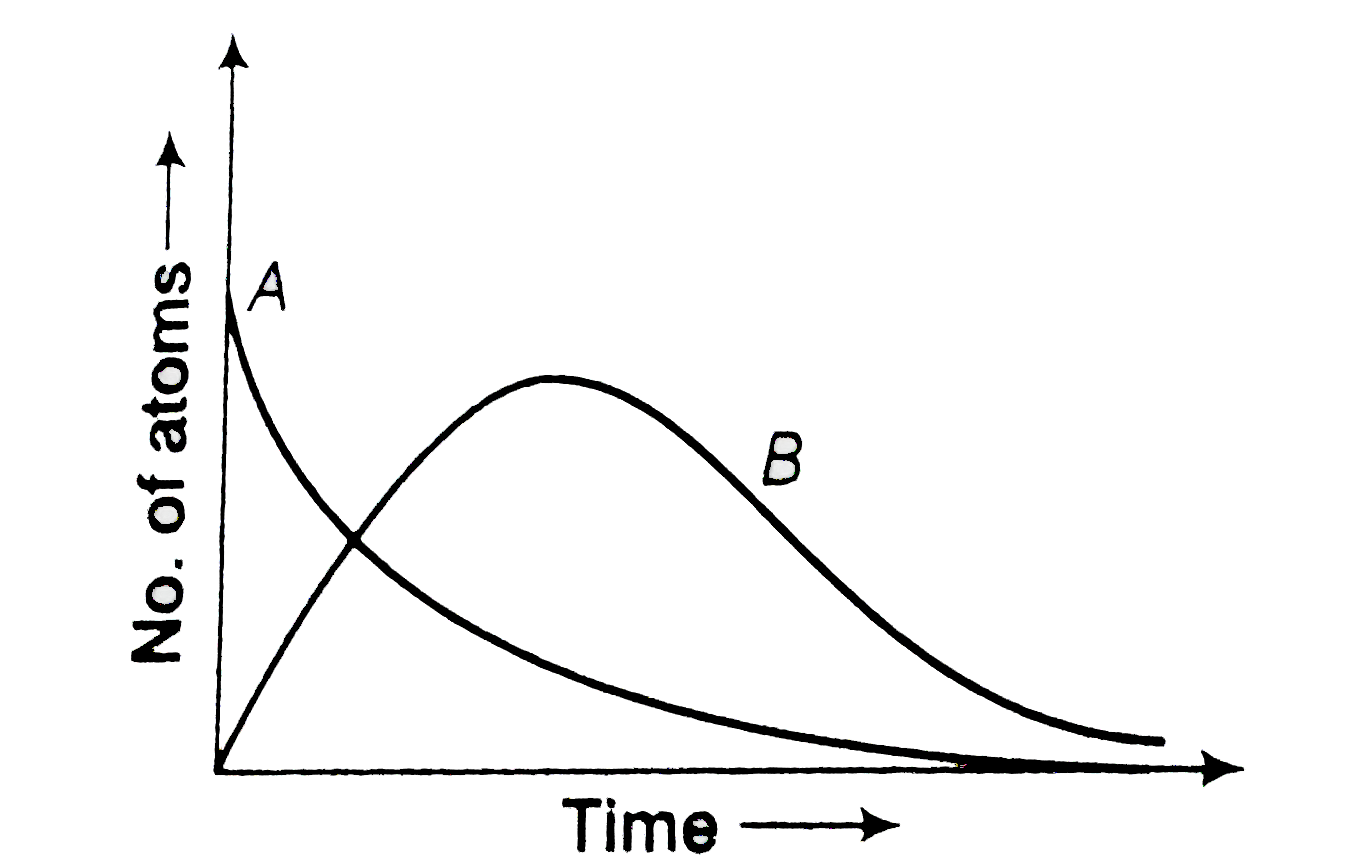
Consider the situation shown in the graph.

At `t= 0 , N_(A) =N_(0)` (maximum) while `N_(B) =0`. As time increases `N_(A)` decreases exponentially and the number of atoms of B increases. They becomes `(N_(B))` maximum and finally drop to zero exponenetially by radioactive decay law.
Promotional Banner

Topper's Solved these Questions

  • RAY OPTICS AND OPTICAL INSTRUMENTS

    NCERT EXEMPLAR|Exercise Ray Optics And Optical Instruments|32 Videos
  • WAVE OPTICS

    NCERT EXEMPLAR|Exercise Wave Optics|23 Videos

Similar Questions

Explore conceptually related problems

A radioactive nucleus X undergoes spontaneous decay in the sequence z X to z-1 B to z-3 C to z-2 D, where Z is the atomic number of element Z. The possible decay particles in the sequence are:

Which type of radioactive decay produces a daughter nucleus with a higher atomic number?

A radioactive nucleus A with a half life T, decays into a nucleus B. At t = 0, there is no nucleus B. At sometime t, the ratio of the number of B to that of A is 0.3. Then, t is given by :

A sample of a radioactive nucleus A disintegrates to another radioactive nucleus B, which in turn disintegrates to some other stable nucleus C. Plot of a graph showing the variation of number of atoms of nucleus B vesus time is : (Assume that at t = 0, there are no B atoms in the sample)

A radioactive isotope X decays into a stable nucleus Y. Draw graphs showing the variation of rate of formation of Y versus time and the variation of population of Y versus time. Initial population of Y is zero.

A radioactive nucleus A with a half life T, decays into nucleus B. At t=0, there is no nucleus B. At somewhat t, the ratio of the number of B to that of A is 0.3 . Then, t is given by

NCERT EXEMPLAR-SEMICONDUCTOR ELECTRONICS: MATERIAL,DEVICES AND SIMPLE CIRCUIT-Semiconductor Electronics: Material,Devices And Simple Circuit
  1. In a nuclear reactor, moderators slow down the neutrons which come out...

    Text Solution

    |

  2. Fusion processes, like combining two deuterons to form a He nucleus ar...

    Text Solution

    |

  3. Sample of two radioactive nuclides A and B are taken. lambda(A) and la...

    Text Solution

    |

  4. The variation of decay rate of two radioactive samples A and B with ti...

    Text Solution

    |

  5. He(2)^(3) and He(1)^(3) nuclei have the same mass number. Do they have...

    Text Solution

    |

  6. Draw a graph showing the variation of decay rate with number of active...

    Text Solution

    |

  7. Which sample A or B shown in figure has shorter mean-life ?

    Text Solution

    |

  8. Which one of the following cannot emit radiation and why ? Excited nuc...

    Text Solution

    |

  9. In pair annihilation an electron and a position destroy each other to ...

    Text Solution

    |

  10. Why do stable nuclei never have more protons than neutrons ?

    Text Solution

    |

  11. Consider a radioactive nucleus A which decays to a stable nucleus C th...

    Text Solution

    |

  12. A piece of wood form the ruins of an ancient building was found to ha...

    Text Solution

    |

  13. Are the nucleons fundamental particles or do they consist of still sma...

    Text Solution

    |

  14. A nuclide 1 is said to be the mirror isobar of nuclide 2 if Z(1) =N(1)...

    Text Solution

    |

  15. Sometimes a radioactive nucleus decays into a nucleus which itself is...

    Text Solution

    |

  16. Deuteron is a bound state of a neutron and a proton with a binding ene...

    Text Solution

    |

  17. The deuteron is bound by nuclear forces just as H-atom is made up of p...

    Text Solution

    |

  18. Before the neutrino hypothesis the beta decay process was throught to ...

    Text Solution

    |

  19. The activity R of and unknown radioactive nuclide is measured at hourl...

    Text Solution

    |

  20. Nuclei with magic no. of proton Z=2,8,20,28,50,52 and magic no. of neu...

    Text Solution

    |

