

Home
Class 12
CHEMISTRY
Explain the terms ideal and non-idealsol...

Explain the terms ideal and non-idealsolution in the light of forces of interactions operating between molecules in liquid solutions.

Text Solution

Verified by Experts

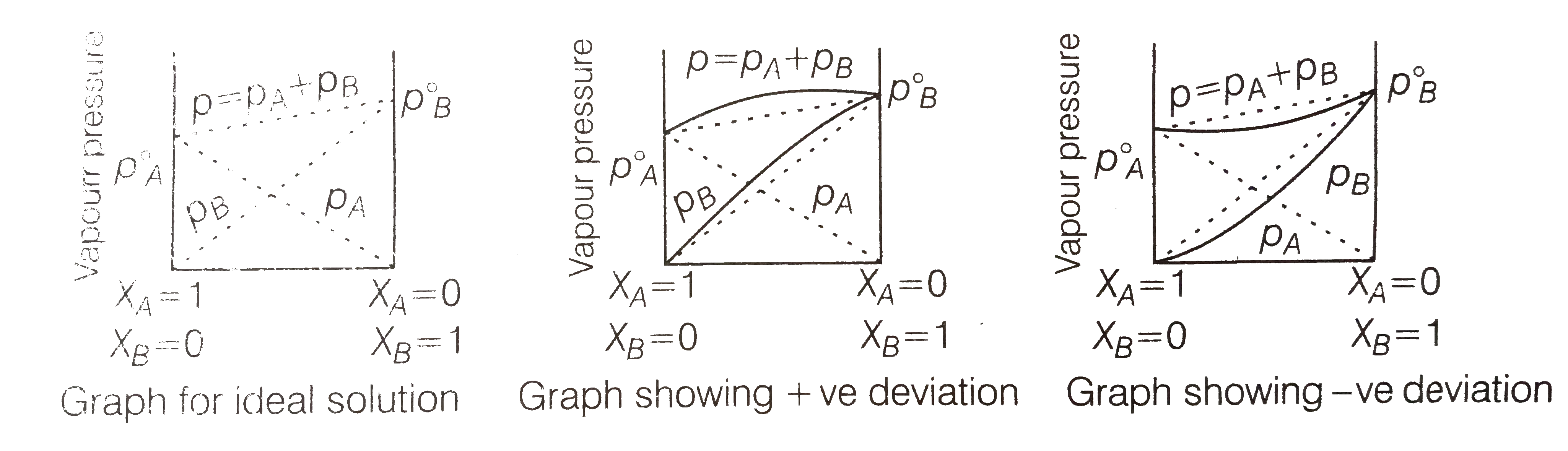
The solutions which obey Raoult's law over entire range of concentration are known as ideal solutions. For an ideal solution `DeltaV_(mix)=Oand DeltaV_(mix)=O.` The ideal behaviour of the solutions can be explined by considering two components A and B
In pure components, the intermolecular attractive interactions will be of A-A type B-B type, whereas in the binary solution in adition of these two, A-B type of interaction will also be present. If A-A and B-B intermolecular forces are nearly equal to those between A-B this leads to the formation of ideal solution e.g., solution of n-hexane n-heptane
When a solution does not obey-Raoult's law over the entire range of concentration, then it is called non-ideal solution. The vapour pressure of such a solution is either higher or lower, than that predicted by Roult's law.
If is is higher, hte solution exhibits positive deviation and if it is lower it exhibits negative deviation from Raoult's law, in casse of positive deviation, A-B interactions are weaker than those between A-A of B-B i.e., the attractive forces betweeen solute solvent molecules are weaker than those between solute-solute and solvent-solvent molecules e.g., mixture of ethanol and acetone.
For such solutions `" "DeltaH_("mixing")=+ve and DeltaV_("micing")=+ve`
On the other hand in case of negative deviation the intermolecular attractive forces between A-A and B-B are weakeer than those between A-B molecules. Thus, the escaping tendency of A and B types of molecules from the solution becomes less than from the pure liquid i.e., mixture of chloroform and acetone.
Promotional Banner

Topper's Solved these Questions

  • SOLID STATE

    NCERT EXEMPLAR|Exercise Solid State|77 Videos
  • SURFACE CHEMISTRY

    NCERT EXEMPLAR|Exercise Surface Chemistry|81 Videos

Similar Questions

Explore conceptually related problems

Distinguish between ideal and non-ideal solutions.

vapour pressure|ideal and non ideal solution

Boiling point|Ideal and non ideal solutions and their properties

Name two intermolecular forces that exist between HF molecules in liquid state.

Raoult’s Law, Ideal and Non ideal Solutions

Revision |Non-ideal Solutions

NCERT EXEMPLAR-SOLUTIONS -Solutions
  1. Why is the vapous pressure of an aqueous solution of gulucose lower th...

    Text Solution

    |

  2. How does sprinking of salt help in clearing the snow covered roads in ...

    Text Solution

    |

  3. What is "esmipermeble membrane"?

    Text Solution

    |

  4. Give an example of a material used for makin gsemipermeable membrance ...

    Text Solution

    |

  5. Match the following Columns

    Text Solution

    |

  6. Match the following Columns

    Text Solution

    |

  7. Which of the following order is correct?

    Text Solution

    |

  8. Match the following columns

    Text Solution

    |

  9. Assertion (A) Molarity of a solution in liquid state changes with temp...

    Text Solution

    |

  10. Assertion (A) When methyl alcohol is added to water, boiling point of ...

    Text Solution

    |

  11. Assertion (A) When NaCl is added to water a depression in freezing poi...

    Text Solution

    |

  12. Assertion (A) When solution is separated from the pure solved by a sem...

    Text Solution

    |

  13. Diffine the following mofes of expressing the concentration of a solut...

    Text Solution

    |

  14. Using Raoult's Law explain how the total vapour pressure over the solu...

    Text Solution

    |

  15. Explain the terms ideal and non-idealsolution in the light of forces o...

    Text Solution

    |

  16. Why is it not possible to obtain pure ethanol by fractional distillati...

    Text Solution

    |

  17. When kept in water, raisin swells in size. Name and explain the phenom...

    Text Solution

    |

  18. Discuss biological and industrial applications of osmosis.

    Text Solution

    |

  19. How can you remove the hard calcium carbonate layer of the egg without...

    Text Solution

    |

  20. Why is the mass determined by measuring a colligative property in case...

    Text Solution

    |