

Home
Class 12
CHEMISTRY
In PCl(5) phosphorus is in sp^(3) d hybr...

In `PCl_(5)` phosphorus is in `sp^(3)` d hybridised state but all its five bonds are not equivalent. Justify your answer with reason.

Text Solution

Verified by Experts

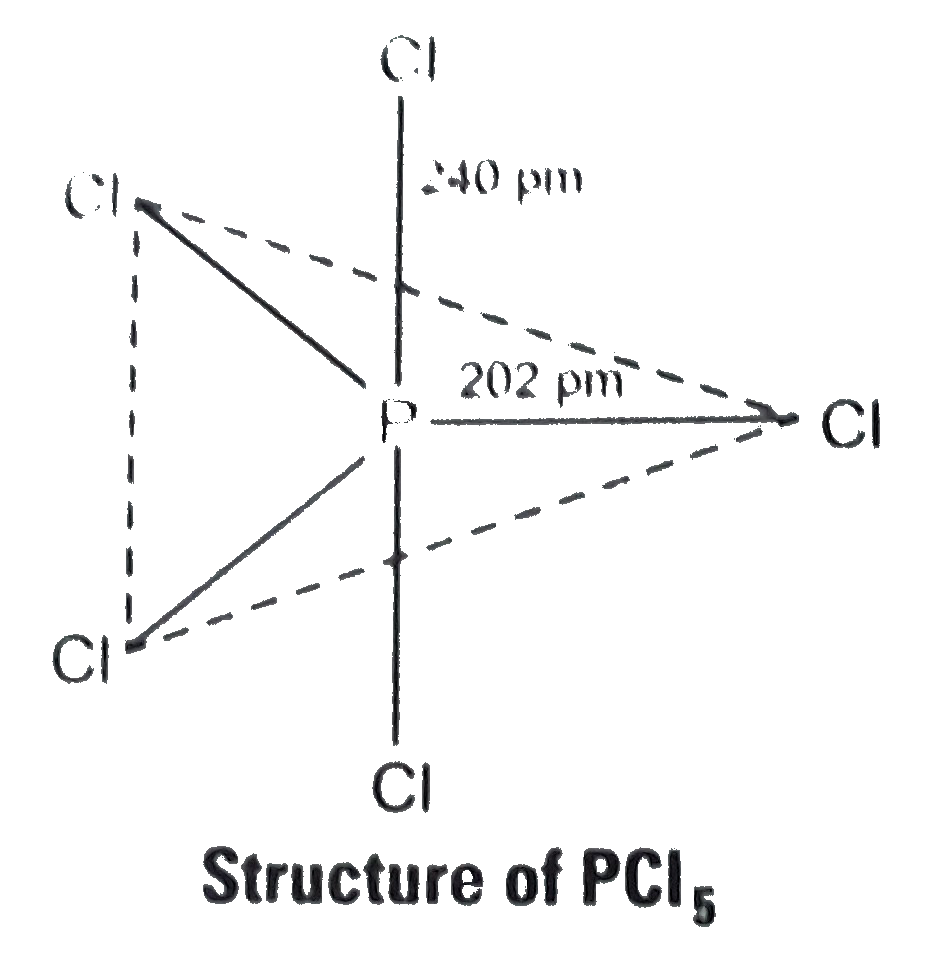
It has trigonal bipyramidal geometry, in which two Cl atoms occupy axial position while three occupy equatorial positions . All five P__Cl bonds are not identical. There are two types of bond lengths ("i) Axial bond lengths (ii) Equatorial bond lengths

Thus, difference in bond length is due to fact that axial bond pairs suffer more repulsion as compared to equatorial bond pairfs.
Promotional Banner

Topper's Solved these Questions

  • HALOALKANES AND HALOARENES

    NCERT EXEMPLAR|Exercise Haloalkanes And Haloarenes|97 Videos
  • POLYMER

    NCERT EXEMPLAR|Exercise Polymer|57 Videos

Similar Questions

Explore conceptually related problems

(a) Why does PCl_3 fume in moisture ? (b) Are all the five bonds in PCl_5 molecule equivalent ? Justify your answer. ( c) How do you account for the reducing behaviour of H_3 PO_2 on the basic of its structure ? (d) Give the disproportional reaction of H_3PO_3 .

All bonds in the molecule of PCl_(5) are not equivalent. Explain.

The hybrid states of phosphorous atoms in each PCl_(5) and PBr_(5) in gasesous phase are sp^(3)d . But, in solid PCl_(5) ,phosphorous shows sp^(3)d^(2) and sp^(3) hybrid states. While,P in PBr_(5) is in sp^(3) hybrid state. This is because:

All five bonds of PCl_(5) are not equilvalent and PCl_(5) is less stable. Explain.

Explain the structure of PCl_(5) according to hybridization. Why all P – Cl bonds lengths are not equivalent in PCl_(5) ?

NCERT EXEMPLAR-P-BLOCK ELEMENTS-P-Block Elements
  1. Write the structure of pyrophosphoric acid.

    Text Solution

    |

  2. PH(3) forms bubbles when passed slowly in water but NH(3) dissolves. E...

    Text Solution

    |

  3. In PCl(5) phosphorus is in sp^(3) d hybridised state but all its five ...

    Text Solution

    |

  4. Why is nitric oxide paramagnetic in gaseous state but the solid obtain...

    Text Solution

    |

  5. Give one reason to explain why ClF(3) exists but FCl(3) does not exist...

    Text Solution

    |

  6. Out of H(2)O which one has higher bond angle and why?

    Text Solution

    |

  7. SF(6) is known but SC(6) is not. Why?

    Text Solution

    |

  8. On reaction with Cl(2) phosphorus forms two types of halides 'A' and '...

    Text Solution

    |

  9. In the ring test of NO(3)^(-) ion, Fe^(2+) ion reduces nitrate ion to ...

    Text Solution

    |

  10. Explain why the stability of oxoacids of chlorine increases in the ord...

    Text Solution

    |

  11. Explain why ozone is thermodynamically less stable then oxygen ?

    Text Solution

    |

  12. P(4)O(6) reacts with water according to equation P(4)O(6)to4H(3)PO(3)....

    Text Solution

    |

  13. White phosphorus reacts with chlorine and the product hydrolyses in th...

    Text Solution

    |

  14. Name three oxoacids of nitrogen. Write the disproportionation reaction...

    Text Solution

    |

  15. Nitric acid forms an oxide of nitrogen on reaction with P(4)O(10). Wri...

    Text Solution

    |

  16. (i) White phosphorus (ii) red phosphorus and (iii) black phosphorus. W...

    Text Solution

    |

  17. Given an example to show the effect of concentration of nitric acid on...

    Text Solution

    |

  18. PCl(5) reacts with finely divided silver on heating and a white silver...

    Text Solution

    |

  19. Phosphorus forms a number of oxoacids. Out of these oxoacids, phosphin...

    Text Solution

    |

  20. Match the compounds given in Column I with the hybridisation and shape...

    Text Solution

    |