Home
Class 12
CHEMISTRY
On heating lead (II) nitrate gives a bro...

On heating lead (II) nitrate gives a brown gas " A". The gas " A" on cooling changes to colourless solid "B" . Solid B on heating with NO changes to a blue solid 'C . Identify ' A', 'B' and' C and also write reactions involved and draw the structures of 'B' and 'C' .

Text Solution

Verified by Experts
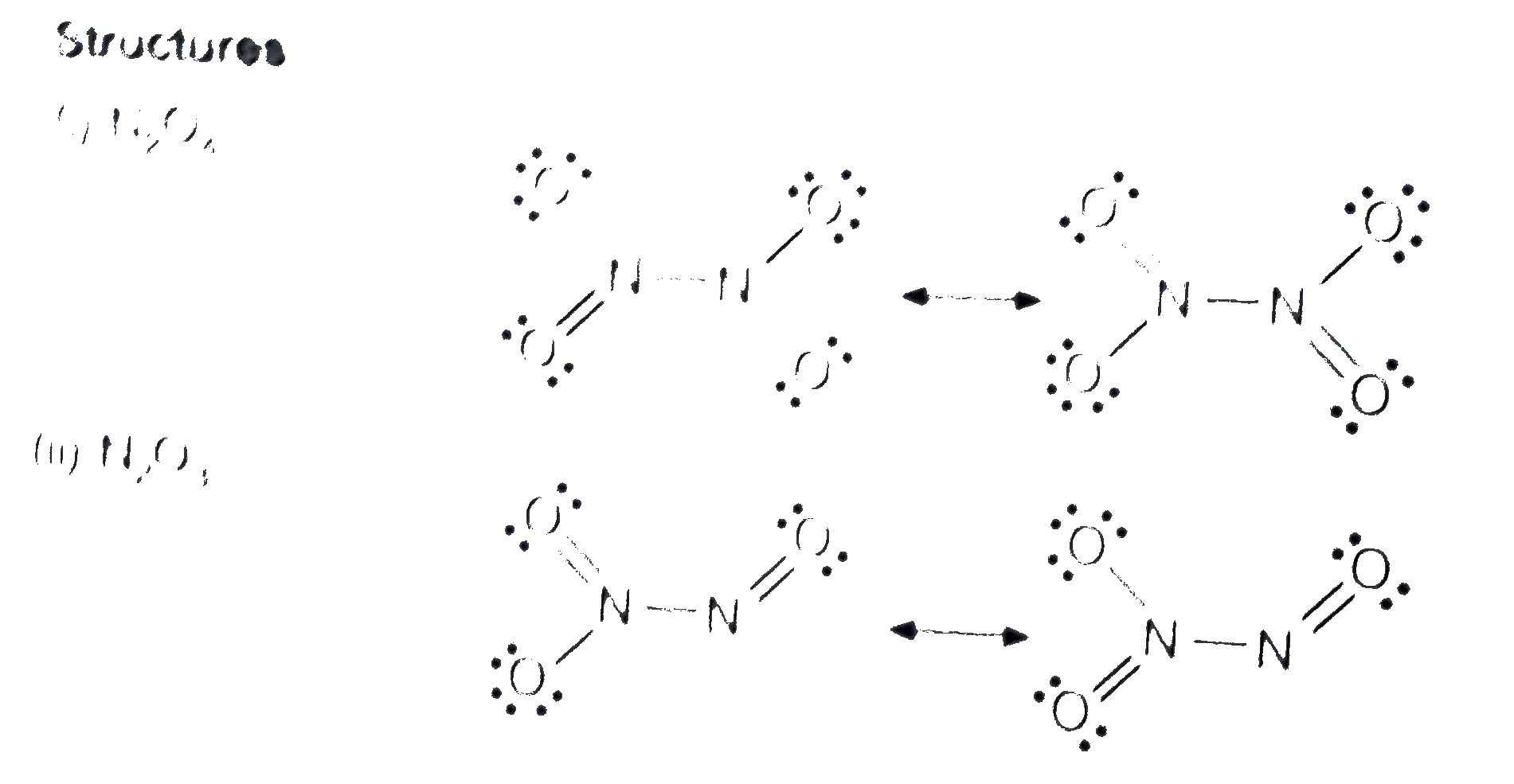
`Pb(NO_(3))_(2)` on heating produces a brown coloured gas which may be `NO_(2)`. Since , on reaction with `N_(2)O_(4)` and on heating it produces `N_(2)O_(3)` and `N_(2)O_(4)` respectively.
Structures
(i) `N_(2)O_(4)` , (ii) `N_(2)O_(3)`
Promotional Banner

Topper's Solved these Questions

  • HALOALKANES AND HALOARENES

    NCERT EXEMPLAR|Exercise Haloalkanes And Haloarenes|97 Videos
  • POLYMER

    NCERT EXEMPLAR|Exercise Polymer|57 Videos

Similar Questions

Explore conceptually related problems

By cannizaro reaction A change to B and C as gives Identify 'A'

(a) When concentrated sulphuric acid was added to an unknown salt present in a test tube a brown gas (A) was evolved. This gas intensified when copper turnings were added to this test tube.On cooling the gas (A) changed into a colourless solid (B). Identify (A) and (B). Writen chemical reactions involved. (b) Drawn structure of XeOF_(4).

(a) When concentrated sulphuric acid was added to an unknown salt present in a test tube a brown gas (A) was evolved . This gas intensified when copper turnings were added to this test tube . On cooling, the gas (A) changed into a colourless solid (B) . (i) Identify (A) and (B). (ii) Write the structures of (A) and (B). (iii) Why does gas (A) change to solid on cooling ? (b) Arrange the following in the decreasing order of their reducing character : HF , HCl , HBr , HI (c) Complete the following reaction : XeF_(4) + SbF_(5) to

Lead nitrate on heating gives A, A on cooling give B, NO with B give C(blue solid). Find oxidation no of N in compound C

When conc. H_(2)SO_(4) was added to an unknown salt present in a test which was heated, a brown gas (A) was evolved. The gas intenstified when copper turning were also added into the test tube. On cooling, the gas (A) changed into a colourless liquid (B). (a) Identify the gases A and B (b) Write equations for the reactions involved.

NCERT EXEMPLAR-P-BLOCK ELEMENTS-P-Block Elements
  1. Name three oxoacids of nitrogen. Write the disproportionation reaction...

    Text Solution

    |

  2. Nitric acid forms an oxide of nitrogen on reaction with P(4)O(10). Wri...

    Text Solution

    |

  3. (i) White phosphorus (ii) red phosphorus and (iii) black phosphorus. W...

    Text Solution

    |

  4. Given an example to show the effect of concentration of nitric acid on...

    Text Solution

    |

  5. PCl(5) reacts with finely divided silver on heating and a white silver...

    Text Solution

    |

  6. Phosphorus forms a number of oxoacids. Out of these oxoacids, phosphin...

    Text Solution

    |

  7. Match the compounds given in Column I with the hybridisation and shape...

    Text Solution

    |

  8. Match the formulas of oxides given in Column I with the type of oxide ...

    Text Solution

    |

  9. Match the items of Columns I and II and mark the correct option.

    Text Solution

    |

  10. Match the species given in Column I with the shape given in Column II ...

    Text Solution

    |

  11. Match the items of Columns I and II and mark the correct option.

    Text Solution

    |

  12. Assertion (A) N(2) is less reactive than P(4). Reason (R ) Nitrog...

    Text Solution

    |

  13. Assertion (A) HNO(3) makes iron passive. Reason (R ) HNO(3) form...

    Text Solution

    |

  14. Assertion (A) HI cannot be prepared by the reaction of KI with concent...

    Text Solution

    |

  15. Assertion (A) Both rhombic and monoclinic sulphur exist as S(8) but ox...

    Text Solution

    |

  16. Assertion (A) NaCl reacts with concentrated H(2)SO(4) to give colourle...

    Text Solution

    |

  17. Assertion:- SF(6) cannot be hydrolysed but SF(4) can be. Reason:- Si...

    Text Solution

    |

  18. An amorphous solid A burns in air to form a gas B which turns lime w...

    Text Solution

    |

  19. On heating lead (II) nitrate gives a brown gas " A". The gas " A" on ...

    Text Solution

    |

  20. On heating compound (A) gives a gas (B) which is a constituent of air....

    Text Solution

    |

