Home
Class 12
CHEMISTRY
A hydrocarbon 'A' (C(4)H(8)) on reaction...

A hydrocarbon 'A' `(C_(4)H_(8))` on reaction HCl gives a compound 'B', `(C_(4)H_(9)Cl)` which on reaction with 1 mol of `NH_(3)` gives compounds 'C' `(C_(4)H_(11)N)`. On reacting with `NaNO_(2)` and HCl followed by treatment with water compound 'C' yields an optically active alcohol, 'D'. Ozonolysis of 'A' given 2mols of acetyldehyde. Identify compound 'A' to 'D'. Explain the reaction involved.

Text Solution

Verified by Experts
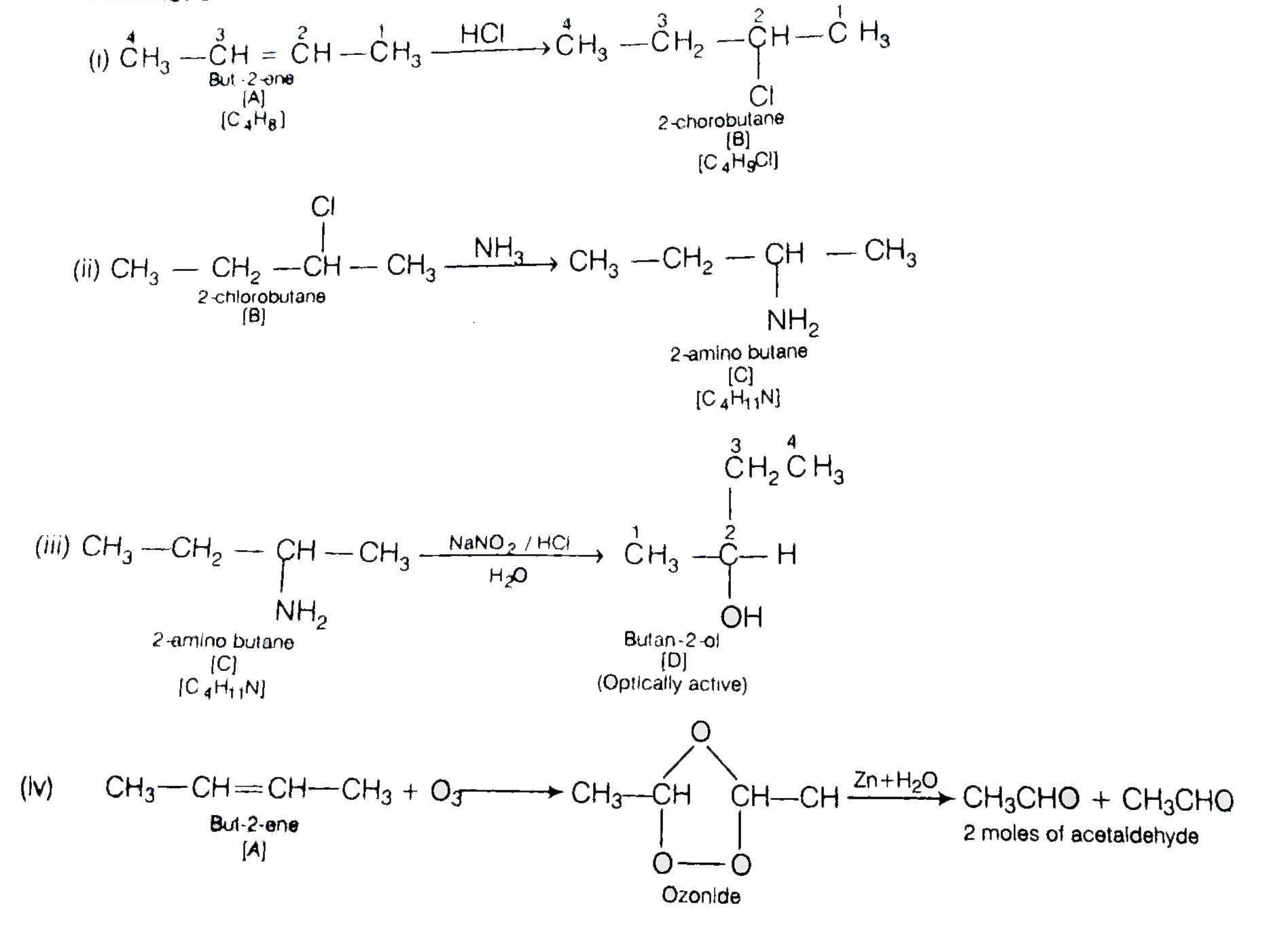
(i) Addition of HCl to compound A shows that compound 'B' is `C_(4)H_(9)Cl`.
(ii) Compound 'B' reacts with `NH_(2)`. It forms amine 'C'.
(iii) 'C' gives diazonium salt with `NaNO_(2)//HCl` , which yields an optically active alcohol. So, 'C' is aliphatic amine.
(iv) 'A' on ozonolysis produces 2 moles of `CH_(3)CHO`. So, 'A' is `CH_(3)-CH =CH-CH_(3)` (But-2-ene)
Promotional Banner

Topper's Solved these Questions

  • ALDEHYDE, KETONES AND CARBOXYLIC ACIDS

    NCERT EXEMPLAR|Exercise Aldehyde, Ketones And Carboxylic Acids|50 Videos
  • BIOMOLECULES

    NCERT EXEMPLAR|Exercise Biomolecules|71 Videos

Similar Questions

Explore conceptually related problems

A hydrocarbon A(C_4H_8) on reaction with HCl gives a compound B(C_4H_9Cl) which on reaction with 1 mole of NH_3 gives a compound C(C_4H_(11)N) . On reacting with NaNO_2 and HCl followed by treatment with water, compound C yields an optically active alcohol,D. Ozonolysisi of A gives 2 moles of acetaldehyde. The structure of compound C is

Compound (x)(m.f=C_(7)H_(8)N) , on reaction with NaNO_(2) and conc. HCl at O^(@)C followed by beta - naphthol gives orange coloured dye. Compound (x) is :

Optically active isomer (A) of (C_(5)H_(9)Cl) on treatment with one mole of H_(2) gives an optically inactive compound (B) compound (A) will be :

Compound C_(4)H_(8)CI_(2) (A) on hydrolysis gives a compound C_(4)H_(8)O(B) which reacts with hydroxylamine and does not give any test with Tollens reagent . What are (A) and (B) ?

An alkene (A)C_(16)H_(16) on ozonolysis gives only one product (B)(C_(8)H_(8)O) . Compound (B) on reaction with NH_(2)OH followed by reaction with H_(2)SO_(4), Delta gives N - methyl benzamide the compound 'A' is -

NCERT EXEMPLAR-AMINES-Amines
  1. Identfy A and B in the following reactions.

    Text Solution

    |

  2. How will you carry out the follwing conversion? (i) Toluene -p-tolui...

    Text Solution

    |

  3. Write following conversions (i) Nitrobenzene-Acetanilide (ii) Acet...

    Text Solution

    |

  4. A solution contains 1g mol. Each of p-toluene diazonium chloride and p...

    Text Solution

    |

  5. How will you bring out the following conversion?

    Text Solution

    |

  6. How will you carry out the following conversion?

    Text Solution

    |

  7. How will you carry out the following conversion?

    Text Solution

    |

  8. How will you carry out the following conversion?

    Text Solution

    |

  9. Match the reactions given in Column I with the statements given in Col...

    Text Solution

    |

  10. Match the reactions given in Column I with the statements given in Col...

    Text Solution

    |

  11. Assertion(A) Acylation of amines gives a monsubstituted product where...

    Text Solution

    |

  12. Assertion (A): Hofmann's bromamide reaction is given by primary amines...

    Text Solution

    |

  13. Assertion (A): N-ethylbenzene sulphonamide is solube in alkali. Reas...

    Text Solution

    |

  14. Assertion(A): N,N-diethylbenzene sulphonamide is insoluble in alkali. ...

    Text Solution

    |

  15. Assertion(A): Only a small amount of HCl is required in the reduction ...

    Text Solution

    |

  16. Assertion(A): Aromatic 1^(@ amines can be prepared by Gabriel phtalmi...

    Text Solution

    |

  17. Assertion(A): Acetanilide is less basic aniline. Reson(R ): Acetylat...

    Text Solution

    |

  18. A hydrocarbon 'A' (C(4)H(8)) on reaction HCl gives a compound 'B', (C(...

    Text Solution

    |

  19. A colours substance 'A' (C(6)H(7)) is sparingly soluble in water and g...

    Text Solution

    |

  20. Predict the reagent or the product in the following reaction sequence.

    Text Solution

    |

