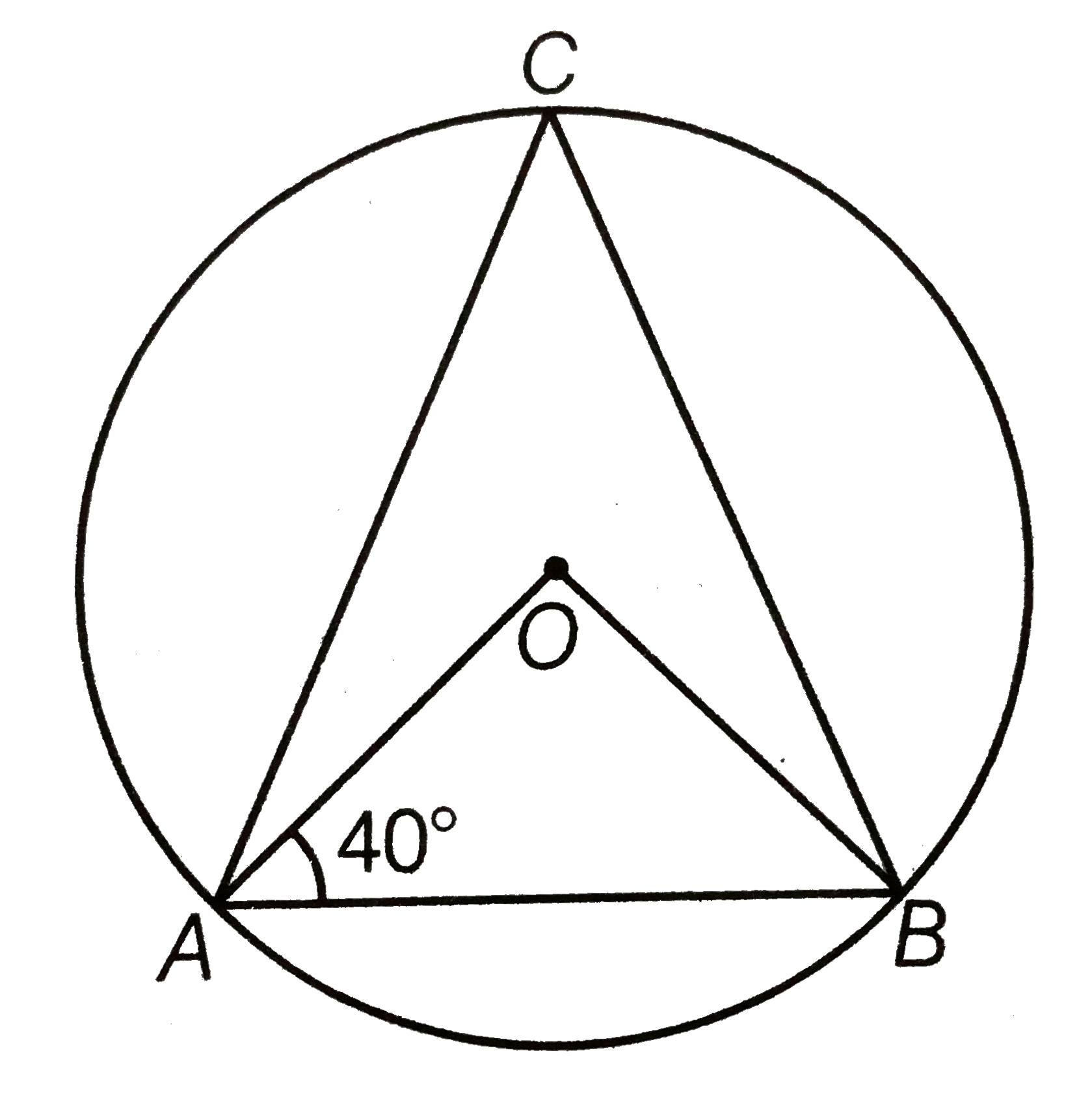
In figure, if `angleOAB=40^(@),"then"angleACB " is equal to "`
A
`50^(@)`
B
`40^(@)`
C
`60^(@)`
D
`70^(@)`
Text Solution
Verified by Experts
The correct Answer is:
A
`"In "DeltaOAB, OA=OB ["both are the radius of a circle"]` `:.angleOAB=angleOBArArrangleOBA=40^(@)` [angle opposite to equal sides are equal] Also, `angleAOB+angleOBA+angleBAO=180^(@)` [by angle sum property of a triangle] `:.angleAOB+40^(@)+40^(@)=180^(@)` `rArr angleAOB=180^(@)-80^(@)=100^(@)` We know that, in a circle, the angle subtended by an arc at the centre is twice the angle subtended by it at the remaining part of the circle. `:. angle AOB=2angleACB` `rArr 100^(@)=2angleACB` `:. angleACB=100^(@)/2=50^(@)`
Topper's Solved these Questions
CIRCLES
NCERT EXEMPLAR|Exercise Exercise 10.4|2 Videos
Areas of Parallelograms and Triangles
NCERT EXEMPLAR|Exercise Areas Of Parallelograms And Triangles|34 Videos
CONSTRUCTIONS
NCERT EXEMPLAR|Exercise Long Answer Type Questions|5 Videos
Similar Questions
Explore conceptually related problems
In figure, angleACB=40^(@) ." Find "angleOAB .
In figure, if angleDAB=60^(@),angleABD=50^(@),"then "angleACB is equal to
PA and PB are tangents to a circle with centre 0, from a point P outside the circle, and A and B are point on the circle. If angleAPB = 30^(@) , then angleOAB is equal to:
PA and PB are two tangents to a circle with centre 0. from a point P outside the circle. A and B are points on the circle. If angleAPB= 70^@ then angleOAB is equal to:
In figure, if PA and PB are tangents to the circle with centre O such that angleAPB=50^(@) , then angleOAB is equal to
In the given figure, ABCD is a rectangle whose diagonals AC and BD intersect at 0. If angleOAB = 28^(@) , then angleOBC is equal to
In the given figure, angleOAB=110^@ and angleBCD=130^(@) then angleABC is equal to
In the figure XY is a tangent to the circle with centre O at A. If angle BAX = 70^(@), angle BAQ = 40^(@) then angle ABQ is equal to :