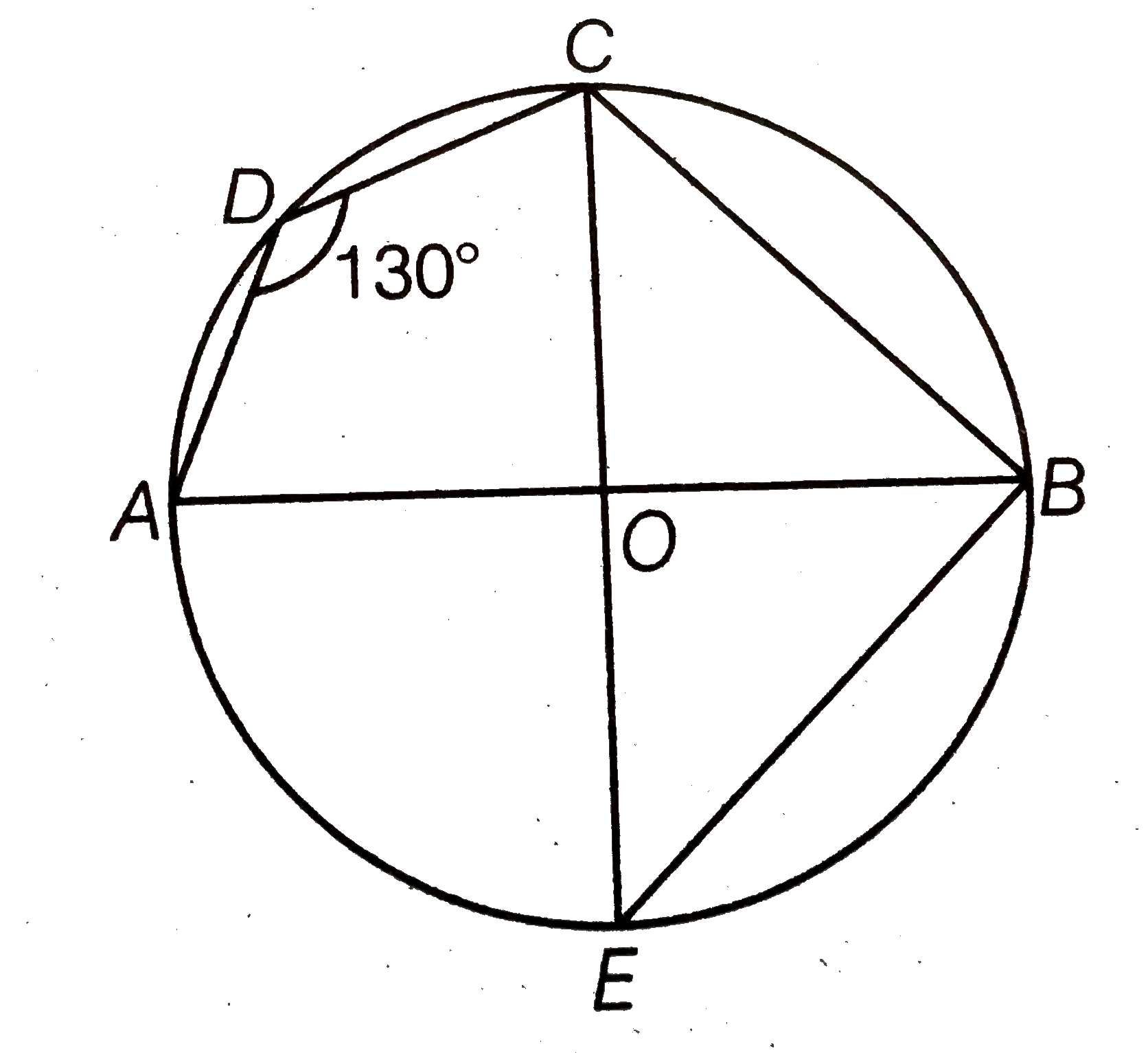
In figure, `angleADC=130^(@)" and chord BC=chord BE. Find "angleCBE`.
Text Solution
Verified by Experts
We have, `angleADC=130^(@)` and chord BC=chord BE. Suppose, we consider the points A, B, C and D form a cyclic quadrilateral. Since, the sum of opposite angles of a cyclic quadrilateral ADCB is ` 180^(@)`. `:. angleADC+angleOBC=180^(@)` `rArr 130^(@)+angleOBC=180^(@)` `rArr angleOBC=180^(@)-130^(@)=50^(@)` `"In" DeltaBOC and DeltaBOE`, BC=BE [given equal chord] OC=OE [both are the radius of a circle] and OB=OB [common side] `:. DeltaBOC cong DeltaBOE` [by SSS songruence rule] `rArr angle OBC=angleOBE=50^(@)` [by CPCT] Now, `angleCBE=angleCBO+angleEBO` `=50^(@)+50^(@)=100^(@)`
Topper's Solved these Questions
CIRCLES
NCERT EXEMPLAR|Exercise Exercise 10.4|2 Videos
Areas of Parallelograms and Triangles
NCERT EXEMPLAR|Exercise Areas Of Parallelograms And Triangles|34 Videos
CONSTRUCTIONS
NCERT EXEMPLAR|Exercise Long Answer Type Questions|5 Videos
Similar Questions
Explore conceptually related problems
In the given figure, AB is the diameter of the circle, angleADC = 120^(@) . Find angleCAB :
In the adjoining figure, chord AB= chord PQ. If angleOBA=55^@ , then find angle POQ .
The radius of a circle is 10 cm and the perpendicular form the centre to a chord is 8cm. Find the length of the chord. (ii) The radius of a circle is 10 cm. its one chord is 16 cm long. Find the perpendicular distance of this chord form the centre. (iii) in the adjoining figure O is the centre of circle. the radius of circle is 17 cm . if OC=8cm, then find the length of chord AB. (iv) In the adjoining figure, OMbotAB , radius OC=5cm and chord AB=8cm .Find the length of OM.
In the given figure, O is the center and chord PQ = Chord RS. If OT = 5 cm, then find OU.
In the figure, bar(AB)" || "bar(CD) and bar(AD)" || "bar(BC) . If angleABC=110^(@), angleACD=30^(@) , then find angleADC .
O is the centre of a circle of diameter AB. If chord AC= chord BC, then find the value of angleABC .
In the given figure , find the length of chord AB .
In the figure, chords AD and BC intersect each other at right angles at a point P. If /_DAB = 35^(@) , then /_ADC =
In the given figure, ABCD is a rhombos and BCE is an isosceles triangle, with BC = CE, angleCBE = 84^@ and angleADC = 78^@ . What is the value (in degree) of angleDEC ?