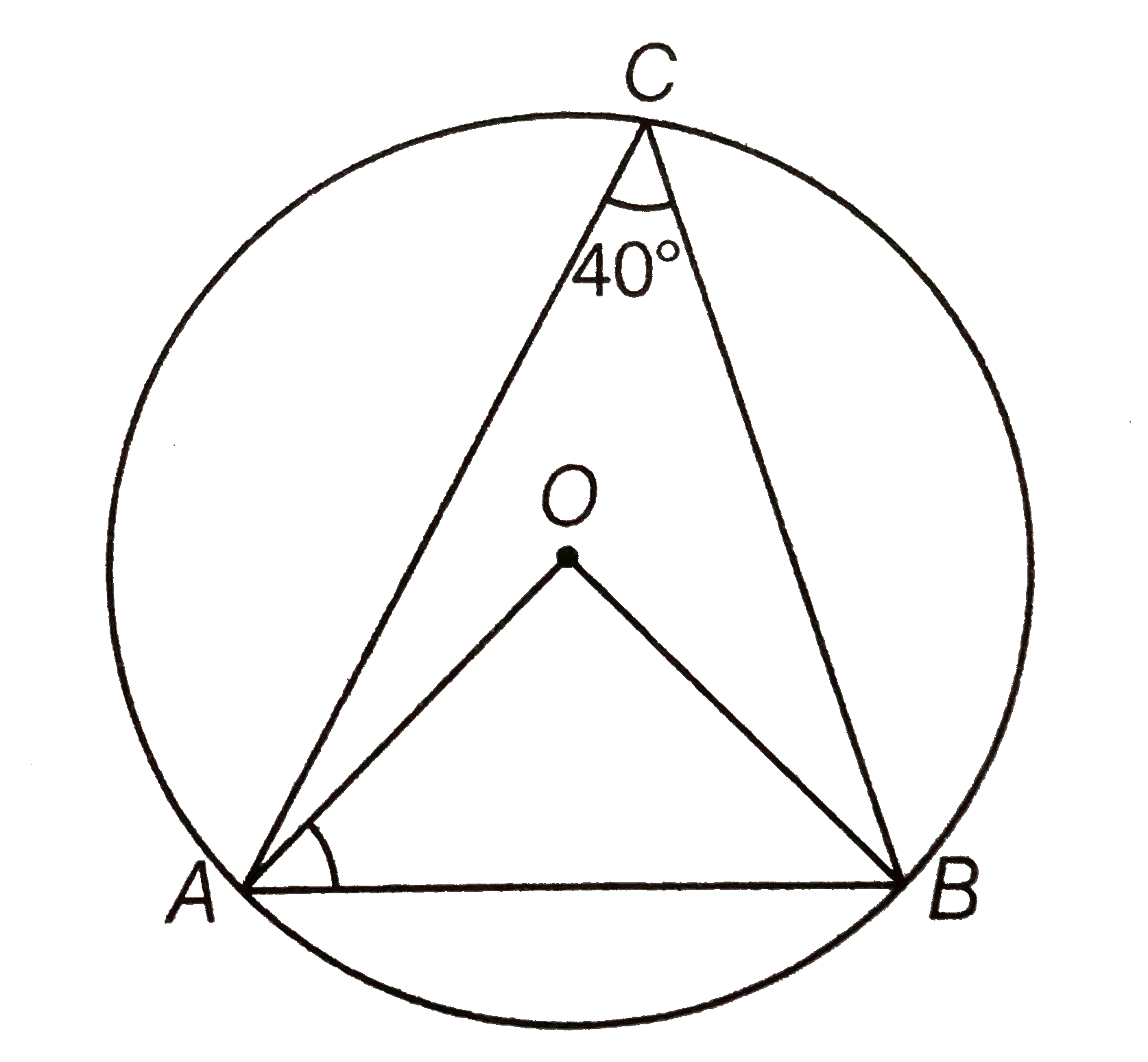
Given, `angleACB=40^(@)` We know that, a segment subtends an angle to the circle is half the angle subtends to the centre. `:. angleAOB=2angleACB` `rArr angleACB=(angleAOB)/2` `rArr 40^(@)=1/2angleAOB` `rArr angleAOB=80^(@)` ….(i) In `DeltaAOB, AO=BO` [both are the radius of a circle] `rArr angleOBA=angleOAB` ....(ii) [angles opposite to the equal sides are equal] We know that, the sum of all three angles in a triangle AOB is `180^(@)`. `:. angleAOB+angleOBA+angleOAB=180^(@)` `rArr 80^(@)+angleOAB+angleOAB=180^(@)` [form Eqs. (i) and (ii)] `rArr 2 angleOAB=180^(@)-80^(@)` `rArr 2angleOAB=100^(@)` `:. angleOAB=100^(@)/2=50^(@)`
Topper's Solved these Questions
CIRCLES
NCERT EXEMPLAR|Exercise Exercise 10.4|2 Videos
Areas of Parallelograms and Triangles
NCERT EXEMPLAR|Exercise Areas Of Parallelograms And Triangles|34 Videos
CONSTRUCTIONS
NCERT EXEMPLAR|Exercise Long Answer Type Questions|5 Videos
Similar Questions
Explore conceptually related problems
In figure, if angleOAB=40^(@),"then"angleACB " is equal to "
In figure, angleOAB=30^(@) and angleOCB=57^(@)." Find "angleBOC and angleAOC .
In the given figure angleABC=50^(@) and angleACB=55^(@) , then find the value of angleP, angleQ, angleR .
In the adjoining figure , O is the centre of the circle and angleOAB=60^(@) . Find angle APC .
In the given figure, angleOAB=30^@ and angleOCB=57^@ Find angleBOC
In the given figure, angleACB=60^(@), angleCAB=50^(@) and BC=BD . Find angleBDC .