Home
Class 12
PHYSICS
An infinitely large plate of surface cha...

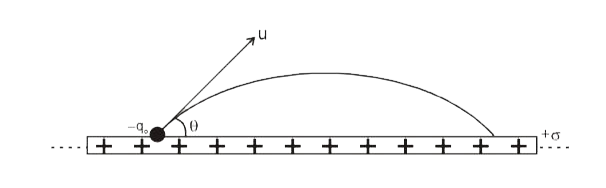
An infinitely large plate of surface charge density `+sigma` lying in horizontal xy plane. A particle having charge `-q_(0)` and mass m is projected from the plate with velocity u making an angle `theta` with sheet. Find :

(i) the time taken by the particle to return on the plate.
(ii) maximum height achieved by the particle.
(iii) At what distance will it strike the plate (Neglect gravitational force on the particle)

Text Solution

Verified by Experts
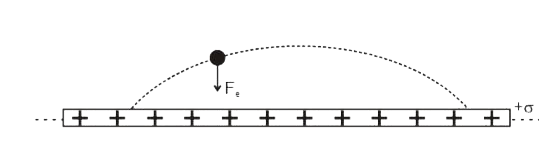

Electric force acting on the particle
`F_(e) = q_(0)E : F_(e) = (q_(0))((sigma)/(2 epsilon_(0)))` downward
So acceleration of the particle :
`a = (F_(e))/(m) = (q_(0) sigma)/(2epsilon_(0)m)` = uniform
this acceleration will act like 'g'
(acceleration due to gravity)
So the particle will perform projectile motion.
(i) `T = (2u sin theta)/(g) = (2u sin theta)/(((q_(0) sigma)/(2epsilon_(0)m)))`
(ii) `H = (u^(2) sin^(2) theta)/(2g) = (2u^(2) sin^(2) theta)/(2((q_(0) sigma)/(2epsilon_(0)m)))`
(iii) `R = (u^(2) sin 2 theta)/(g) = (u^(2) sin 2 theta)/(((q_(0) sigma)/(2epsilon_(0)m)))`
Promotional Banner

Topper's Solved these Questions

  • ELECTROSTATICS

    MOTION|Exercise SELF MISCELLANEOUS PROBLEM (Example )|15 Videos
  • ELECTROSTATICS

    MOTION|Exercise SELF PRACTICE PROBLEM|27 Videos
  • ELECTRONICS - SEMI CONDUCTOR

    MOTION|Exercise EXERCISE - 3|29 Videos
  • ELECTROSTATICS - I

    MOTION|Exercise EXERCISE - 4 (Level -II) PREVIOUS YEAR - JEE ADVANCED|13 Videos

Similar Questions

Explore conceptually related problems

An infinitely large plate of surface charge density + sigma is lying in horizontal xy-plane. A particle having charge -q_(0) and mass m is projected from the plate with velocity u making an angle theta with sheet. Find : (i) The time taken by the particle to return on the plate. (ii) Maximum height achieved by the particle. (iii) At what distance will it strike the plate (Neglect gravitational force on the particle)

A particle of mass 'm' is projected from ground with velocity u making angle theta with the vertical. The de-Broglie wave length of the particle at the highest point is:

A particle of charge q and mass m is prjected in a uniform and contant magnetic field of strength B .The initial velocity vecv makes angle theta with the vecB .Find the distance travelled by the particle in time t .

A particle projected with velocity u at angle theta with horizontal at t=0. What is the magnitude of change in the velocity of the particle when it is at maximum height?

A particle of mass m projected horizontally with velocity u . if it makes an angle theta with the horizontal after some time, then at that instant, its be Broglie wavelength is

A particle having mass m is projected with a velocity v_(0) from a point P on a horizontal ground making an angle theta with horizontal. Find out the torque about the point of projection acting on the particle when it is at its maximum height ?

A particle is projected with velocity u at angle theta with horizontal. Find the time when velocity vector is perpendicular to initial velocity vector.

A particle is projected from horizontal making an angle of 53^(@) with initial velocity 100 ms^(-1) . The time taken by the particle to make angle 45^(@) from horizontal is

A large plate with uniform surface charge density sigma is moving with constant speed v as shown in the figure. The magnetic field at a small distance from plate is

A particle of mass m is projected with an initial velocity U at an angle theta to the horizontal. The torque of gravity on projectile at maximum height about the point of projection is

MOTION-ELECTROSTATICS-Exercise -3 Section (B) Previous Year Problems | JEE Main
  1. An infinitely large plate of surface charge density +sigma lying in ho...

    Text Solution

    |

  2. Two point charges +8q and -2q are located at x=0 and x=L respectively....

    Text Solution

    |

  3. Two thin wire rings each having a radius R are placed at a distance d ...

    Text Solution

    |

  4. A charged ball B hangs from a silk thread S, which makes an angle thet...

    Text Solution

    |

  5. Two insulting plates are both uniformly charged in such a way that the...

    Text Solution

    |

  6. An electric dipole is placed at an angle of 30^@ to a non-uniform elec...

    Text Solution

    |

  7. Two spherical conductors A and B of radii 1mm and 2mm are separated by...

    Text Solution

    |

  8. The potential at a point x ( measured in mu m) due to some charges sit...

    Text Solution

    |

  9. Charges are placed on the vertices of a square as shown Let vecE ...

    Text Solution

    |

  10. An electric charge 10^-3muC is placed at the origin (0, 0) of X-Y co-o...

    Text Solution

    |

  11. Delta V measured between B and C is

    Text Solution

    |

  12. A thin spherical shell of radius R has charge Q spread uniformly over ...

    Text Solution

    |

  13. Statement I : For a charged particle moving form point P to point Q, t...

    Text Solution

    |

  14. Two points P and Q are maintained at the potentials of 10V and -4V, re...

    Text Solution

    |

  15. Let P(r)=(Q)/(piR^4)r be the charge density distribution for a solid s...

    Text Solution

    |

  16. A charge Q is place at each of the opposite corners of a square. A cha...

    Text Solution

    |

  17. A thin semi-circular ring of radius r has a positive charge q distribu...

    Text Solution

    |

  18. Two identical charged spheres are suspended by strings of equal length...

    Text Solution

    |

  19. Let there be a spherically symmetric charge distribution with charge d...

    Text Solution

    |

  20. Two positive charges of magnitude q are placed at the ends of a side (...

    Text Solution

    |

  21. The electrostatic potential inside a charged spherical ball is given b...

    Text Solution

    |

