Home
Class 12
PHYSICS
If a charge is released in electric fiel...

If a charge is released in electric field, will it follow lines of force ?

Text Solution

Verified by Experts
Case I :
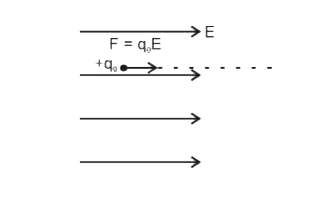
If lines of force are parallel (in uniform electric field) : -

In this type of field, if a charge is released, force on it will be `q_(0)E` and its direction will be along `vec(E)`. So the charge will move in a straight line, along the lines of force.
Case II : -
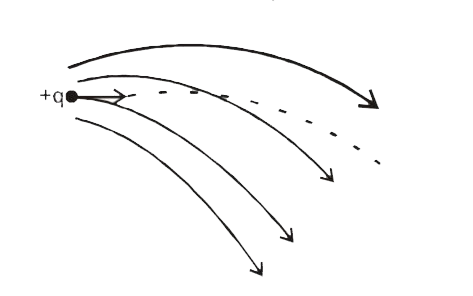
It lines of force are curved (in non-uniform electric field) :-

The charge will not follow lines of force
Promotional Banner

Topper's Solved these Questions

  • ELECTROSTATICS

    MOTION|Exercise SELF MISCELLANEOUS PROBLEM (Example )|15 Videos
  • ELECTROSTATICS

    MOTION|Exercise SELF PRACTICE PROBLEM|27 Videos
  • ELECTRONICS - SEMI CONDUCTOR

    MOTION|Exercise EXERCISE - 3|29 Videos
  • ELECTROSTATICS - I

    MOTION|Exercise EXERCISE - 4 (Level -II) PREVIOUS YEAR - JEE ADVANCED|13 Videos

Similar Questions

Explore conceptually related problems

If a charge is placed at rest in an electric field, will its . path be along a line of force ? Discuss the situation when . the lines of force are straight and when they are curved.

An electric dipole (AB) consisting of two particles of equal and opposite charge and same mass is released in an electric field. In the figure field lines are without considering effect of field of dipole. Angular acceleration of the dipole, immediately after it is released

Whe a negative charge is releases and moves in electric field , it moves toward a position of -

An electric dipole (AB) consisting of two particles of equal and opposite charge and same mass is released in an electric field. In the figure field lines are without considering effect of field of dipole. The centre of mass of the dipole

Which of the following is correct regarding electric lines of force ? (i) Electric lines of force diverge from +ve and converge at a -ve charge (ii) Electric lines of force never cross each other , otherwise there will be two directions of electric field at a point of intersection which is not possible (iii) Closer are the electric lines of forces , stronger is the field , and further apart lines of force ,weaker is electric field (iv) The electric lines of forces are parallel for a uniform electric field

A charged particale is free to move in an electric field. Will it always move along an electric line of force ?

Equipotential lines arising from a static charge distribution has been shown in a certain region of space. (a) Draw the electric field lines starting from point A (b) If a charge is released at A, will it move along the field line passing through A? (c) How much work is done by the electric force if a charge moves from B to C? Is the knowledge of path important in this calculation?

A particle having positive charge is released from rest in the electric field and moves under the influence of both electric field and gravity. The quantity connected with the charged particle that increases continuously with time is

MOTION-ELECTROSTATICS-Exercise -3 Section (B) Previous Year Problems | JEE Main
  1. If a charge is released in electric field, will it follow lines of for...

    Text Solution

    |

  2. Two point charges +8q and -2q are located at x=0 and x=L respectively....

    Text Solution

    |

  3. Two thin wire rings each having a radius R are placed at a distance d ...

    Text Solution

    |

  4. A charged ball B hangs from a silk thread S, which makes an angle thet...

    Text Solution

    |

  5. Two insulting plates are both uniformly charged in such a way that the...

    Text Solution

    |

  6. An electric dipole is placed at an angle of 30^@ to a non-uniform elec...

    Text Solution

    |

  7. Two spherical conductors A and B of radii 1mm and 2mm are separated by...

    Text Solution

    |

  8. The potential at a point x ( measured in mu m) due to some charges sit...

    Text Solution

    |

  9. Charges are placed on the vertices of a square as shown Let vecE ...

    Text Solution

    |

  10. An electric charge 10^-3muC is placed at the origin (0, 0) of X-Y co-o...

    Text Solution

    |

  11. Delta V measured between B and C is

    Text Solution

    |

  12. A thin spherical shell of radius R has charge Q spread uniformly over ...

    Text Solution

    |

  13. Statement I : For a charged particle moving form point P to point Q, t...

    Text Solution

    |

  14. Two points P and Q are maintained at the potentials of 10V and -4V, re...

    Text Solution

    |

  15. Let P(r)=(Q)/(piR^4)r be the charge density distribution for a solid s...

    Text Solution

    |

  16. A charge Q is place at each of the opposite corners of a square. A cha...

    Text Solution

    |

  17. A thin semi-circular ring of radius r has a positive charge q distribu...

    Text Solution

    |

  18. Two identical charged spheres are suspended by strings of equal length...

    Text Solution

    |

  19. Let there be a spherically symmetric charge distribution with charge d...

    Text Solution

    |

  20. Two positive charges of magnitude q are placed at the ends of a side (...

    Text Solution

    |

  21. The electrostatic potential inside a charged spherical ball is given b...

    Text Solution

    |