Home
Class 12
PHYSICS
A charge + Q is fixed at a distance d in...

A charge + Q is fixed at a distance d in front of an infinite metal plate. Draw the lines of force indicating the directions clearly.

Text Solution

Verified by Experts
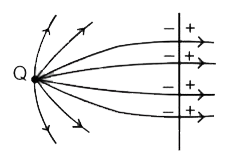
There will be induced charge on two surfaces of conducting plate, so ELOF will start from +Q charge and terminate at conductor and then will again start from other surface of conductor.
Promotional Banner

Topper's Solved these Questions

  • ELECTROSTATICS

    MOTION|Exercise SELF MISCELLANEOUS PROBLEM (Example )|15 Videos
  • ELECTROSTATICS

    MOTION|Exercise SELF PRACTICE PROBLEM|27 Videos
  • ELECTRONICS - SEMI CONDUCTOR

    MOTION|Exercise EXERCISE - 3|29 Videos
  • ELECTROSTATICS - I

    MOTION|Exercise EXERCISE - 4 (Level -II) PREVIOUS YEAR - JEE ADVANCED|13 Videos

Similar Questions

Explore conceptually related problems

A charge Q is fixed at a distance d in front of an infinite metal plate. The lines of force are represented by

Two point charge Q and 4Q are fixed at a distance of 12cm from each other. Sketch lines of force and locate the neutral point, if any .

Figure shows a point charge +Q, located at a distance R/2 from the centre of a spherical metal shell. Draw the electric field lines for the given system.

An uncharged sphere of metal is placed in between two charged plates as shown. The lines of force look like

A charge +q is situated at a distance 'd' away from both the sides of a grounded conducting 'L' shaped sheet as shown in the figure. The force acting on the charge +q is

Consider an electron in front of metallic surface at a distance d (treated as an infinite plane surface). Assume the force of attraction by the plate is given as 1/4 (q^(2))/(4pi in_(0)d^(2)) . Calculate work in taking the charge to an infinite distance from the plate. Taking d=0.1nm, find the work done in electron volts. [Such a force law is not valid for d lt 0.1nm].

Assertion. If a point charge q is placed in front of an infinite grounded condcuting plane surface, the point charge will experience a force. Reason. This force is due to the induced charge on the conducting surface which is at zero potential

A metallic partical having no net charge is placed near a finite metal plate carrying a positive charge. The electric force on the particale will be

Charges +q and -2q are fixed at distance d apart as shown in fig. (i) sketch roughly the pattern of electric field lines, showing the positon of neutral point. (ii) Where should a charge partical q be placed so that it experience no force ? .

MOTION-ELECTROSTATICS-Exercise -3 Section (B) Previous Year Problems | JEE Main
  1. A charge + Q is fixed at a distance d in front of an infinite metal pl...

    Text Solution

    |

  2. Two point charges +8q and -2q are located at x=0 and x=L respectively....

    Text Solution

    |

  3. Two thin wire rings each having a radius R are placed at a distance d ...

    Text Solution

    |

  4. A charged ball B hangs from a silk thread S, which makes an angle thet...

    Text Solution

    |

  5. Two insulting plates are both uniformly charged in such a way that the...

    Text Solution

    |

  6. An electric dipole is placed at an angle of 30^@ to a non-uniform elec...

    Text Solution

    |

  7. Two spherical conductors A and B of radii 1mm and 2mm are separated by...

    Text Solution

    |

  8. The potential at a point x ( measured in mu m) due to some charges sit...

    Text Solution

    |

  9. Charges are placed on the vertices of a square as shown Let vecE ...

    Text Solution

    |

  10. An electric charge 10^-3muC is placed at the origin (0, 0) of X-Y co-o...

    Text Solution

    |

  11. Delta V measured between B and C is

    Text Solution

    |

  12. A thin spherical shell of radius R has charge Q spread uniformly over ...

    Text Solution

    |

  13. Statement I : For a charged particle moving form point P to point Q, t...

    Text Solution

    |

  14. Two points P and Q are maintained at the potentials of 10V and -4V, re...

    Text Solution

    |

  15. Let P(r)=(Q)/(piR^4)r be the charge density distribution for a solid s...

    Text Solution

    |

  16. A charge Q is place at each of the opposite corners of a square. A cha...

    Text Solution

    |

  17. A thin semi-circular ring of radius r has a positive charge q distribu...

    Text Solution

    |

  18. Two identical charged spheres are suspended by strings of equal length...

    Text Solution

    |

  19. Let there be a spherically symmetric charge distribution with charge d...

    Text Solution

    |

  20. Two positive charges of magnitude q are placed at the ends of a side (...

    Text Solution

    |

  21. The electrostatic potential inside a charged spherical ball is given b...

    Text Solution

    |

