Home
Class 12
PHYSICS
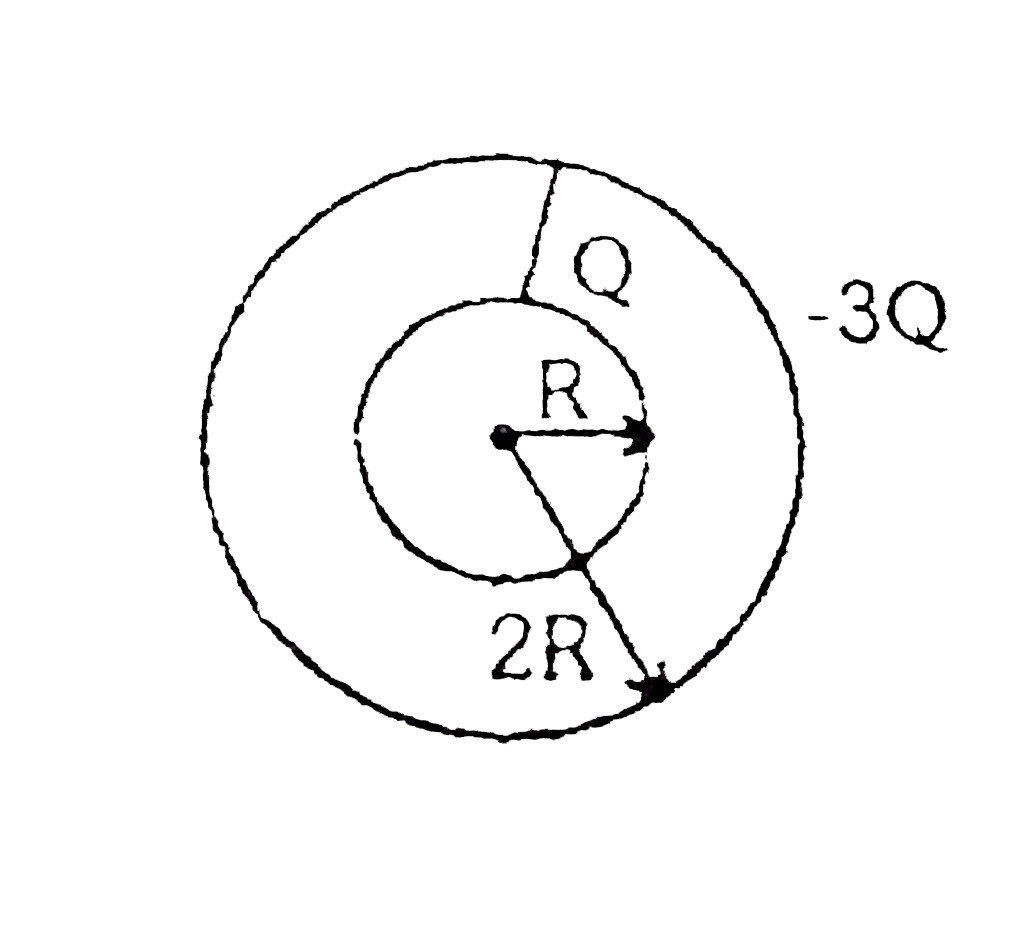
The two conducting spherical shells are ...

The two conducting spherical shells are joined by a conducting wire and cut after some time when charge stops flowing. Find out the charge on each sphere after that.

Text Solution

Verified by Experts
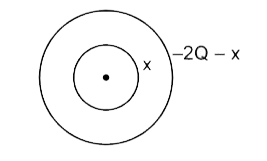
After cutting the wire, the potential of both the shells is equal
Thus, potential of inner shell `V_("in")`
`= (kx)/(R ) + (K(-2Q - x))/(2R) = (k(x-2Q))/(2R)` and potential of outer shell `V_("out") = (Kx)/(2R) + (K(-2Q - x))/(2R) = (-KQ)/(R )`

As `V_("out") = V_("in") rArr (-KR)/(R ) = (K(x-2Q))/(2R)`
`rArr -2Q = x - 2Q rArr x = 0`
So charge on inner spherical shell = 0 and outer spherical shell = -2Q.
Promotional Banner

Topper's Solved these Questions

  • ELECTROSTATICS

    MOTION|Exercise SELF MISCELLANEOUS PROBLEM (Example )|15 Videos
  • ELECTROSTATICS

    MOTION|Exercise SELF PRACTICE PROBLEM|27 Videos
  • ELECTRONICS - SEMI CONDUCTOR

    MOTION|Exercise EXERCISE - 3|29 Videos
  • ELECTROSTATICS - I

    MOTION|Exercise EXERCISE - 4 (Level -II) PREVIOUS YEAR - JEE ADVANCED|13 Videos

Similar Questions

Explore conceptually related problems

Figure shows three concentric conducting spherical shells with inner and outer shells earthed and the middle shell is given a charge q . Find the charge distribution of sphere

Column-I gives certain situations involving two thin conducting shells connected by a conducting wire via a key K. In all situation one sphere has net charge +q and other sphere has no net charge. After the key K is pressed, column-II gives some resulting effect.

Statement-1 : If two concentric conducing sphere which are connected by a conducting wire. No charge can exist on inner sphere. Statement-2: When charge on outer sphere will exist then potential of inner shell and outer shell will be same.

A solid metallic sphere of radius a is surrounded by a conducting spherical shell of radius b(bgt a ). The solid sphere is given a charge Q. A student measures the potential at the surface of the solid sphere as V and the potential at the surface of spherical shell as V_b . After taking these readings, he decides . to put charge of -4Q on the shell. He then noted the readings of the potential of solid sphere and the shell and found that the potential difference is /_\V . He then connected the outer spherical shell to the earth by a conducting wire and found that the charge on the outer surface of the shell as He then decides to remove the earthing connection from the shell and earthed the inner solid sphere. Connecting the inner sphere with the earth he observes the charge on the solid sphere as q_2 . He then wanted to check what happens if the two are connected by the conducting wire. So he removed the earthing connection and connected a conducting wire between the solid sphere and the spherical shelll. After the connections were made he found the charge on the outer shell as q_3 . Potential difference (/_\CV) measured by the student between the inner solid shere and outer shell after putting a charge -4Q is

When two charged bodies at different potentials are connected by a conducting wire, then the charge flows from one body to another body

A solid metallic sphere of radius a is surrounded by a conducting spherical shell of radius b(bgt a) . The solid sphere is given a charge Q. A student measures the potential at the surface of the solid sphere as V and the potential at the surface of spherical shell as V_b . After taking these readings, he decides . to put charge of -4Q on the shell. He then noted the readings of the potential of solid sphere and the shell and found that the potential difference is /_\V . He then connected the outer spherical shell to the earth by a conducting wire and found that the charge on the outer surface of the shell as He then decides to remove the earthing connection from the shell and earthed the inner solid sphere. Connecting the inner sphere with the earth he observes the charge on the solid sphere as q_2 . He then wanted to check what happens if the two are connected by the conducting wire. So he removed the earthing connection and connected a conducting wire between the solid sphere and the spherical shelll. After the connections were made he found the charge on the outer shell as q_3 . q_2 is

A solid metallic sphere of radius a is surrounded by a conducting spherical shell of radius b(bgt a) . The solid sphere is given a charge Q. A student measures the potential at the surface of the solid sphere as V and the potential at the surface of spherical shell as V_b . After taking these readings, he decides . to put charge of -4Q on the shell. He then noted the readings of the potential of solid sphere and the shell and found that the potential difference is /_\V . He then connected the outer spherical shell to the earth by a conducting wire and found that the charge on the outer surface of the shell as He then decides to remove the earthing connection from the shell and earthed the inner solid sphere. Connecting the inner sphere with the earth he observes the charge on the solid sphere as q_2 . He then wanted to check what happens if the two are connected by the conducting wire. So he removed the earthing connection and connected a conducting wire between the solid sphere and the spherical shelll. After the connections were made he found the charge on the outer shell as q_3 . q_3 is

A point charge +q is placed at the centre of a conducting spherical shell of inner radius a and outer radius b. Find the charge appearing on the inner and outer surface of the shell.

When two concentric shells are connected by a thin conducting wire, whole of the charge of inner shell transfers to the outer shell and potential difference between them becomes zero. Surface charge densities of two thin concentric spherical shells are sigma and -sigma respectively. Their radii are R and 2R . Now they are connected by a thin wire. Suppose electric field at a distance r (gt 2R) was E_(1) before connecting the two shells and E_(2) after connecting the two shells, then |E_(2)/E_(1)| is :-

When two concentric shells are connected by a thin conducting wire, whole of the charge of inner shell transfers to the outer shell and potential difference between them becomes zero. Surface charge densities of two thin concentric spherical shells are sigma and -sigma respectively. Their radii are R and 2R . Now they are connected by a thin wire. Suppose electric field at a distance r=(3R)/2 was E_(1) before connecting the two shells and E_(2) after connecting the two shells, then |E_(2)/E_(1)| is :-

MOTION-ELECTROSTATICS-Exercise -3 Section (B) Previous Year Problems | JEE Main
  1. The two conducting spherical shells are joined by a conducting wire an...

    Text Solution

    |

  2. Two point charges +8q and -2q are located at x=0 and x=L respectively....

    Text Solution

    |

  3. Two thin wire rings each having a radius R are placed at a distance d ...

    Text Solution

    |

  4. A charged ball B hangs from a silk thread S, which makes an angle thet...

    Text Solution

    |

  5. Two insulting plates are both uniformly charged in such a way that the...

    Text Solution

    |

  6. An electric dipole is placed at an angle of 30^@ to a non-uniform elec...

    Text Solution

    |

  7. Two spherical conductors A and B of radii 1mm and 2mm are separated by...

    Text Solution

    |

  8. The potential at a point x ( measured in mu m) due to some charges sit...

    Text Solution

    |

  9. Charges are placed on the vertices of a square as shown Let vecE ...

    Text Solution

    |

  10. An electric charge 10^-3muC is placed at the origin (0, 0) of X-Y co-o...

    Text Solution

    |

  11. Delta V measured between B and C is

    Text Solution

    |

  12. A thin spherical shell of radius R has charge Q spread uniformly over ...

    Text Solution

    |

  13. Statement I : For a charged particle moving form point P to point Q, t...

    Text Solution

    |

  14. Two points P and Q are maintained at the potentials of 10V and -4V, re...

    Text Solution

    |

  15. Let P(r)=(Q)/(piR^4)r be the charge density distribution for a solid s...

    Text Solution

    |

  16. A charge Q is place at each of the opposite corners of a square. A cha...

    Text Solution

    |

  17. A thin semi-circular ring of radius r has a positive charge q distribu...

    Text Solution

    |

  18. Two identical charged spheres are suspended by strings of equal length...

    Text Solution

    |

  19. Let there be a spherically symmetric charge distribution with charge d...

    Text Solution

    |

  20. Two positive charges of magnitude q are placed at the ends of a side (...

    Text Solution

    |

  21. The electrostatic potential inside a charged spherical ball is given b...

    Text Solution

    |

