Home
Class 12
PHYSICS
Two blocks of masses m(1) and m(2) are a...

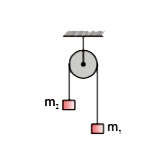
Two blocks of masses `m_(1)` and `m_(2)` are attached at the ends of an inextensible string which passes over a smooth massless pulley. If `m_(1)gtm_(2)`, find :
(i) the acceleration of each block
(ii) the tension in the string.

Text Solution

Verified by Experts
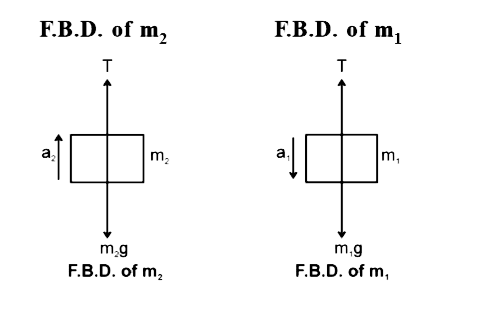
The block `m_(1)` is assumed to be moving downward and the block `m_(2)` is assumed to be moving upward, It is merely an assumption and it does not imply the real direction. If the values of `a_(1)` and `a_(2)` come out to be positive then body the assumed directions are correct, oherwise the body moves in the opposite direction. Since the pulley is smoth and massless, therefore, the tension on each side of the pulley is same. The free body diagram of each block is shown in the figure.

Fig. 1.1
Applying Newton's second Law on blocks `m_(1)` and `m_(2)`
Block `m_(1)" "m_(1)g-T=m_(1)a . . . . .. . . . (1)`
Block `m_(2)" "-m_(2)g+T=m_(2)a_(2) . . . . . . . . . . . (2)`
Number of unknowns : T, `a_(1)` and `a_(2)` (three)
Number of equations : only two
Obviously, we require one more equation to solve the problem Note that whenever one finds the number of equations less than the number of unknowns, one must think about the constraint relation. Now we are going to explain the mathematical procedure for this.
How to determine Constraint Relation ?
(1) Assume the direction of acceleration of each block e.g. `a_(1)` (downward) and `a_(2)` (upward) in this case.
(2) Locate the position of each block from a fixed point (depending on convenience), e.g. centre of the pulley in this case.
(3) Identify the constraint and write down the equation of constraint in terms of the distance assumed. For example, in the chosen problem, the length of string remains constant is the constraint or restriction.
Thus, `x_(1)+x_(2)=` constant
we get `(dx_(1))/(dt)+(dx_(2))/(dt)=0`
Each term on the left side represents the velocity of the blocks. Since we have to find a relation between acceletations, therefore we differntiate it once again w.r.t. time.

Thus `(d^(2)x_(1))/(dt^(2))+(d^(2)x_(2))/(dt^(2))=0`
Since, the block `m_(1)` is assumed to be moving downward (`x_(1)` is increasing with timw)
`:.(d^(2)x_(1))/(dt^(2))=+a_(1)`
and block `m_(2)` is assumed to be moving upward (`x_(2)` is decreasing with time)
`:.(d^(2)x_(2))/(dt^(2))=-a_(2)`
Thus `a_(1)-a_(2)=0`
or `a_(1)=a_(2)=a` (say) is the required constraint relation. Substituting `a_(1)=a_(2)=a` in equations (1) and (2) and solving them, we get
`(i)a=[(m_(1)-m_(2))/(m_(1)+m_(2))]g` (ii) `T=[(2m_(1)m_(2))/(m_(1)+m_(2))]g`
Promotional Banner

Topper's Solved these Questions

  • NEWTON'S LAWS OF MOTION & FRICTION

    MOTION|Exercise Problem|26 Videos
  • NEWTON'S LAWS OF MOTION & FRICTION

    MOTION|Exercise Questions For Practice|25 Videos
  • MODERN PHYSICS -1

    MOTION|Exercise EXERCISE-4 ( LEVEL- II)|39 Videos
  • NLM & FRICTION

    MOTION|Exercise EXERCISE-4 ( LEVEL-II)|15 Videos

Similar Questions

Explore conceptually related problems

Two masses M and m are connected at the two ends of an inextensible string. The string passes over a smooth frictionless pulley. Calculate the acceleration of the masses and the tension in the string. Given Mgtm .

Two masses M_(1) and M_(2) are attached to the ends of a light string which passes over a massless pulley attached to the top of a double inclined smooth plane of angles of inclination alpha and beta .The tension in the string is :

Two masses m_(1) and m_(2) are attached to a string which passes over a frictionless smooth pulley. When m_(1)=10kg,m_(2)=6kg , the acceleration of masses is

Two mass m_(1) and m_(2) are attached to a flexible inextensible massless rope, which passes over a frictionless and massless pully. Find the accelerations of the masses and tension in the rope.

Two bodies of masses m_(1) " and " m_(2) are connected a light string which passes over a frictionless massless pulley. If the pulley is moving upward with uniform acceleration (g)/(2) , then tension in the string will be

Two blocks of masses 6 kg and 4 kg are attached to the two ends of a massless string passing over a smooth fixed pulley. if the system is released, the acceleration of the centre of mass of the system will be

A block of mass m_(1)=2 kg is kept on a smooth horizontal table. Another block of mass m_(2)=1 kg is connected to m_(1) by a light inextensible string passing over a smooth pulley as shown in the figure. If the blocks are released, what will be the (a) acceleration of each block (b) tension in the string?

Two blocks are connected by an inextensible light string, the string is passing over smooth, light pulley as shown. Find the acceleration of blocks and tension in the string, reaction in pulley.

Two blocks of masses m_1 = 4 kg and m_2 = 2 kg are connected to the ends of a string which passes over a massless, frictionless pulley. The total downwards thrust on the pulley is nearly

Two masses m_(1) and m_(2) are connected by light inextensible string passing over a smooth pulley P . If the pulley moves vertically upwards with an acceleration equal to g then .

