Home
Class 10
MATHS
The decimal expansion of the rational nu...

The decimal expansion of the rational number `(14587)/(1250)` will terminate after how many decimal places?

A

one decimal place

B

two decimal places

C

three decimal places

D

four decimal places

Text Solution

Verified by Experts

The correct Answer is:
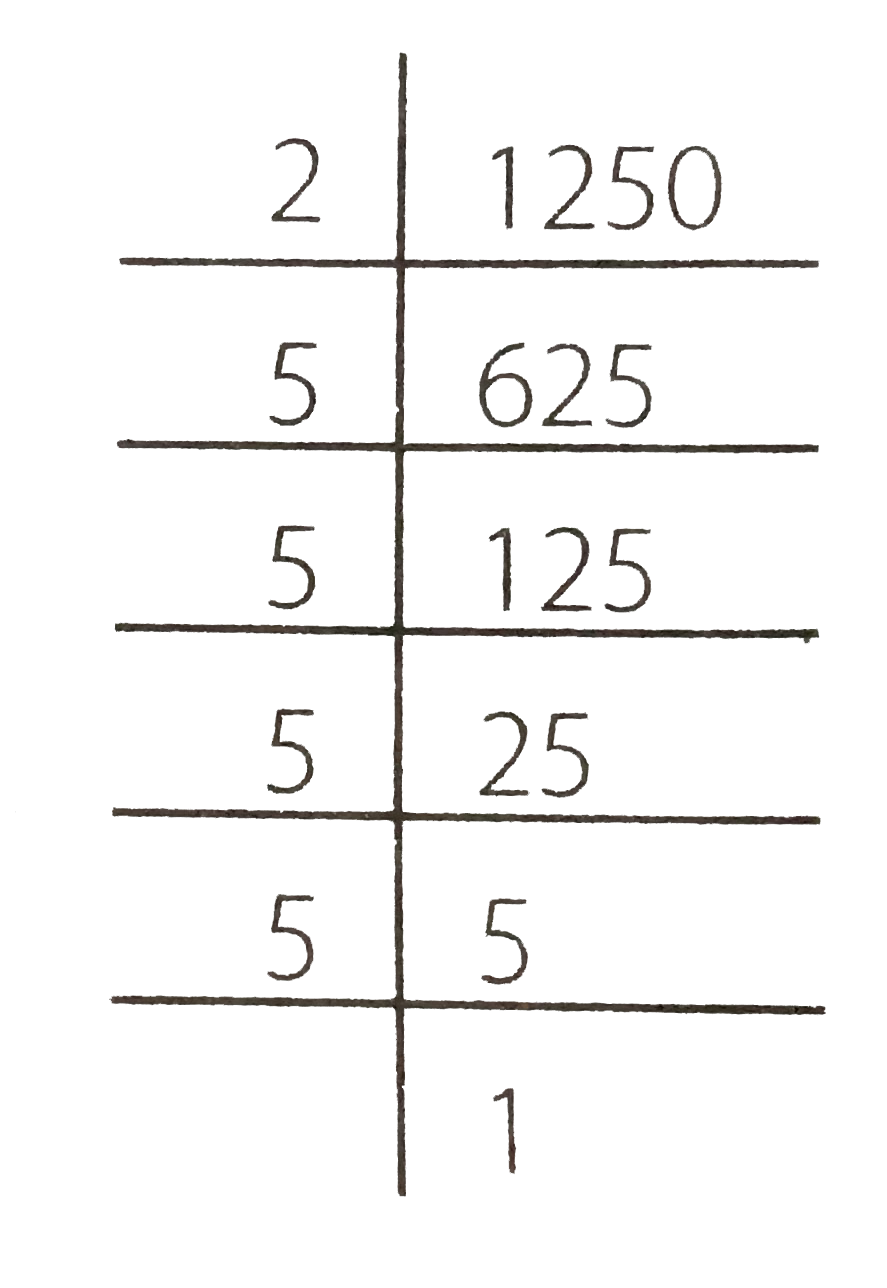
D

Rational number `=(14587)/(1250)=(14587)/(2^(1)xx5^(4))`
`(14587)/(10xx5^(3)) xx ((2))^(3)/((2))^(3)`
`(14587 xx 8)/(10 xx1000)`
`(116696)/(10000)=11.6696`
Hence, given rational number will terminate after four decimal places.
Promotional Banner

Topper's Solved these Questions

  • QUADRIATIC EQUATIONS

    NCERT EXEMPLAR|Exercise Quadratic Equations|51 Videos
  • STATISTICS AND PROBABILITY

    NCERT EXEMPLAR|Exercise LONG ASWERS QUESTIONS|5 Videos

Similar Questions

Explore conceptually related problems

The decimal expansion of the rational number (14587)/(1250) will terminate after (a) one decimal place (b) two decimal place (c) three decimal place (d) four decimal place

Find the decimal expansion of the rational number (14587)/(1250) .

The number (665)/(625) will terminate after how many decimal places ?

The decimal expansion of the rational number 327/(2^(3)xx5) will terminate after

The decimal expansion of the rational number 37/(2^(2) xx5) will termination after

The decimal expansion of the rational number (83)/(2^(3)xx5^(4)) will terminate after how many places of decimals?

The decimal expansion of the rational number (27)/(2^(2) * 5^(3)) , will terminate after how many places of decimals ?

The decimal expansion of the rational number (43)/(2^(4)xx5^(3)) will terminate after how many places of decimals?

The decimal expansion of the rational number 43/((2^(4) xx 5^(3)) will termiate after how many places of decimals.

What will be the decimal expansion of the rational number (27)/(1250) ?

NCERT EXEMPLAR-REAL NUMBERS-Real Numbers
  1. The product of a non-zero rational number with an irrational number is...

    Text Solution

    |

  2. What is the least number that is divisible by all the numbers 1 to 10

    Text Solution

    |

  3. The decimal expansion of the rational number (14587)/(1250) will termi...

    Text Solution

    |

  4. Write whether every positive integer can be of the form 4q+2 where q i...

    Text Solution

    |

  5. The product of two consecutive integers is divisible by 2. Is this sta...

    Text Solution

    |

  6. The product of any three consecutive natural numbers is divisible b...

    Text Solution

    |

  7. Write whether the square of any positive integer can be of the form 3m...

    Text Solution

    |

  8. A positive integer is the form of 3q+1 q, being a natural number. Can ...

    Text Solution

    |

  9. The number 525 and 3000 are both divisible only 3,5,15,25,75. What is ...

    Text Solution

    |

  10. Explain why 3 xx 5 xx 7 +7 is a composite number.

    Text Solution

    |

  11. Can two number have 18 as their HCF and 380 as their LCM? Give reason

    Text Solution

    |

  12. Without actually performing the long divison, find if (987)/(10500) wi...

    Text Solution

    |

  13. A rational number in its decimal expansion is 327.7081. What can you s...

    Text Solution

    |

  14. Prove that the square of any positive integer is of the form 4q or ...

    Text Solution

    |

  15. Show that cube of any positive integer is of the form 4m, 4m+1 or 4m+3...

    Text Solution

    |

  16. Show that the square of any positive integer cannot of the form 5q+2 o...

    Text Solution

    |

  17. Show that the square of any positive integer cannot be of the form 6m+...

    Text Solution

    |

  18. Show that the square of any odd integer is of the form 4m+1, for some ...

    Text Solution

    |

  19. If n is an odd positive integer, show that (n^2-1) is divisible by 8.

    Text Solution

    |

  20. Prove that if xa n dy are odd positive integers, then x^2+y^2 is even ...

    Text Solution

    |

