Home
Class 12
PHYSICS
In double slit experiment using light of...

In double slit experiment using light of wavelength `600 nm`, the angular width of a fringe formed on a distant screen is `0.1^(@)`. What is the spacing between the two slits ?

Text Solution

Verified by Experts
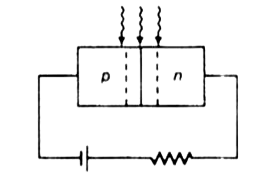
A photodiode (for special purpose) is fabricated with a transparent window to allow light to fall on the junction of the diode.
When the junction of photodiode is reverse bias it is illuminated with light of energy `hv gt E_(g)` of the semiconductor, the electron-hole pairs are generated due to absorption of photon.
Due to electric field of the function, electron are collected in n side and holes are collected on p-side and produces an emf. When an external load is connected, an electric current flows in the external circuit. The magnitude of the electric current depends on the intensity of incident light.
Reason of Reverse Biasing :
If there is no illumination, majority electrons are more than minority holes in n region of the diode. On illumination the junction, some electrons-hole pairs are generated. Let the excess electrons and holes generated are Dn and Dp respectively So. at a particular illumination,
`n'=n+Delta n`
and `p'=p+Delta p`
Since, `Delta n = Delta p` and `n gt p`
Hence, `= (Delta n)/(n) lt lt (Delta P)/(P)`
It means the minority carriers dominated reverse bias current is more easily measurable, than change in the forward bias current. Hence, photodiodes are preferably used in the reverse bias light intensity.
Promotional Banner

Topper's Solved these Questions

  • CBSE EXAMINATION PAPER, DELHI REGION - 2015 (CODE NO. 55/1/1/D)

    CBSE COMPLEMENTARY MATERIAL|Exercise SECTION E|6 Videos
  • CBSE EXAMINATION PAPER, DELHI REGION - 2015 (CODE NO. 55/1/1/D)

    CBSE COMPLEMENTARY MATERIAL|Exercise SECTION B|6 Videos
  • CBSE Examination Paper Delhi–2014

    CBSE COMPLEMENTARY MATERIAL|Exercise SET-III (Questions Uncommon to set-I and II)|9 Videos
  • DUAL NATURE OF MATTER AND RADIATION & ATOMS AND NUCLEI

    CBSE COMPLEMENTARY MATERIAL|Exercise Long Answer Question|22 Videos

Similar Questions

Explore conceptually related problems

In Young's double slit experiment, the angular width of a fringe formed on a distant screen is 0.1^(@) . What is the spacing between the slits, if the waveelngth of light used is 6000 Å?

In Young's double-slit experiment the angular width of a fringe formed on a distant screen is 1^(@) . The wavelength of light used is 6000 Å . What is the spacing between the slits?

In a Young's double slit esperiment, the angular width of a fringe formed on a distant screen is 1^(@) . The slit separation is 0.01 mm. The wavelength of the light is

In young's double-slit experiment , the spacing between the slits is 'd' and the wavelength of light used is 6000Å If the angular width of a fringe formed on a distance screen is 1^@ then calculate 'd' .

In a Young's double slit experiment, bi-chromatic light of wavelengths 400 nm and 560 nm are used. The distance between the slits is 0.1 mm and the distance between the plane of the slits and the screen is 1m. The minimum distance between two successive regions of complete darkness is

In Young's double slit experiment, while using a source of light of wavelength 4500 Å , the fringe width obtained is 0.4 cm. If the distance between the slits and the screen is reduced to half , calculate the new fringe width.

State two conditions to obtain sustained interference of light. In young's double slit experiment, using light of wavelength 400 nm, interference fringes of width X are obtained. The wavelength of light is increased to 600 nm and the separation between the slits is halved. if one wants the observed fringe width on the screen to be the same in the two cases, find the ratio of the distance between the screen and the plane of the slits in the two arrangements.

In young's double slit experiment the slits are illumated by light of wavelength 5890^(@) A and the distance between the fringes obtained on the screen is 0.2^(@) . If the whole apparatus is immersed in water then the angular fringe width will be, if the refractive index of water is 4//3

