

Home
Class 12
CHEMISTRY
Ordinarily the barrier to rotation about...

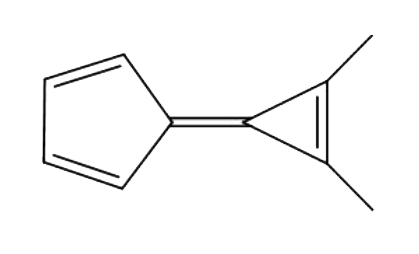
Ordinarily the barrier to rotation about a carbon - carbon double bond is quite high but in compound P double bond between two rings was observed by NMR to have a rotational energy barrier of only about 20 cal/mol., showing that it has lot of single bond character.

The reason for this is

A

Double bond having partial triple bond character because of resonance

B

Double bond undergoes flipping

C

Double bond having very high single bond character because of aromaticity gained in both three and five membered rings.

D

`+I` effect of `nC_(3)H_(7)` groups makes double bond having partial single bond character.

Text Solution

Verified by Experts

The correct Answer is:
C
Promotional Banner

Topper's Solved these Questions

  • NTA JEE MOCK TEST 42

    NTA MOCK TESTS|Exercise CHEMISTRY|25 Videos
  • NTA JEE MOCK TEST 44

    NTA MOCK TESTS|Exercise CHEMISTRY|25 Videos

Similar Questions

Explore conceptually related problems

Ordinarily the barrier to rotation about a carbon-carbon double bond is quite high but in compound P double bond between two rings was observed by NMR to have a rotational energy barrier of only about 20 cal/mol The reason for this is

The restricted rotation about carbon-carbon double bond in 2-butene is due to

The barrier for rotation about indicated bonds will be maximum in which of these compounds?

The barrier for rotation about the indicated bonds Will be maximum in which of these three compounds ?

Which of the following will have least hindered rotation about carbon -carbon bond?

Which of the following will have least hindered rotation about carbon-carbon bond?

NTA MOCK TESTS-NTA JEE MOCK TEST 43-CHEMISTRY
  1. The plots of the extent of adsroption (x/m) Vs pressure at different t...

    Text Solution

    |

  2. Which of the following are not more basic than Al(OH)(3)?

    Text Solution

    |

  3. Ordinarily the barrier to rotation about a carbon - carbon double bond...

    Text Solution

    |

  4. In the reaction, 4NH(3)(g)+5O(2)(g) rarr 4NO(g)+6H(2)O(g), when 1 mole...

    Text Solution

    |

  5. The equilibrium SO(2)Cl(2)(g) hArr SO(2)(g)+Cl(2)(g) is attained at 25...

    Text Solution

    |

  6. Wooden artifact and freshly cut tree give 7.7 and "15.4 min"^(-1)g^(-1...

    Text Solution

    |

  7. Which of the following is an example of heterogeneous catalysis ?

    Text Solution

    |

  8. X gives white turbidity with Lucas reagent instantly. X and Y both tur...

    Text Solution

    |

  9. A and B respectively are

    Text Solution

    |

  10. underset("Tollen's test")underset("Gives positive")underset(darr)(C(3)...

    Text Solution

    |

  11. 1 - Methylcyclohexene on addition of HCl produces

    Text Solution

    |

  12. Major product C is :

    Text Solution

    |

  13. Which of the following orders is correct? (1) SbH(3)gt NH(3) gt AsH(...

    Text Solution

    |

  14. Select the correct statement :

    Text Solution

    |

  15. Which of the following statements is incorrect?

    Text Solution

    |

  16. According to the molecular orbital theory which of the following state...

    Text Solution

    |

  17. Gradual addition of KI solution of Bi(NO(3))(3) solution intially prod...

    Text Solution

    |

  18. The characteristics X-rays wavelength is related to atomic number by t...

    Text Solution

    |

  19. How many of the following can show geometrical isomerism VI. CHCl...

    Text Solution

    |

  20. For the strong electrolytes NaOH, NaCl and BaCl(2) the molar ionic con...

    Text Solution

    |