

Home
Class 12
PHYSICS
The correct graph between the temperatur...

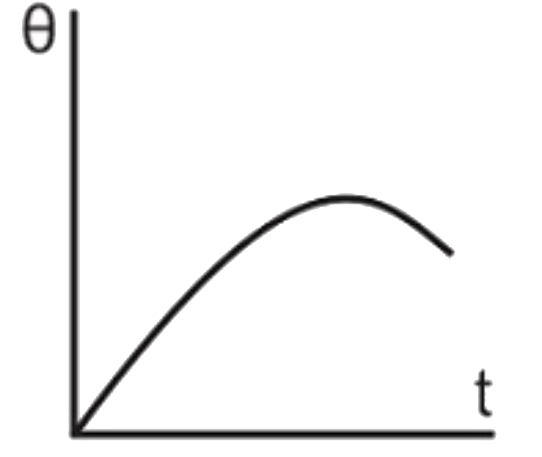
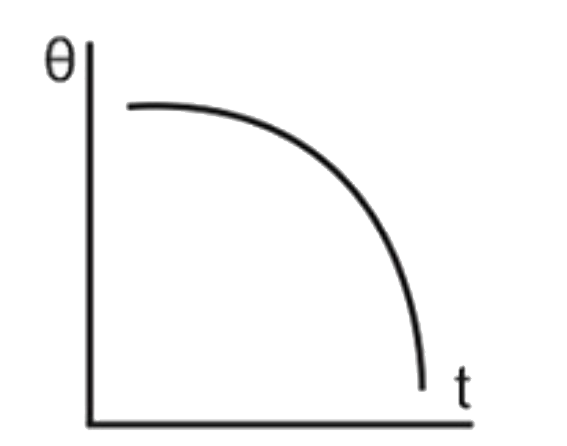
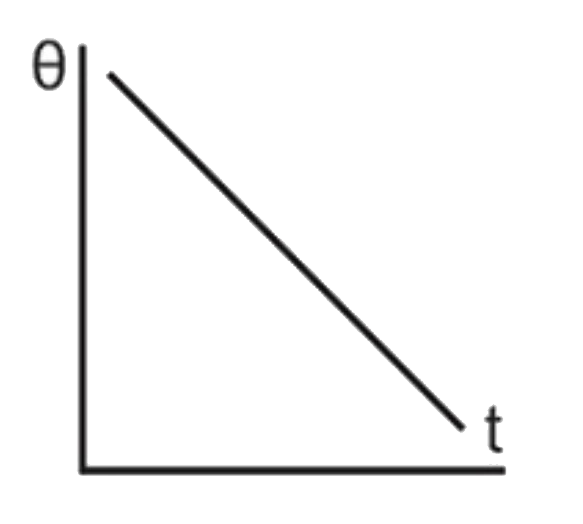
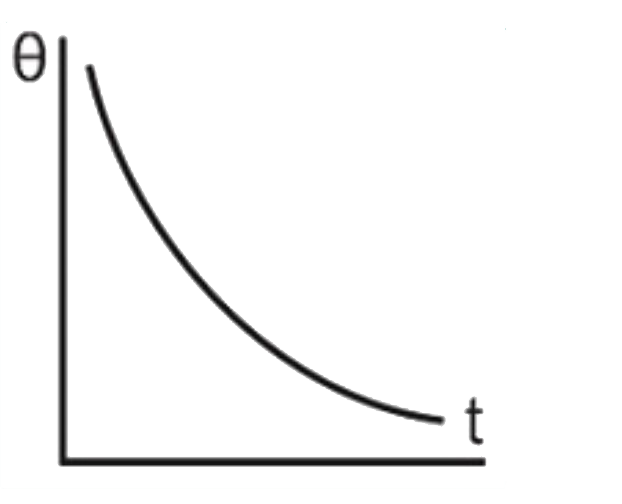
The correct graph between the temperature of a hot body kept in cooler surrounding and time is (Assume newton's law of cooling)

A

B

C

D

Text Solution

AI Generated Solution

The correct Answer is:
To solve the problem of determining the correct graph between the temperature of a hot body kept in cooler surroundings and time, we will apply Newton's Law of Cooling. Here’s a step-by-step breakdown of the solution: ### Step 1: Understand Newton's Law of Cooling Newton's Law of Cooling states that the rate of change of temperature of an object is proportional to the difference between its own temperature and the ambient temperature. Mathematically, it can be expressed as: \[ \frac{dT}{dt} = -k(T - T_s) \] Where: - \( T \) is the temperature of the hot body, - \( T_s \) is the temperature of the surroundings, - \( k \) is a positive constant, - \( t \) is time. ### Step 2: Set Up the Initial Conditions Let: - \( T_0 \) be the initial temperature of the hot body, - \( T_s \) be the constant temperature of the surroundings. Initially, at \( t = 0 \): \[ T(0) = T_0 \] ### Step 3: Solve the Differential Equation To find the temperature of the body as a function of time, we can integrate the differential equation. The solution to the equation is given by: \[ T(t) = T_s + (T_0 - T_s)e^{-kt} \] ### Step 4: Analyze the Behavior of the Function 1. At \( t = 0 \): \[ T(0) = T_s + (T_0 - T_s)e^{0} = T_s + (T_0 - T_s) = T_0 \] This confirms that the initial temperature is \( T_0 \). 2. As \( t \to \infty \): \[ T(t) \to T_s + (T_0 - T_s)e^{-\infty} = T_s + 0 = T_s \] This indicates that the temperature of the body approaches the temperature of the surroundings as time progresses. ### Step 5: Graph the Function The function \( T(t) = T_s + (T_0 - T_s)e^{-kt} \) is an exponential decay function. The graph will start at \( T_0 \) when \( t = 0 \) and will asymptotically approach \( T_s \) as \( t \) increases. The curve will be decreasing and will never actually reach \( T_s \), but will get infinitely close to it. ### Conclusion The correct graph that represents the temperature of a hot body cooling in cooler surroundings over time is an exponential decay curve starting from \( T_0 \) and approaching \( T_s \).
Promotional Banner

Topper's Solved these Questions

  • NTA NEET SET 33

    NTA MOCK TESTS|Exercise PHYSICS|45 Videos
  • NTA NEET SET 35

    NTA MOCK TESTS|Exercise PHYSICS|45 Videos

Similar Questions

Explore conceptually related problems

Graph of rate of cooling against time is (assume Newton's law of cooling)

A body cools in 7 minutes from 60^(@)C to 40^(@)C . What will be its temperature after the next 7 minutes? The temperature of the surrounding is 10^(@)C . Assume that Newton's law of cooling holds good throughout the process.

The temperature of a body falls from 52^(@)C to 36^(@)C in 10 minutes when placed in a surrounding of constant temperature 20^(@)C . What will be the temperature of the body after another 10min . (Use Newton's law of cooling)

A body cools from 70^(@)C to 50^(@)C in 6 minutes when the temperature of the surrounding is 30^(@)C . What will be the temperature of the body after further 12 minutes if coolilng proseeds ac cording to Newton's law of cooling ?

A cooling curve is plotted between the temperature of a hot body and time. Which of the following is not true for the cooling curve?

A liquid takes 10 minutes to cool from 80^(@)C to 50^(@)C . The temperature of the surroudings is 20^(@)C . Assuming that the Newton's law of cooling is obeyed, the cooling constant will be -

A liquid in a beaker has temperature theta(t) at time t and theta_0 is temperature of surroundings, then according to Newton's law of cooling the correct graph between log_e( theta-theta_0) and t is :

Ac cording to Newton's law of cooling, the rate of cooling of a body is proportional to (Delta theta)^(n) , where Delta theta is the difference of the temperature of the body and thae surrounding. What is the value of n out of 4,3,2,and 1?

A body cools from 60%@C to 50^@ C in 10 min. Find its temperature at the end of next 10 min if the room temperature is 25^@C . Assume Newton's law of cooling holds.

NTA MOCK TESTS-NTA NEET SET 34-PHYSICS
  1. the gauge pressure in both tyres of a bicycle is 690 k Pa. If the bicy...

    Text Solution

    |

  2. A given ray of light suffers minimum deviation in an equilateral prism...

    Text Solution

    |

  3. Red light of wavelength 6400 Å in air has a wavelength of 4000 Å in ...

    Text Solution

    |

  4. Two blocks of masses 10 kg and 4 kg are connected by a spring of negli...

    Text Solution

    |

  5. One quarter sector is cut from a uniform circular disc of radius R. Th...

    Text Solution

    |

  6. In the following, which one of the diodes is reverse biased ?

    Text Solution

    |

  7. In the circuit shown in figure,the base current I(B) is 10 mu A and th...

    Text Solution

    |

  8. The specific heat of an ideal gas varies with temperature T as

    Text Solution

    |

  9. 1kg of water is at 20^(@)C. A resistor of 20Omega is connected across ...

    Text Solution

    |

  10. A double-slit apparatus is immersed in a liquid of refractive index 1....

    Text Solution

    |

  11. White light is incident on the interface of glass and air as shown in ...

    Text Solution

    |

  12. The frequency of tuning fork A is 2% more than the frequency of a stan...

    Text Solution

    |

  13. A source of sound of frequency 600 Hz is placed inside water. The spee...

    Text Solution

    |

  14. A gas enclosed in a vessel has pressure P, volume V and absolute tempe...

    Text Solution

    |

  15. Name the gate , which represents the Boolean expression y = A. B for i...

    Text Solution

    |

  16. A particular hydrogen like atom has its ground state Binding energy = ...

    Text Solution

    |

  17. In a step-up transformer the voltage in the primary is 220 V and the c...

    Text Solution

    |

  18. The correct graph between the temperature of a hot body kept in cooler...

    Text Solution

    |

  19. A heat engine is a device

    Text Solution

    |

  20. The operating point of transistor amplifier should be in

    Text Solution

    |