Home
Class 12
PHYSICS
A monochromatic plane wave of speed c an...

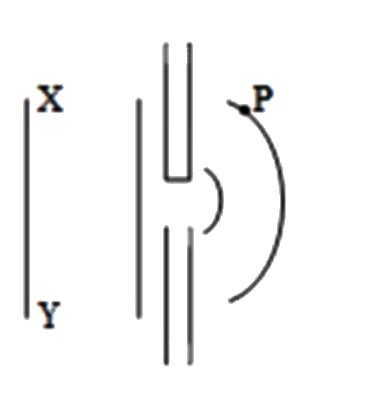
A monochromatic plane wave of speed c and wavelength `lamda` is diffracted at a small aperture . The diagram illustrates successive wavefront. After what time will some portion of the wavefront XY reach P ?

A

`(3lamda)/(2c)`

B

`(2lamda)/(c)`

C

`(3lamda)/(c)`

D

`(4lamda)/(c)`

Text Solution

Verified by Experts

The correct Answer is:

C
Promotional Banner

Topper's Solved these Questions

  • NTA NEET SET 54

    NTA MOCK TESTS|Exercise PHYSICS|44 Videos
  • NTA NEET SET 56

    NTA MOCK TESTS|Exercise PHYSICS|45 Videos

Similar Questions

Explore conceptually related problems

Plane parallel wavefornts encounter the interference one medium and another as shown below The wave speed is different in the two media. what will happen to the distance between wavefront and the direction of travel wavefronts as the waves enter the second media?

Huygen was the figure scientist who proposed the idea of wave theory of light he said that the light propagates in form of wavelengths. A wavefront is a imaginary surface of every point of which waves are in the same. phase. For example the wavefront for a point source of light is collection of concentric spheres which have centre at the origin w_(1) is a wavefront w_(2) is another wavefront. The radius of the wavefront at time 't' is 'ct' in thic case where 'c' is the speed of light the direction of propagation of light is perpendicular to the surface of the wavelength. the wavefronts are plane wavefronts in case of a parallel beam of light. Huygen also said that every point of the wavefront acts as the source of secondary wavelets. The tangent drawn to all secondary wavelets at a time is the new wavefront at that time. The wavelets are to be considered only in the forward direction (i.e., the direction of propagation of light) and not in the reverse direction if a wavefront w_(1) and draw spheres of radius 'cDeltat' they are called secondary wavelets. Draw a surface w_(2) which is tangential to all these secondary wavelets w_(2) is the wavefront at time t+Deltat Huygen proved the laws of reflection and laws of refraction using concept of wavefront. Q. A point source of light is placed at origin, in air. the equation of wavefront of the wave at time t, emitted by source at t=0 is (take refractive index of air as 1)

Huygen was the figure scientist who proposed the idea of wave theory of light he said that the light propagates in form of wavelengths. A wavefront is a imaginary surface of every point of which waves are in the same. phase. For example the wavefront for a point source of light is collection of concentric spheres which have centre at the origin w_(1) is a wavefront w_(2) is another wavefront. The radius of the wavefront at time 't' is 'ct' in thic case where 'c' is the speed of light the direction of propagation of light is perpendicular to the surface of the wavelength. the wavefronts are plane wavefronts in case of a parallel beam of light. Huygen also said that every point of the wavefront acts as the source of secondary wavelets. The tangent drawn to all secondary wavelets at a time is the new wavefront at that time. The wavelets are to be considered only in the forward direction (i.e., the direction of propagation of light) and not in the reverse direction if a wavefront w_(1) and draw spheres of radius 'cDeltat' they are called secondary wavelets. Draw a surface w_(2) which is tangential to all these secondary wavelets w_(2) is the wavefront at time t+Deltat Huygen proved the laws of reflection and laws of refraction using concept of wavefront. Q. Wavefronts incident on an interface between the media are shown in the figure. the refracted wavefront will be as shown in

Huygen was the figure scientist who proposed the idea of wave theory of light he said that the light propagates in form of wavelengths. A wavefront is a imaginary surface of every point of which waves are in the same. phase. For example the wavefront for a point source of light is collection of concentric spheres which have centre at the origin w_(1) is a wavefront w_(2) is another wavefront. The radius of the wavefront at time 't' is 'ct' in thic case where 'c' is the speed of light the direction of propagation of light is perpendicular to the surface of the wavelength. the wavefronts are plane wavefronts in case of a parallel beam of light. Huygen also said that every point of the wavefront acts as the source of secondary wavelets. The tangent drawn to all secondary wavelets at a time is the new wavefront at that time. The wavelets are to be considered only in the forward direction (i.e., the direction of propagation of light) and not in the reverse direction if a wavefront w_(1) and draw spheres of radius 'cDeltat' they are called secondary wavelets. Draw a surface w_(2) which is tangential to all these secondary wavelets w_(2) is the wavefront at time t+Deltat Huygen proved the laws of reflection and laws of refraction using concept of wavefront. Q. Spherical wavefronts shown in figure, strike a plane mirror. reflected wavefront will be as shown in

Huygen was the figure scientist who proposed the idea of wave theory of light he said that the light propagates in form of wavelengths. A wavefront is a imaginary surface of every point of which waves are in the same. phase. For example the wavefront for a point source of light is collection of concentric spheres which have centre at the origin w_(1) is a wavefront w_(2) is another wavefront. The radius of the wavefront at time 't' is 'ct' in thic case where 'c' is the speed of light the direction of propagation of light is perpendicular to the surface of the wavelength. the wavefronts are plane wavefronts in case of a parallel beam of light. Huygen also said that every point of the wavefront acts as the source of secondary wavelets. The tangent drawn to all secondary wavelets at a time is the new wavefront at that time. The wavelets are to be considered only in the forward direction (i.e., the direction of propagation of light) and not in the reverse direction if a wavefront w_(1) and draw spheres of radius 'cDeltat' they are called secondary wavelets. Draw a surface w_(2) which is tangential to all these secondary wavelets w_(2) is the wavefront at time t+Deltat Huygen proved the laws of reflection and laws of refraction using concept of wavefront. Q. Plane are incident on a spherical mirror as shown in the figure. the reflected wavefronts will be

Huygen was the figure scientist who proposed the idea of wave theory of light he said that the light propagates in form of wavelengths. A wavefront is a imaginary surface of every point of which waves are in the same. phase. For example the wavefront for a point source of light is collection of concentric spheres which have centre at the origin w_(1) is a wavefront w_(2) is another wavefront. The radius of the wavefront at time 't' is 'ct' in thic case where 'c' is the speed of light the direction of propagation of light is perpendicular to the surface of the wavelength. the wavefronts are plane wavefronts in case of a parallel beam of light. Huygen also said that every point of the wavefront acts as the source of secondary wavelets. The tangent drawn to all secondary wavelets at a time is the new wavefront at that time. The wavelets are to be considered only in the forward direction (i.e., the direction of propagation of light) and not in the reverse direction if a wavefront w_(1) and draw spheres of radius 'cDeltat' they are called secondary wavelets. Draw a surface w_(2) which is tangential to all these secondary wavelets w_(2) is the wavefront at time t+Deltat Huygen proved the laws of reflection and laws of refraction using concept of wavefront. Q. Certain plane wavefronts are shown in figure the refractive index of medius is

NTA MOCK TESTS-NTA NEET SET 55-PHYSICS
  1. The acceleration of a body due to the attraction of the earth (radius ...

    Text Solution

    |

  2. Two bodies of mass m(1) and m(2) are initially at rest placed infinite...

    Text Solution

    |

  3. A particle moves such that its acceleration a is given by a = -bx , wh...

    Text Solution

    |

  4. The displacement of two identical particles executing SHM are represen...

    Text Solution

    |

  5. A cubical block is floating in a liquid with half of its volume immers...

    Text Solution

    |

  6. In a capillary tube experiment, a vertical 30 cm long capillary tube i...

    Text Solution

    |

  7. A square plate is kept in YZ plane. Then according to perpendicular ax...

    Text Solution

    |

  8. A shell of mass 20 kg at rest explodes into two fragments whose masses...

    Text Solution

    |

  9. An electron in H atom makes a transition from n = 3 to n = 1. The reco...

    Text Solution

    |

  10. When an electron revolves around the nucleus, then the ratio of magnet...

    Text Solution

    |

  11. A radioactive sample at any instant has its disintegration rate 5000 d...

    Text Solution

    |

  12. When a metallic surface of threshold wavelength 4lamda is illuminated ...

    Text Solution

    |

  13. If an electron and a photon propagate in the form of waves having the...

    Text Solution

    |

  14. For given logic gate truth table is

    Text Solution

    |

  15. In a transistor

    Text Solution

    |

  16. A transistor is used as an amplifier in CB mode with a load resistance...

    Text Solution

    |

  17. A crown glass prism of refracting angle 6^@ is to be used for deviatio...

    Text Solution

    |

  18. A beam of light consisting of red, green, and blue colors is incident ...

    Text Solution

    |

  19. A monochromatic plane wave of speed c and wavelength lamda is diffract...

    Text Solution

    |

  20. The contrast in the fringes in any interference pattern depends on:

    Text Solution

    |
