Home
Class 12
PHYSICS
Two particles of mass m and 2m have thei...

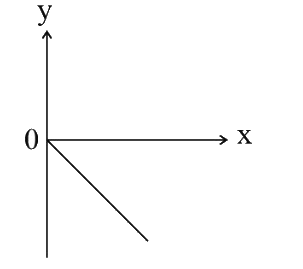
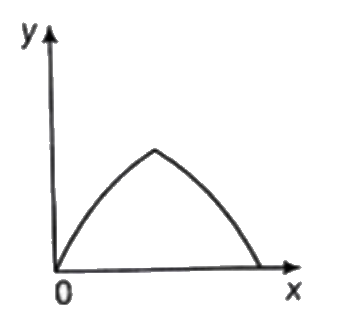
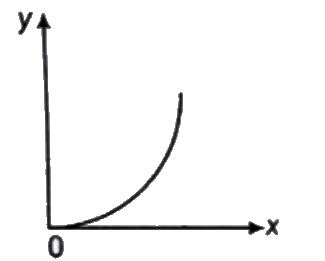
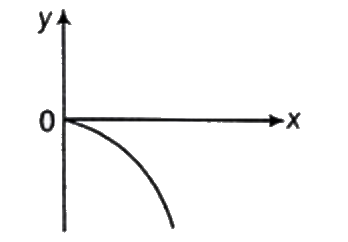
Two particles of mass m and 2m have their position vectors as a function of time as `r_(1) (t) = hat i - t^(3) hat(j) +2t^(2)hat(k) and r_(2) (t) = t hat (i) -t^(3)hat(j) -t^(2) hatk` respectively (where t is the time). Which one of the following graphs represents the path of the centre of mass ?

A

B

C

D

Text Solution

AI Generated Solution

The correct Answer is:

To find the path of the center of mass of two particles with given position vectors, we can follow these steps: ### Step 1: Identify the position vectors The position vectors of the two particles are given as: - For particle 1 (mass \( m \)): \[ \vec{r}_1(t) = \hat{i} - t^3 \hat{j} + 2t^2 \hat{k} \] - For particle 2 (mass \( 2m \)): \[ \vec{r}_2(t) = t \hat{i} - t^3 \hat{j} - t^2 \hat{k} \] ### Step 2: Write the formula for the center of mass The position vector of the center of mass \( \vec{r}_{cm} \) for two particles can be calculated using the formula: \[ \vec{r}_{cm} = \frac{m_1 \vec{r}_1 + m_2 \vec{r}_2}{m_1 + m_2} \] Where: - \( m_1 = m \) (mass of particle 1) - \( m_2 = 2m \) (mass of particle 2) ### Step 3: Substitute the values into the formula Substituting the masses and position vectors into the formula: \[ \vec{r}_{cm} = \frac{m \vec{r}_1 + 2m \vec{r}_2}{m + 2m} \] This simplifies to: \[ \vec{r}_{cm} = \frac{m \vec{r}_1 + 2m \vec{r}_2}{3m} \] \[ \vec{r}_{cm} = \frac{1}{3} \left( \vec{r}_1 + 2 \vec{r}_2 \right) \] ### Step 4: Calculate \( \vec{r}_{cm} \) Now, we will calculate \( \vec{r}_{cm} \): \[ \vec{r}_{cm} = \frac{1}{3} \left( \left( \hat{i} - t^3 \hat{j} + 2t^2 \hat{k} \right) + 2 \left( t \hat{i} - t^3 \hat{j} - t^2 \hat{k} \right) \right) \] Expanding this: \[ = \frac{1}{3} \left( \hat{i} - t^3 \hat{j} + 2t^2 \hat{k} + 2t \hat{i} - 2t^3 \hat{j} - 2t^2 \hat{k} \right) \] Combining like terms: \[ = \frac{1}{3} \left( (1 + 2t) \hat{i} + (-1 - 2)t^3 \hat{j} + (2 - 2)t^2 \hat{k} \right) \] This simplifies to: \[ = \frac{1}{3} \left( (1 + 2t) \hat{i} - 3t^3 \hat{j} \right) \] ### Step 5: Write the final expression for \( \vec{r}_{cm} \) Thus, the position vector of the center of mass is: \[ \vec{r}_{cm} = \frac{1 + 2t}{3} \hat{i} - t^3 \hat{j} \] ### Step 6: Analyze the components From the expression: - The x-component is \( \frac{1 + 2t}{3} \) which is always positive for \( t \geq 0 \). - The y-component is \( -t^3 \) which is always negative for \( t > 0 \). ### Step 7: Determine the path The path of the center of mass will be a curve where: - As \( t \) increases, the x-coordinate increases linearly, while the y-coordinate decreases cubically. ### Conclusion Based on the analysis, the graph representing the path of the center of mass will show a positive x-coordinate and a negative y-coordinate, indicating a curve that moves upwards to the right and downwards in the y-direction.
Promotional Banner

Topper's Solved these Questions

  • NTA NEET SET 60

    NTA MOCK TESTS|Exercise PHYSICS|45 Videos
  • NTA NEET SET 62

    NTA MOCK TESTS|Exercise PHYSICS|45 Videos

Similar Questions

Explore conceptually related problems

The position vectors of three particles of mass m_(1) = 1kg, m_(2) = 2kg and m_(3) = 3kg are r_(1) = (hat(i) + 4hat(j) +hat(k)) m, r_(2) = (hat(i)+hat(j)+hat(k)) m and r_(3) = (2hat(i) - hat(j) -hat2k) m, respectively. Find the position vector of their center of mass.

Two particles of mass 1 kg and 3 kg have position vectors 2 hat i+ 3 hat j + 4 hat k and -2 hat i+ 3 hat j - 4 hat k respectively. The centre of mass has a position vector.

Two blocks of mass 1kg and 3 kg have position v ectors hat(i) + 2 hat(j) + hat(k) and 3 hat(i) - 2 hat(j) + hat(k) , respectively . The center of mass of this system has a position vector.

The time dependence of the position of a particle of mass m = 2 is given by vec(r) (t) = 2t hat(i) - 3 t^(2) hat(j) Its angular momentum, with respect to the origin, at time t = 2 is :

Find the shortest distance between the lines whose vector equations are quad vec r=(1-t)hat i+(t-2)hat j+(3-2t)hat k and vec r=(s+1)hat i+(2s-1)hat j-(2s+1)hat k

The position vector of a particle changes with time according to the relation vec(r ) (t) = 15 t^(2) hat(i) + (4 - 20 t^(2)) hat(j) What is the magnitude of the acceleration at t = 1?

NTA MOCK TESTS-NTA NEET SET 61-PHYSICS
  1. The ratio of minimum to maximum wavelength in Balmer series is

    Text Solution

    |

  2. Two particles of mass m and 2m have their position vectors as a functi...

    Text Solution

    |

  3. A particle of mass m rotates in a circle of radius a with uniform angu...

    Text Solution

    |

  4. The velocity-time graph of a particle moving along a straight line is ...

    Text Solution

    |

  5. If a wire of resistance R is melted and recasted in to half of its len...

    Text Solution

    |

  6. The conducting circular loops of radii R(1) and R(2) are placed in the...

    Text Solution

    |

  7. The magnitude and direction of the electric field at point P can be be...

    Text Solution

    |

  8. Two balls of radius r each are placed at a distance R and released . T...

    Text Solution

    |

  9. A black body of temperature T is inside a chamber of temperature T(0) ...

    Text Solution

    |

  10. For the adiabatic expansion of a perfect monoatomic gas, when volume i...

    Text Solution

    |

  11. A charged particle moving in a uniform magnetic field penetrates a lay...

    Text Solution

    |

  12. A boat which has a speed of 5 km// hr in steel water crosses a river...

    Text Solution

    |

  13. A cyclist turns around a curve at 15 miles/hour. If he turns at double...

    Text Solution

    |

  14. If a simple pendulum oscillates with an amplitude of 50 mm and time pe...

    Text Solution

    |

  15. In photoelectric emission process from a metal of work function 1.8 eV...

    Text Solution

    |

  16. The SI unit of the coefficent of viscosity is

    Text Solution

    |

  17. A ray of light travelling in the direction 1/2 (hati+sqrt(3)hatj) is i...

    Text Solution

    |

  18. A cylinder is rolling down on a inclined plane of inclination60^(@). W...

    Text Solution

    |

  19. A transistor is used as a common emitter amplifier with a load resista...

    Text Solution

    |

  20. A point near the equator has: (H and V are horizontal and vertical com...

    Text Solution

    |
