

Home
Class 12
PHYSICS
From the following graph of photocurrent...

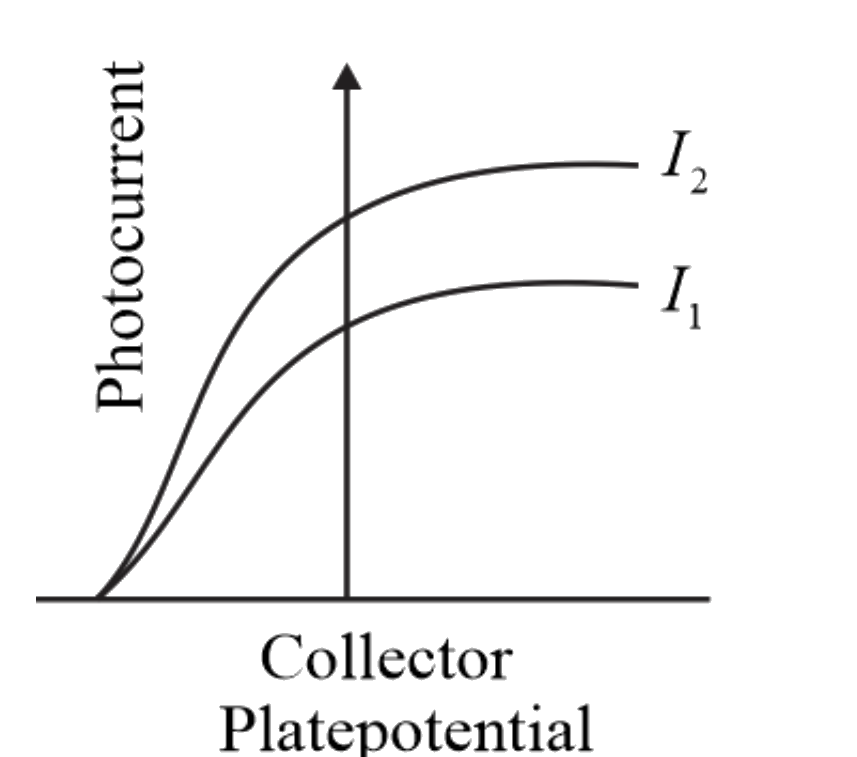
From the following graph of photocurrent against collector plate potential for two different intensities of light `I_1 and I_2` one can , conclude

A

`I_1=I_2`

B

`I_1gtI_2`

C

`I_1ltI_2`

D

Comparison is not possible

Text Solution

Verified by Experts

The correct Answer is:
C
Promotional Banner

Topper's Solved these Questions

  • NTA NEET SET 63

    NTA MOCK TESTS|Exercise PHYSICS|45 Videos
  • NTA NEET SET 66

    NTA MOCK TESTS|Exercise PHYSICS|45 Videos

Similar Questions

Explore conceptually related problems

The Fig shows a plot of three curves a, b, c showing the variation of photocurrent versis collector plate potential for the different intensities I_1, I_2 and I_3 having frequencies v_1, v_2 and v_3 respectively, incident on a photosensitive surface. Point out the two curves for which the incident radiation have same frequency but different intensities.

Draw a plot showing the variation of photoelectric current with collector plate potential for two different frequencies v_1 and v_2 (v_1gtv_2) of incident radiation having the same intensity. In which case will the stopping potential be higher? Justify your answer.

Draw a plot showing the variation of photoelectric current with collector plate potential for two different frequencies, v_1gtv_2 of incident radiation having the same intensity. In which case will the stopping potential be higher? Justify your answer.

(a) Define the terms , (i) threshold frequency and (ii) stopping potential in photoelectric effect. (b) Plot a graph of photocurrent versus anode potential for a radiation of frequency v and intensities I_1 and I_2 . (I_1 lt I_2) .

The graph of Fig. shows the variation of photoelectric current with collector plate potential for different frequencies of incident radiations. (i) Which physical parameter is kept constant for the three curves? (ii) Which frequency (v_1,v_2 or v_3) is the highest?

The variation of photocurrent with collector potential for different frequencies of incident radiation v_1,v_2,v_3 is as shown in the the graph , then

NTA MOCK TESTS-NTA NEET SET 65-PHYSICS
  1. How many alpha and beta-particles are emitted in the transformation ""...

    Text Solution

    |

  2. In nuclear reaction .(4)Be^(9)+.(2)He^(4)rarr.(6)C^(12)+X,X will be

    Text Solution

    |

  3. The time period of oscillations of a block attached to a spring is t(1...

    Text Solution

    |

  4. The phase difference between two waves represented by y(1)=10 ^(...

    Text Solution

    |

  5. The maximum kinetic energy of a photoelectron is 3 eV. What is its sto...

    Text Solution

    |

  6. From the following graph of photocurrent against collector plate poten...

    Text Solution

    |

  7. A liquid drop having surface energy E is spread into 512 droplets of s...

    Text Solution

    |

  8. A body floats in a liquid contained in a beaker. The whole system as s...

    Text Solution

    |

  9. Given that, velocity of light in quartz =1.5xx10^(8)m//s and velocity ...

    Text Solution

    |

  10. Light has the following wave property

    Text Solution

    |

  11. On applying a constant torque, a wheel at rest, turns through 400 radi...

    Text Solution

    |

  12. If the ratio of the concentration of electron to that of holes in a se...

    Text Solution

    |

  13. In the following common emitter configuration an NPN transistor with c...

    Text Solution

    |

  14. Coefficient of linear expansion of brass and steel rods are alpha(1) a...

    Text Solution

    |

  15. A public park , in the form of a square , has an area of (100pm0.2 ) m...

    Text Solution

    |

  16. In a Young's double slit experiment, 12 fringes are observed to be for...

    Text Solution

    |

  17. If numerical aperture of a microscope is increased, then its

    Text Solution

    |

  18. A wave of frequency 500 Hz has velocity 360 m/sec. The distance betwee...

    Text Solution

    |

  19. If E and B represent electric and magnetic field vectors of the electr...

    Text Solution

    |

  20. The potential energy for a force filed vecF is given by U(x,y)=cos(x+y...

    Text Solution

    |