Home
Class 12
PHYSICS
A bead of mass m can slide without frict...

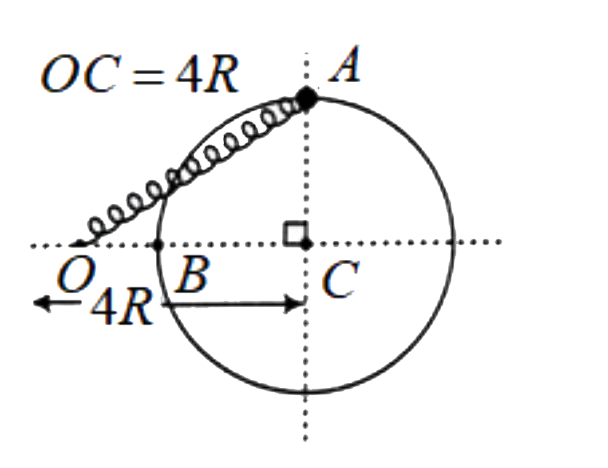
A bead of mass m can slide without friction on a fixed circular horizontal ring of radius 3R having a centre at the point C. The bead is attached to one of the ends of spring of spring constant k. Natural length of spring is R and the other end of the spring is R and the other end of the spring is fixed at point O as shown in the figure. If the bead is released from position A, then the kinetic energy of the bead when it reaches point B is

A

`25/2kR^2`

B

`9/2kR^2`

C

`8kR^2`

D

`12kR^2`

Text Solution

Verified by Experts

The correct Answer is:

C
Promotional Banner

Topper's Solved these Questions

  • NTA NEET SET 69

    NTA MOCK TESTS|Exercise PHYSICS|45 Videos
  • NTA NEET SET 71

    NTA MOCK TESTS|Exercise PHYSICS|45 Videos

Similar Questions

Explore conceptually related problems

A Bead of mass m is attached to one end of a spring of natural length 'R' and spring cosntant 'k=((sqrt3+1)mg)/R' . The other end of the spring is fixed at point 'A' on a smooth vertical ring of radius 'R' as shown

A spring has natural length 40 cm and spring constant 500 N//m . A block of mass 1 kg is attached at one end of the spring and other end of the spring is attached to a ceiling. The block is relesed from the position, where the spring has length 45 cm .

A ring of mass m is attached to a horizontal spring of spring constant k and natural length l_0 . The other end of the spring is fixed and the ring can slide on a horizontal rod as shown. Now the ring is shifted to position B and released Find the speed of the ring when the spring attains its natural length.

A bead of mass m is attached to one end of a spring of natural length R and spring constant K=((sqrt(3)+1)mg)/(R ) . The other end of the spring is fixed at a point A on a smooth vertical ring of radius R as shown in fig. The normal reaction at B just after it is released to move is

A bead of mass 'm' is attached to one end of a spring of natural length R & spring constant k = ((sqrt3 + 1))/(R) . The other end of the spring is fixed at point A on a smooth vertical ring of radius R as shown. The normal reaction at B just after it is released to move is

A block of mass 'm' is attached to a spring in natural length of spring constant 'k' . The other end A of the spring is moved with a constat velocity v away from the block . Find the maximum extension in the spring.

A ring of mass m can slide over a smooth vertical rod as shown in figure. The ring is connected to a spring of force constant k = 4 mg//R , where 2R is the natural length of the spring . The other end of spring is fixed to the ground at a horizontal distance 2R from base of the rod . If the mass is released at a height 1.5 J then the velocity of the ring as it reaches the ground is

A bead of mass m slides without friction on a vertical hoop of radius R . The bead moves under the combined influence of gravity and a spring of spring constant k attached to the bottom of the hoop. For simplicity assume, the equilibrium length of the spring to be zero. The bead is released at the top of the hoop with negligible speed as shown . The bead, on passing the bottom point will have a velocity of :

A small block of mass m, can move without friction on the outside of a fixed vertical circular track of radiusR. The block is attached to a spring of natural length R//2 and spring constant K. The other end of spring is connected to a point at height R//2 directly above the centre of track. Consider block to be at rest at top most point A of track. If the block is slowly pushed from rest at the highest A. When the spring reaches in horizontal state, then.

A small block of mass m, can move without friction on the outside of a fixed vertical circular track of radiusR. The block is attached to a spring of natural length R//2 and spring constant K. The other end of spring is connected to a point at height R//2 directly above the centre of track. If the block is released from rest when the spring is in horizontal state (see figure) then at that moment,

NTA MOCK TESTS-NTA NEET SET 70-PHYSICS
  1. Calculate the energy equivalent of 1g of substance.

    Text Solution

    |

  2. The time period of a simple pendulum measured inside a stationary lift...

    Text Solution

    |

  3. A particle is subjected to two simple harmonic motions along x and y d...

    Text Solution

    |

  4. Wavelength of characteristic X-ray depends on which property of target...

    Text Solution

    |

  5. The work functions of three metals A, B and C are W A ,WB and WC resp...

    Text Solution

    |

  6. Two water pipes P and Q having diameters 2 xx 10^(-2) m and 4 xx 10^(...

    Text Solution

    |

  7. A hydraulic automobile life has input and output pistons with diameter...

    Text Solution

    |

  8. If the distance between the virtual image from Its real object is 60 c...

    Text Solution

    |

  9. Two thin equiconvex lenses each of focal length 0.2 m are placed coaxi...

    Text Solution

    |

  10. A uniform disc of mass M and radius R is hinged at its centre C . A fo...

    Text Solution

    |

  11. Two balls of mass m and 4m are connected by a rod of length L. The mas...

    Text Solution

    |

  12. Two identical p-n junctions may be connected in series in which a batt...

    Text Solution

    |

  13. A reverse biased diode is

    Text Solution

    |

  14. A liquid of density 0.85 g//cm^(3) flows through a calorimeter at the ...

    Text Solution

    |

  15. The pressure on a square plate is measured by measuring the force on t...

    Text Solution

    |

  16. A single slit Fraunhofer diffraction pattern is formed with white lig...

    Text Solution

    |

  17. In a Young's double slit experiment the intensity at a point where tha...

    Text Solution

    |

  18. A siren emitting a sound of frequency 800 Hz moves away from an observ...

    Text Solution

    |

  19. An observer starts moving with unifrom acceleration a towards a statio...

    Text Solution

    |

  20. A bead of mass m can slide without friction on a fixed circular horizo...

    Text Solution

    |
